Publication of Police University Crime Policy Research Institute Report
"Emergency First Aid and Provisional Measures System Must Be Improved"
A study has revealed that the Stalking Punishment Act does not sufficiently protect victims. There are calls to strengthen the enforcement power of measures such as 'emergency response measures' and 'provisional measures' that swiftly separate perpetrators from victims to protect stalking victims.
On the 25th, the Police University’s Institute of Security Policy Research published a report titled “Effective Police Response for Victim Protection under the Stalking Crime Punishment Act,” which pointed out that the current Stalking Punishment Act is unlikely to prevent additional stalking crimes.

Under the current Stalking Punishment Act, perpetrators who violate 'emergency response measures' can be fined up to 10 million won, but the report highlighted that this is unlikely to prevent further stalking crimes.
Emergency response measures prohibit stalking perpetrators from approaching victims within 100 meters and from contacting them via electronic communication means.
The current law allows for a fine of up to 10 million won if emergency response measures are violated. Unlike criminal penalties, fines do not leave a criminal record. There is also a lack of means to enforce payment of these fines. Because of this, perpetrators do not fear committing the crimes.
Some perpetrators even display attitudes such as “I just pay the money, so what? Report me if you want.”
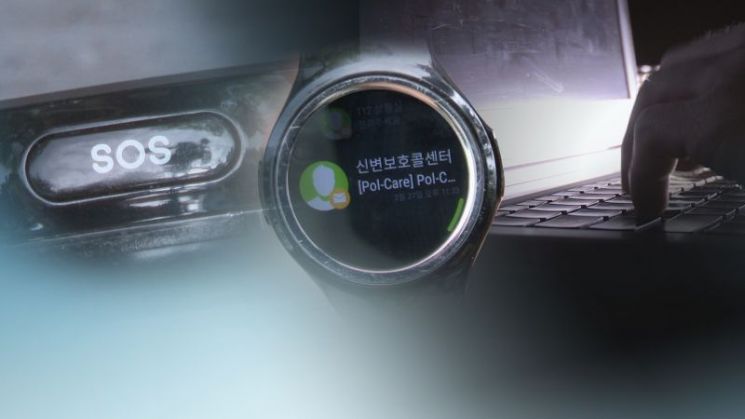
There is also criticism that the ‘provisional measure’ period, during which perpetrators can be detained in a detention center or jail, is too short.
Article 9 of the Stalking Punishment Act limits the provisional measure period for prohibiting electronic communication contact to two months, and the detention period in a detention center or jail to one month.
In the case of provisional measures prohibiting electronic communication contact, the period can be extended twice for two months each time, allowing a maximum of six months. The report pointed out that even this extension requires further renewal.
Kim Hak-shin, the researcher who wrote the report, argued, “If a stalking perpetrator intentionally or deliberately violates emergency response measures, it is necessary to conduct an in-depth review to impose criminal penalties such as imprisonment instead of fines.”
According to the National Police Agency, the number of stalking reports in June last year was 14,272, about four times higher than the 3,482 cases reported in the same month the previous year before the law was enacted.
From October of the year before last, when the law was enacted, to July this year, the violation rate of emergency response measures was 11.0% (662 violations out of 6,030 cases). During the same period, the violation rate of provisional measures was 8.0% (955 violations out of 12,008 cases).
Recently, there have been numerous court rulings related to stalking crimes. On the 24th, a correctional officer in Tongyeong, Gyeongnam, who repeatedly called a woman living in the house in front of his own using a public phone and followed her by car, was sentenced to eight months in prison with a two-year probation.
On the 21st, a man in his 60s who sent hundreds of messages stalking his ex-wife despite a restraining order was sentenced to imprisonment.
As related crimes have increased, in November, the Sentencing Commission (Yanghyeongwi), an independent body under the Supreme Court that sets sentencing guidelines for various crimes, reviewed a proposal to broaden the recommended sentencing range for stalking crimes. The commission decided to expand the recommended sentencing range up to the statutory maximum for both stalking crimes involving weapons and general stalking crimes in the ‘special adjustment aggravation area.’
© The Asia Business Daily(www.asiae.co.kr). All rights reserved.
![Clutching a Stolen Dior Bag, Saying "I Hate Being Poor but Real"... The Grotesque Con of a "Human Knockoff" [Slate]](https://cwcontent.asiae.co.kr/asiaresize/183/2026021902243444107_1771435474.jpg)
















