Repercussions of the Failure to Abolish the Actual Residence Obligation
#. "Right now, there are neither people putting properties on the market nor buyers. Since the abolition of the occupancy requirement has not been finalized, if a transaction occurs prematurely, there is a risk of losing the pre-sale rights." (A real estate agency in Dunchon-dong, Gangdong-gu, Seoul)
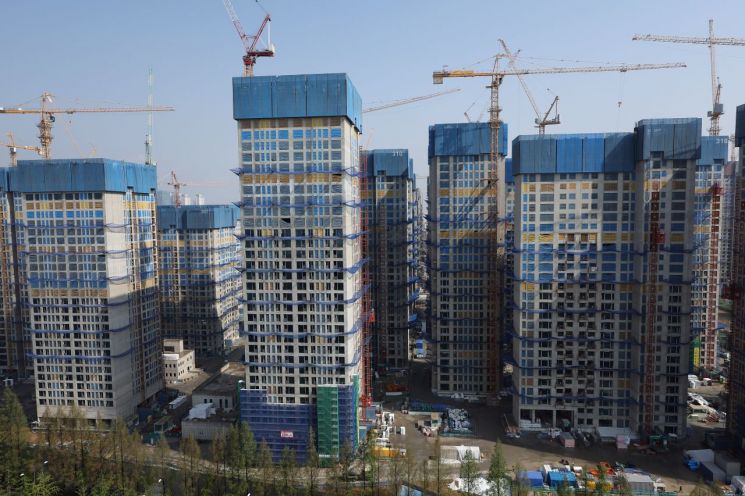 Seoul Gangdong-gu Olympic Park Foreon (Dunchon Jugong Apartment Reconstruction) site view. / Photo by Yonhap News
The market is experiencing significant repercussions as the 'Housing Act Amendment Bill,' which aims to abolish the occupancy requirement for housing subject to the pre-sale price ceiling system, has once again failed to pass the subcommittee of the National Assembly's Land, Infrastructure and Transport Committee.
On the afternoon of the 21st, the Land, Infrastructure and Transport Committee held a subcommittee meeting to discuss the Housing Act Amendment Bill but could not reach a conclusion. Until just before the subcommittee meeting, it was expected that a bipartisan agreement would be reached centered on the bill proposed by Kim Jeong-jae, a member of the People Power Party, which requires occupants to fulfill the occupancy obligation until the property is disposed of. President Yoon Suk-yeol also presided over a Cabinet meeting on the 19th and urged, "Please expedite discussions so that the amendment can be processed during this extraordinary session of the National Assembly." However, differences between ruling and opposition party members remained unresolved in the subcommittee.
The occupancy requirement mandates that residents of housing subject to the pre-sale price ceiling system must live in the property themselves for 2 to 5 years from the earliest possible move-in date. Introduced in 2021 to block speculative demand and promote housing supply focused on actual demand, violators who do not live in the purchased home but rent it out or sell it before paying the balance may face up to one year in prison or a fine of up to 10 million KRW.
Criticism has been raised that this rule hinders buyers from choosing residences that suit their circumstances or forces them to rent out the property due to difficulty in raising the balance payment. Moreover, when the housing market cooled in the second half of last year, the government introduced market revitalization measures in January this year, focusing on easing resale restrictions and abolishing the occupancy requirement. Among these, the abolition of the occupancy requirement is a matter of amending the Housing Act, and an amendment bill was proposed in February. However, concerns from the opposition party that abolishing the occupancy requirement could encourage gap investments have left the bill pending in the National Assembly.
According to the Ministry of Land, Infrastructure and Transport, a total of 66 apartment complexes comprising 43,786 households are subject to the occupancy requirement. Among them, 'Olympic Park Foreon,' a reconstruction of the Dunchon Jugong Apartments in Gangdong-gu, Seoul, is directly affected by the occupancy requirement regulation as its resale restriction was lifted on the 15th of this month, ahead of its scheduled move-in in January 2025. A representative from a nearby real estate agency, B, said, "We frequently receive inquiries about purchases involving jeonse (long-term lease) or transaction situations, but we tell them to wait until the abolition of the occupancy requirement is confirmed," adding, "There are no transactions right now, so real estate agencies are indeed struggling. However, we believe it will eventually be abolished."
Buyers who tried to pay the balance using jeonse deposits or who face loan restrictions are growing increasingly anxious. On the 12th, a public petition urging the prompt abolition of the occupancy requirement was posted. The petitioner stated, "I trusted the government's promise to abolish the occupancy requirement and applied for subscription with the intention to live there, but since the promise was not fulfilled, I am about to lose even the down payment and interim payments," and added, "The government should promptly implement the promised legal amendment to prevent actual residents from suffering while trying to catch speculators."
The Land, Infrastructure and Transport Committee plans to hold one more subcommittee meeting within the year to review the amendment bill. However, with the general election scheduled for April next year, there is speculation that responsibility issues may arise, making it difficult to reach a conclusion easily.
Ham Young-jin, head of the Zigbang Big Data Lab, said, "It is contradictory to allow resale but still require occupancy," and added, "Since this is a matter promised by the government and real estate prices have recently been adjusting, it is necessary to proactively consider abolishing the occupancy requirement." The government eased resale restrictions on apartment pre-sale rights through the 'Housing Act Enforcement Decree Amendment' in April.
© The Asia Business Daily(www.asiae.co.kr). All rights reserved.
![Clutching a Stolen Dior Bag, Saying "I Hate Being Poor but Real"... The Grotesque Con of a "Human Knockoff" [Slate]](https://cwcontent.asiae.co.kr/asiaresize/183/2026021902243444107_1771435474.jpg)















