Bond ETFs Attract Total Net Assets Surpassing 120 Trillion Won
140 New Listings This Year Alone Push Number of Issues Beyond 800
The exchange-traded fund (ETF) market has significantly expanded this year. With high interest rates persisting, bond-type ETFs have aggressively attracted funds, pushing the total net asset value beyond 120 trillion won and the number of listed ETFs over 800. The main constituent stocks of ETFs have also diversified.
ETF Grows into a 120 Trillion Won Market
According to the Korea Exchange on the 18th, as of last month, there were 803 listed ETFs. The total net asset value reached 121.4286 trillion won. ETFs are funds designed to achieve returns that track various representative market indices. These products are listed on the exchange and can be freely bought and sold like regular stocks.
The domestic ETF market is growing rapidly. Starting on October 14, 2002, with 4 ETFs and a total net asset value of 355.2 billion won, the market surpassed 10 trillion won in net assets in November 2011 and exceeded 50 trillion won in December 2019. Last year, there were 666 ETFs with a total net asset value of 78.5116 trillion won. This year, the growth has been even steeper. In just over a year, the number of ETFs increased by about 140, and the total net asset value rose by 50 trillion won.
As of last month, Samsung Asset Management had the most ETFs with 179, followed closely by Mirae Asset Global Investments with 178. Next were KB Asset Management (114), Korea Investment Management (77), and Hanwha Asset Management (64). In terms of total net asset value, Samsung Asset Management led with 49.6765 trillion won, followed by Mirae Asset Global Investments with 45.5478 trillion won.
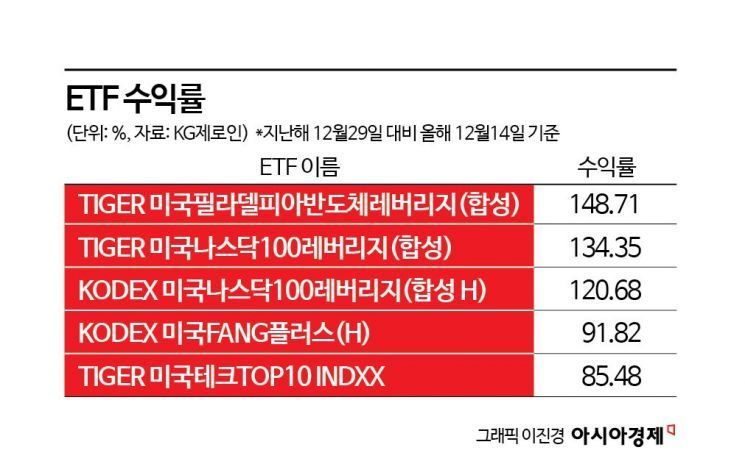
Regarding returns, Mirae Asset Global Investments' 'TIGER Philadelphia Semiconductor Leverage' ETF posted the highest return. According to the fund rating agency KG Zeroin, as of the closing price on the 14th, the return of TIGER Philadelphia Semiconductor Leverage was 148.71% compared to the end of last year. This product tracks twice the daily return of the Philadelphia Semiconductor Index and includes companies such as Nvidia, Quantum, and AMD. Following this, Mirae Asset Global Investments' 'TIGER US Nasdaq 100 Leverage,' which tracks twice the daily return of the Nasdaq 100 Index, recorded a 134.35% return, and Samsung Asset Management's 'KODEX US Nasdaq 100 Leverage' posted a 120.68% return.
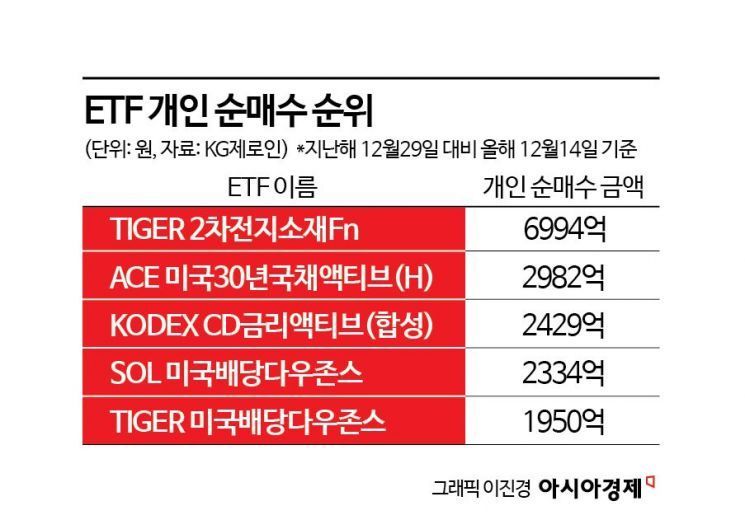
The ETF most favored by individual investors was Mirae Asset Global Investments' 'TIGER Secondary Battery Materials Fn.' Since its listing on July 13, it has seen net purchases of 699.4 billion won. Following this were Korea Investment Management's 'ACE US 30-Year Treasury Active,' launched in March and June, and Samsung Asset Management's 'KODEX CD Interest Rate Active,' with net purchases of 298.2 billion won and 242.9 billion won respectively.
The Growth Driver of ETFs is Bonds
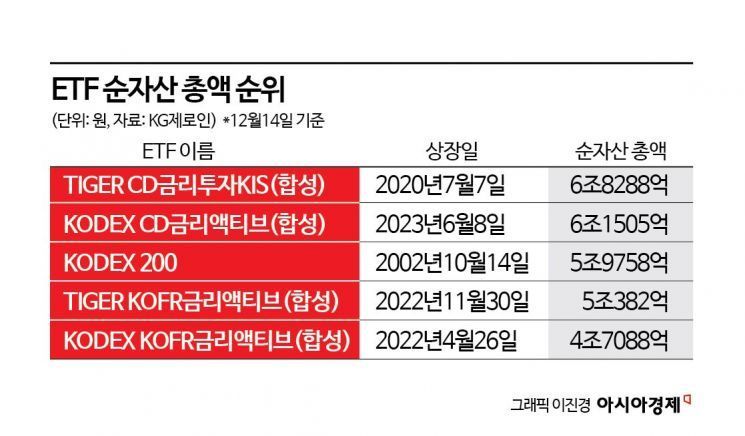
In terms of total net asset value, bond-type ETFs have grown rapidly. Funds have poured into Samsung Asset Management's 'KODEX CD Interest Rate Active.' Despite being listed on June 8 this year, its net assets reached 6.1505 trillion won. This ETF calculates the CD 91-day interest rate level on a daily basis and compounds it daily. Even investing for just one day yields a return equivalent to the one-day CD 91-day interest rate.
Mirae Asset Global Investments' 'TIGER KOFR Interest Rate Active,' listed on November 30 last year, also saw its net assets increase from 352 billion won at the end of last year to 5.0382 trillion won. During the same period, 'TIGER CD Interest Rate Investment KIS' grew from 3.4407 trillion won to 6.8288 trillion won. Over 3 trillion won in funds flowed in.
Experts believe the growth of bond-type ETFs is a result of institutional demand aligning with the ongoing high interest rate environment. A representative from an asset management company explained, "While bond investments typically require tens of billions of won, ETFs allow institutions to buy and sell at any time with smaller amounts, providing flexibility in fund management. Additionally, with bond interest rates rising due to high interest rates, demand has increased. For institutions needing stable fund management, bond-type ETFs are the most optimized option."
Lee Su-jin, head of the ETF product team at KB Asset Management, said, "About 70% of this year's ETF market growth centered on bond-type ETFs, driven by expectations of capital gains from bond price increases due to potential shifts in the Federal Reserve's monetary policy throughout the year. The expansion of long-term economic uncertainty has focused investment needs on relatively stable income assets such as dividend stocks, covered calls, and interest rate products."
Various bond-type ETFs have emerged in response to high interest rates. The 'maturity matching' type is representative. KB Asset Management first launched this product in November last year. It liquidates upon maturity. Investors holding maturity matching bond ETFs until maturity can earn the maturity yield corresponding to the purchase price regardless of market interest rate fluctuations. In October, Kiwoom Asset Management introduced the first domestic maturity matching ETF investing in U.S. bonds.
Korea Investment Management will list 'ACE November Maturity Auto-Renewal Corporate Bond AA-Active,' a first-of-its-kind product domestically. At launch, it mainly includes bonds with a specific maturity month in its portfolio and replaces maturing assets with bonds maturing the following year as the maturity date approaches.
Additionally, ETFs reflecting recent trends have been launched in large numbers. Stocks related to artificial intelligence (AI) and secondary batteries have been strong performers. Asset management companies have rushed to list ETFs that meet investors' needs. Hyundai Asset Management introduced the country's first active ETF investing in small and mid-cap generative AI stocks, 'Hyundai UNICORN Generative AI Small Giants Active ETF.' This ETF invests in companies building the generative AI ecosystem with promising future growth potential. NH-Amundi Asset Management launched 'HANARO US AgTech ETF,' the first domestic product investing in U.S. agricultural advanced technology companies. Timefolio Asset Management also introduced 'TIMEFOLIO Global AI Artificial Intelligence Active ETF,' the first domestic active ETF focusing on the global AI industry in the U.S., Korea, and China.
Lee Su-jin explained, "The Inflation Reduction Act (IRA) of major countries, aimed at combating inflation, has generated growth themes such as secondary batteries. Since the emergence of ChatGPT earlier this year, AI and intensified national technology security competition have elevated semiconductors as a long-term growth theme."
© The Asia Business Daily(www.asiae.co.kr). All rights reserved.
![Clutching a Stolen Dior Bag, Saying "I Hate Being Poor but Real"... The Grotesque Con of a "Human Knockoff" [Slate]](https://cwcontent.asiae.co.kr/asiaresize/183/2026021902243444107_1771435474.jpg)

















