The Convenience Store Map Changed by High Inflation
Office Workers Turn to Convenience Store Meals as Dining Out Costs Rise
College Students and Job Seekers Choose 'Ramen' Over Lunchboxes and Cafeterias
Alcohol Consumption Varies by Neighborhood: 'Soju and Beer' vs. 'Whiskey and Wine'
As dining-out prices rise, 'recession-type consumption' continues, leading more consumers to visit convenience stores. People are trying to save every penny, and this trend is more pronounced in certain neighborhoods. In areas densely packed with office districts and lined with villas and one-room apartments, consumers preferred lunch boxes and rice balls, while areas around universities saw higher demand for cup noodles. In these areas, sales of soju and beer were also high. Instead of gathering with friends outside to share a drink amid rising meal costs, people chose to pour a drink alone at home to wash away the day's fatigue. Conversely, regions with higher income levels showed higher purchase rates of whiskey and wine priced in the tens of thousands of won.
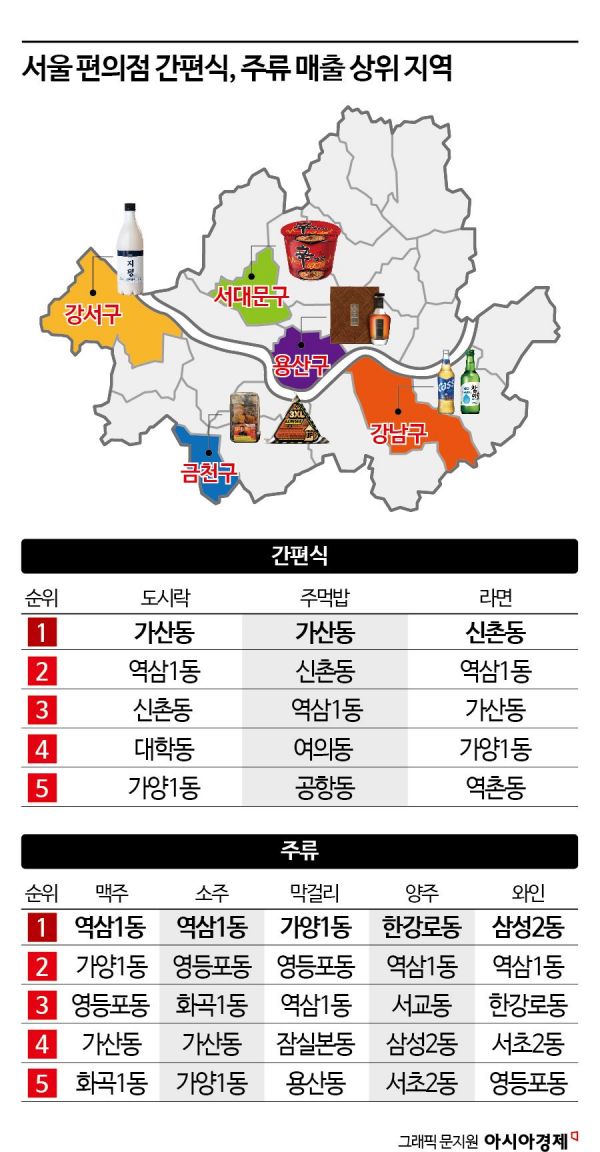
On the 18th, Asia Economy commissioned CU to analyze sales data from over 2,770 convenience stores in Seoul from January to November this year, comparing by region. The results showed that areas with high sales of lunch boxes, rice balls, and ramen were mainly those densely populated by office workers. Especially in neighborhoods where many young single-person households or job seekers live, sales of ready-to-eat meals, soju, and beer were significantly higher.
The area with the highest sales of rice balls and lunch boxes was Gasan-dong, Geumcheon-gu, recording a sales growth rate of 38% and 39% respectively compared to the same period last year. Ramen sales also increased by 30%, ranking third.
Gasan-dong is home to the Seoul Digital Industrial Complex, where IT companies are located, along with many fashion companies. Due to the concentration of companies, the surrounding area consists of one-room apartments and villas, resulting in a high proportion of single-person households. The peak time for convenience food sales in Gasan-dong is from 6 PM to 9 PM. Soju and beer sales were also highest during this time. Most residents are in their 20s and 30s who have not long been in the workforce. After work, it seems more common to buy a convenience store lunch box and a bottle of soju to take home rather than eating a bowl of gukbap (soup with rice) costing over 10,000 won.
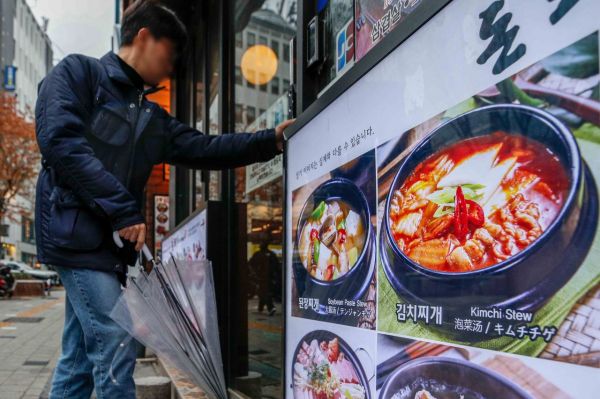 Among the eight representative dining-out items in Korea, the prices of gimbap and kimchi jjigae rose again last month. According to the Korea Consumer Agency's comprehensive price information portal, Chamgagaek, the price of gimbap in Seoul increased from 3,254 won in October to 3,292 won in November, while the price of kimchi jjigae set meal rose from 7,846 won to 7,923 won during the same period. The photo shows a menu installed on the exterior wall of a restaurant on Myeongdong Street in Jung-gu, Seoul. Photo by Kang Jin-hyung aymsdream@
A CU representative explained, "Even during lunchtime, due to lunchflation (a portmanteau of lunch and inflation), convenience store lunch boxes and rice balls, which offer a quick meal, sold well. Especially in Gasan-dong, where many IT companies are concentrated, most employees are young people in their 20s and 30s," adding.
Gangnam-gu Yeoksam 1(il)-dong, which has a large office district, and Gangseo-gu Gayang 1(il)-dong near the Magok Industrial Complex also ranked high. Gayang 1(il)-dong saw an increase in residents due to development such as the industrial complex between Gayang-dong and Magok-dong, leading to more people seeking convenience foods. Yeouido-dong, Yeongdeungpo-gu, ranked fourth in rice ball sales. It is analyzed that people preferred rice balls, which can be quickly heated and eaten, rather than squeezing time to eat lunch boxes or ramen during busy hours.
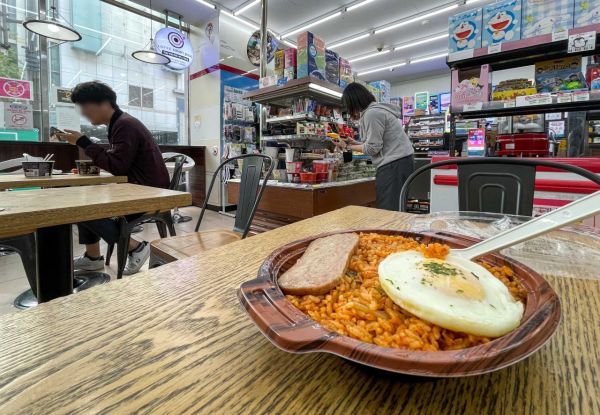 Although the recent consumer price inflation rate remains in the 3% range, the perceived inflation rate is much higher, increasing the burden on ordinary citizens. Amid this, people visiting a convenience store in Seoul during lunchtime are eating lunch boxes and ready-to-eat meals. Photo by Jang Jin-hyeong aymsdream@
The situation was even more severe for college students and job seekers with tight budgets. As university cafeteria meal prices rose from around 4,000-5,000 won to 7,000-9,000 won, more students turned to convenience stores. The most popular item among them was ramen. Sinchon-dong, Seodaemun-gu, adjacent to Yonsei University, Sogang University, and Ewha Womans University, had the highest ramen sales this year. Rice balls ranked second overall. Although lunch boxes ranked third in sales, their higher price (4,000-6,000 won) likely made frequent purchases difficult compared to other convenience foods.
The area with the highest sales of soju and beer among alcoholic beverages was Yeoksam 1(il)-dong, Gangnam-gu. Yeoksam 1(il)-dong is a representative bustling area with large offices and commercial districts along Teheran-ro and Gangnam-daero. It is one of the regions with a high proportion of single-person households mainly occupied by office workers. With a floating population of 160,000, it is one of the busiest areas in Seoul. Following the COVID-19 pandemic, the 'home drinking' trend has spread, and Yeoksam 1(il)-dong has seen high consumption of other alcoholic beverages such as whiskey and Makgeolli over the past two years. However, this year, consumption concentrated notably on soju and beer.
Whiskey and wine, classified as high-priced products, ranked first in Hangangno-dong, Yongsan-gu, and Samseong 2(i)-dong, Gangnam-gu. Recently, convenience stores have been increasing their share of not only daily wines but also high-end wines, and high sales in these two areas with higher income levels are believed to reflect this trend. Notably, Seogyo-dong was the only area to rank within the top five exclusively in the whiskey category. Seogyo-dong is a commercial district concentrated with residential areas, university neighborhoods, and entertainment districts, and this is analyzed as reflecting the rising trend of whiskey as a new alcoholic beverage among people in their 20s and 30s.
Professor Lee Eun-hee of Inha University's Department of Consumer Studies said, "With high inflation continuing this year, demand for inexpensive and quick meals increased mainly in areas with developed office districts and concentrated single-person households such as office workers and university students. Convenience stores adjust product orders according to the characteristics of nearby commercial districts, so this trend has become more pronounced in specific regions," she predicted.
Reporters Lee Min-ji and Lee Seo-hee
© The Asia Business Daily(www.asiae.co.kr). All rights reserved.
![Clutching a Stolen Dior Bag, Saying "I Hate Being Poor but Real"... The Grotesque Con of a "Human Knockoff" [Slate]](https://cwcontent.asiae.co.kr/asiaresize/183/2026021902243444107_1771435474.jpg)

















