"Empowering Women: A Powerful Means to Promote Economic Growth"
"South Korea remains the country with the largest gender gap among advanced nations. If South Korea reduces the gender gap in working hours to the average level of peer countries through appropriate policies, its per capita national income could increase by 18%."
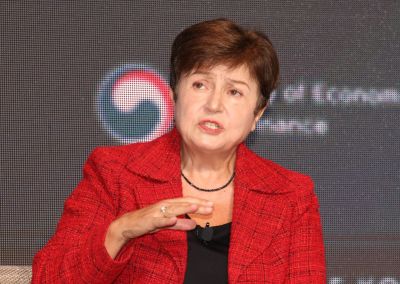
Kristalina Georgieva, Managing Director of the International Monetary Fund (IMF), stated this during her keynote speech on "The Global Economy and Women's Empowerment" at a special forum hosted by the Korea chapter of the International Women's Directors Association, held on the afternoon of the 14th at the International Conference Hall on the 3rd floor of the Government Complex Annex.
Georgieva pointed out, "Despite global progress, the gender gap has not narrowed," and added, "South Korea has made significant strides recently in increasing women's economic participation, but the gender gap remains large. The number of working women in South Korea is 18% less than men, and their wages are 31% lower than those of men."
She emphasized, "At a time when global growth is expected to be the lowest in decades over the next few years, empowering women economically is one of the most powerful means to stimulate economic growth. Increasing the female labor force can help alleviate the stagnation or decline in the economically active population faced by advanced countries, including South Korea."
According to her, South Korea's gender gap mainly stems from social norms and customs, and the dual structure of the labor market, which creates disparities between workers with job security and others. She stated, "More women need to participate in the labor market through direct support, flexible labor markets, and improvements in customs." IMF research indicates that while the gender gap will narrow if current trends continue, it will never be completely closed.
Practical Measures Needed from Companies and Government
In particular, Georgieva cited golf as one of the fields where Korean women excel. She said, "Among the world's top 100 female golfers, 33 are Korean women, thanks primarily to their efforts," and added, "Just as companies support players and tournaments to nurture golf athletes, practical measures from companies and the government are necessary for women to advance in all fields."
She called for strengthening direct support so that women can balance work and family responsibilities. Policies such as childcare support and parental leave should be expanded to include part-time workers, employees, and self-employed individuals. Additionally, support for re-education programs and career maintenance programs should be increased to help married women returning to the labor market enter high-wage sectors.
Flexible labor markets are also a priority. She emphasized the importance of enabling more workers to use flexible working hours, as in Finland and Sweden, and reducing the costs of hiring and firing employees. She also mentioned the need to provide incentives for men to take parental leave and to shift the pay system from seniority-based to performance-based.
She continued, "Empowering women leads to higher incomes and strengthens company competitiveness," and stated, "According to IMF research, if South Korea reduces the gender gap in working hours to the average level of peer countries through appropriate policies, its per capita national income could increase by 18%."
Georgieva added, "Financial institutions with a higher proportion of women in senior positions and gender-diverse boards tend to have lower non-performing loan ratios and greater financial stability," and said, "When there are more female leaders and gender-balanced decision-making, organizational performance can improve."
© The Asia Business Daily(www.asiae.co.kr). All rights reserved.
![Clutching a Stolen Dior Bag, Saying "I Hate Being Poor but Real"... The Grotesque Con of a "Human Knockoff" [Slate]](https://cwcontent.asiae.co.kr/asiaresize/183/2026021902243444107_1771435474.jpg)















