Re-vote on Labor Union Act and Broadcasting Act... Final Rejection
Democratic Party: "Yoon No Longer Qualified to Talk About Fairness"
Sixth Bill Finally Vetoed and Discarded
President Yoon Suk-yeol exercised his veto power for the third time since taking office on the Yellow Envelope Act (amendment to the Labor Union Act) and the Broadcasting Three Acts (amendments to the Broadcasting Act, the Broadcasting Culture Promotion Act, and the Korea Educational Broadcasting System Act). These bills were put to a revote in the National Assembly plenary session on the 8th but were rejected and ultimately discarded. The Democratic Party of Korea strongly criticized, saying, "President Yoon no longer has the right to speak about fairness and common sense."
In the plenary session held that afternoon, the National Assembly conducted a secret ballot on the Yellow Envelope Act, resulting in 175 votes in favor, 115 against, and 1 abstention out of 291 total votes, leading to its final rejection. The Broadcasting Three Acts were also rejected.
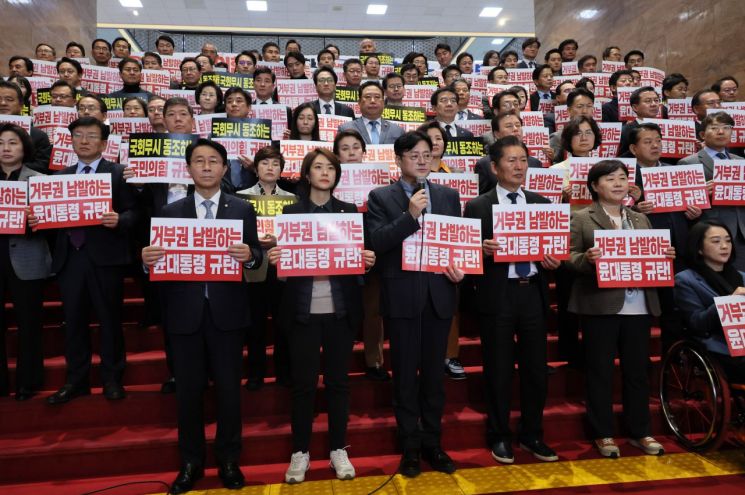 Democratic Party floor leader Hong Ik-pyo and other lawmakers are picketing on the stairs of the National Assembly Rotunda Hall on the 8th, condemning President Yoon Seok-yeol's frequent use of veto power.
 [Image source=Yonhap News]
Immediately after the rejection of these bills, the Democratic Party held a picket protest in front of the rotunda hall outside the plenary chamber, criticizing the government and ruling party. Floor leader Hong Ik-pyo stated, "The Broadcasting Three Acts are laws intended to guarantee freedom of the press and the fairness of public broadcasting," adding, "Ultimately, President Yoon and the ruling party have revealed their intention to seize control of the broadcasting sector." He continued, "The appointment of Kim Hong-il (candidate for the Chairperson of the Korea Communications Commission) is part of that intention," emphasizing, "We will do our best to thoroughly verify and withdraw the appointment during the confirmation process."
Floor spokesperson Lim Oh-kyung also held a press conference at the National Assembly communication office, declaring, "The rejection of the Yellow Envelope Act and the Broadcasting Three Acts is President Yoon's declaration of war against the people," and criticized, "The National Assembly's efforts to protect workers' rights guaranteed by the Constitution and to safeguard the independence of broadcasting have been frustrated by President Yoon's obstinacy and lack of communication." She added, "No power can defeat the people, so the arrogant president and the despicable ruling party will be judged."
The Democratic Party announced plans to reintroduce the Yellow Envelope Act and the Broadcasting Three Acts, following the Grain Management Act and the Nursing Act. Floor spokesperson Lim said, "We will pass these bills again along with the reintroduced Grain Management Act and Nursing Act."
The reintroduced Yellow Envelope Act, which the Democratic Party has announced, aims to recognize parties who are not signatories to labor contracts but who have substantial and concrete control over workers' working conditions?such as prime contractors?as employers, and to limit claims for damages related to labor disputes. It was proposed following a trial involving a subcontractor union strike at Daewoo Shipbuilding & Marine Engineering during the 21st National Assembly, but the People Power Party opposed it, arguing that it could encourage strikes.
Additionally, the Broadcasting Three Acts were designed to improve governance by changing the board structure, board member nomination rights, and president selection methods of public broadcasters such as KBS, MBC, and EBS. Currently, the public broadcasting boards consist of 9 to 11 members, with nominations divided between the ruling and opposition parties. The bills proposed increasing the number to 21 members, with the additional seats nominated by the National Assembly, viewer committees, related academic societies, and the Broadcasting Journalists Association. The Democratic Party has argued that these measures are to secure the independence of public broadcasting, while the ruling party has opposed them as attempts to seize control of broadcasting.
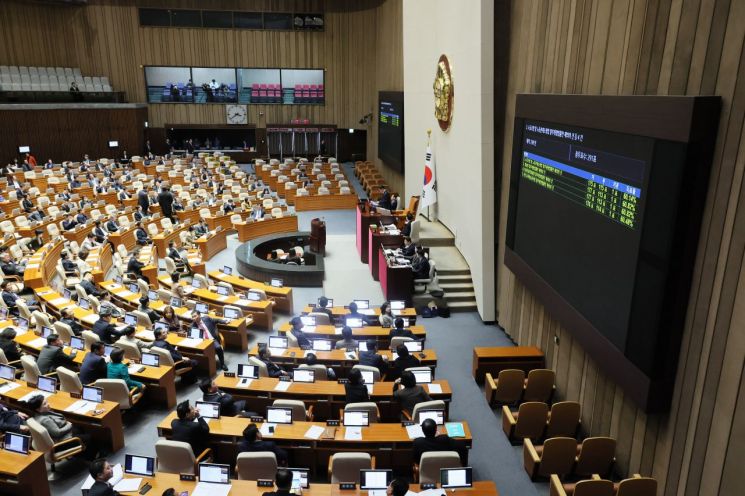 President Yoon Suk-yeol exercised his veto power on the amendments to Articles 2 and 3 of the Labor Union Act (the Yellow Envelope Act) and the amendments to the Broadcasting Act, the Broadcasting Culture Promotion Act, and the Korea Educational Broadcasting System Act (the Broadcasting Three Acts). On the 8th, these were put to a re-vote in the National Assembly plenary session but were rejected. [Image source=Yonhap News]
From the committee review stage, these bills faced opposition between the ruling and opposition parties, preventing consensus. Consequently, the opposition party, which holds an overwhelming majority in the National Assembly, unilaterally processed these bills in the committee and referred them directly to the plenary session, bypassing the Judiciary Committee. On the plenary session on the 9th of last month, the opposition party, holding the majority, forcibly passed these bills, prompting the ruling party to protest by walking out. Subsequently, President Yoon exercised his veto power and sent the bills back to the National Assembly. In the 21st National Assembly, where the opposition holds a majority, a total of six bills?including the Grain Management Act and the Nursing Act?have been discarded due to the president's exercise of veto power.
For bills vetoed by the president, a revote requires the presence of a majority of all members and at least two-thirds approval of those present. Accordingly, before the plenary session convened that day, the Democratic Party displayed banners in front of the plenary hall with phrases such as "Please support the revote on the Labor Union Act and Broadcasting Three Acts," urging ruling party members to pass the bills.
© The Asia Business Daily(www.asiae.co.kr). All rights reserved.
![Clutching a Stolen Dior Bag, Saying "I Hate Being Poor but Real"... The Grotesque Con of a "Human Knockoff" [Slate]](https://cwcontent.asiae.co.kr/asiaresize/183/2026021902243444107_1771435474.jpg)
















