Starting from July next year, a feature will be added to car navigation applications to notify users when entering areas under flood warnings. The flood control budget for next year will be doubled compared to this year, and flood defense infrastructure such as new dams will be significantly expanded.
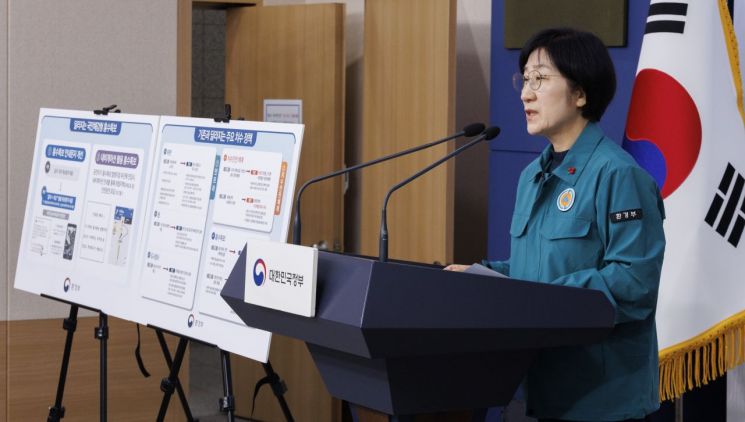
On the 7th, the Ministry of Environment announced the "Flood Control Paradigm Shift Measures" at the 32nd National Policy Issues Ministerial Meeting chaired by Prime Minister Han Duck-soo. The measures mainly include △expansion of flood defense infrastructure △establishment of a flood safety system considering future climate △securing golden time to prevent casualties △strengthening implementation foundations to ensure flood safety.
First, the Ministry of Environment will add a function to flood warning text messages that allows individuals to check whether they are in a flood-prone area. The plan is to notify drivers through navigation systems if they enter a flood warning area to guide evacuation. This means that if a driver unknowingly enters near a warning issuance point, they will be immediately alerted. From May next year, the number of flood warning issuance points will be increased from the current 75 to 223 using artificial intelligence (AI).
To strengthen maintenance of tributaries and streams, local rivers with large watershed areas or those causing significant damage during floods will be gradually upgraded to "national rivers." Through this, the length of national river sections will increase from the current 3,602 km to 4,300 km by 2027. Starting next year, plans will begin for the basic design of 10 dams to construct new dams in necessary areas and redevelop existing dams.
Efforts will also be made to build infrastructure to respond to urban flooding. By 2028, deep underground rainwater tunnels will be installed in the Seoul Gwanghwamun and Gangnam Station areas, and an underground waterproof channel connecting Dorimcheon Stream and the Han River will be constructed. The deep underground rainwater tunnel is a large tunnel built 40 to 50 meters underground to store rainwater during heavy rainfall and release it into rivers.
Inspection personnel for flood-vulnerable areas will also be strengthened. On-site inspections of flood-vulnerable areas, previously mainly conducted by river management agencies, will be handled by specialized organizations such as the River Association and Korea Water Resources Corporation. Flood-vulnerable areas will be jointly inspected during the flood season 'before (February to March), during (August), and after (October to November)' by specialized organizations including the River Association and Korea Water Resources Corporation. The Ministry of Environment plans to prepare "Guidelines for Establishing Emergency Response Plans for Flood Season" by February next year, and each river management agency will prepare annual response plans for flood occurrences based on these guidelines.
Minister of Environment Han Hwa-jin said, "No policy for public safety is ever excessive," adding, "We will promptly implement projects for the safety of residents in flood-vulnerable areas such as river maintenance and dam construction, and from next flood season, improve flood warnings to a level that the public can easily and quickly understand, doing our best to minimize casualties."
© The Asia Business Daily(www.asiae.co.kr). All rights reserved.
![Clutching a Stolen Dior Bag, Saying "I Hate Being Poor but Real"... The Grotesque Con of a "Human Knockoff" [Slate]](https://cwcontent.asiae.co.kr/asiaresize/183/2026021902243444107_1771435474.jpg)
















