Tabelog Fully Supports Korean, Chinese, and English Services
Solving Labor Shortage Amid Yen Weakness Special Demand and Increasing Revenue Through Fees
Starting January next year, Korean travelers to Japan will be able to easily make reservations and visit popular restaurants through local websites. Due to the severe labor shortage in Japan, it is difficult to respond individually to foreign tourists, so the aim is to support this by providing Korean language services. This appears to be a strategy to capitalize on the increasing number of visitors to Japan due to the weak yen as a new demand.
On the 6th, Nihon Keizai Shimbun (Nikkei) reported that the famous Japanese restaurant reservation and recommendation site "Tabelog" will fully launch Korean, Chinese, and English services starting January next year. When accessing the site, users will be able to select and switch languages.
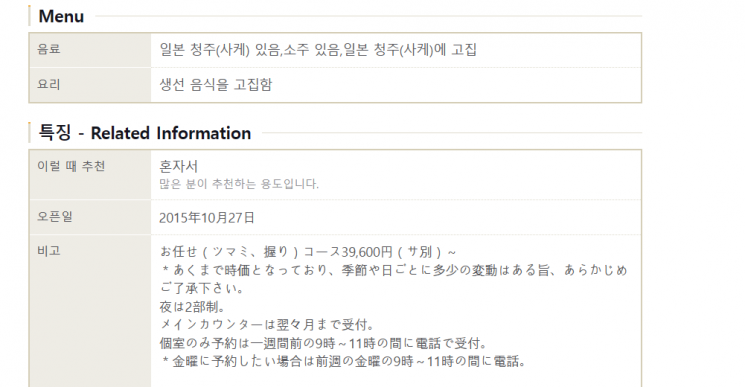 The Korean page of Tabelog before the renewal. The translation is not accurate, making it difficult to understand the content easily, and reservations are also not possible. (Photo by Tabelog)
This full foreign language support is a first for Tabelog. Although Tabelog was widely known among tourists, the currently supported Korean page was merely provided using Google Translate, making smooth usage difficult. Reservations through the homepage were also impossible, so Korean tourists visiting Japan who do not speak Japanese were practically unable to use the service.
However, from January next year, users will be able to use the site in natural Korean. By registering a credit card, it will be possible to make restaurant reservations through the homepage.
This strategy aims to increase related commission income by supporting tourist response services. If a reservation is made but the customer does not visit, a cancellation fee will be charged to the registered credit card. In fact, tourists have a high rate of not showing up after making reservations at popular restaurants. According to the restaurant reservation site TableCheck, the cancellation rate of visitors to Japan last month was 22%, which is 7 percentage points higher than that of domestic customers. Therefore, the plan is to provide convenient services to tourists, collect cancellation fees through Tabelog, and naturally enjoy promotional effects that increase affiliated stores.
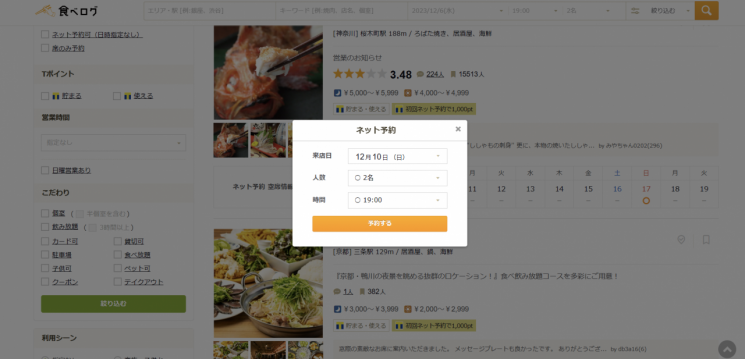 Tabelog page in Japan. Reservations can be made freely within the homepage. From January next year, this service will also be available in Korean. (Photo by Tabelog)
There is also hope that this will help solve Japan’s chronic labor shortage problem. Until now, there was no staff available to respond when foreign tourists visited stores. According to a survey by the research firm Teikoku Databank on the shortage of part-time and other non-regular workers, 82.0% of restaurants in Japan responded that they are short-staffed. This was the highest among the 51 industries surveyed.
Accordingly, not only Tabelog but also other restaurant recommendation sites are actively participating in supporting foreign language services. Recruit’s restaurant reservation site launched a service in July where tourists can scan a QR code at their seat with a smartphone to receive menus translated into English and Chinese, and order by clicking on the menu. An izakaya in Sapporo using this self-order system significantly reduced ordering time, and thanks to the advantage that it is easy for foreigners to visit, the proportion of foreign customers increased to about 30% of the total.
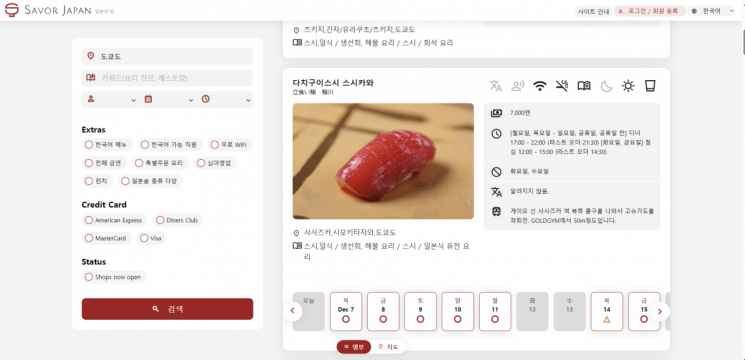
Another reservation site, Saver Japan, is also implementing a service that allows users to check restaurant availability and make reservations in English, Chinese, and Korean. Thanks to this, the number of reservations made through Saver Japan has increased by 1.5 times compared to December 2019, during the COVID-19 pandemic.
Nikkei expects that the number of visitors to Japan will continue to increase for the time being due to the weak yen, and restaurants that keep pace with this trend will be able to earn significant profits. Nikkei stated, “Increasing the capacity to accommodate visitors to Japan will soon lead to increased sales,” and added, “Measures such as improving site awareness so that tourists know and can use the services must also be supported.”
© The Asia Business Daily(www.asiae.co.kr). All rights reserved.
![Clutching a Stolen Dior Bag, Saying "I Hate Being Poor but Real"... The Grotesque Con of a "Human Knockoff" [Slate]](https://cwcontent.asiae.co.kr/asiaresize/183/2026021902243444107_1771435474.jpg)

















