The three major indices of the U.S. New York stock market are all showing a downward trend in the early trading hours on Monday, the 4th (local time). Following the November rally, the market has entered the full-fledged December trading week and appears to be taking a kind of 'breather' ahead of this week's employment report release. While some on Wall Street point out that market expectations for interest rate cuts are excessive, sector-wise, declines are confirmed mainly in technology stocks sensitive to interest rates.
At around 10:15 a.m. at the New York Stock Exchange (NYSE), the Dow Jones Industrial Average was down 0.31% from the previous close, trading near 36,133. The large-cap-focused S&P 500 index fell 0.71% to 4,561, and the tech-heavy Nasdaq index dropped 1.12% to 14,144.
Currently, technology and telecommunications stocks in the S&P 500 are down more than 1.5%. Microsoft, Google Alphabet, and Nvidia all fell by over 2%. Apple and Amazon also declined by more than 1% each. Due to Bitcoin's strength, Coinbase and MicroStrategy rose more than 8% each. Uber jumped over 5% to hit a 52-week high following news of its inclusion in the S&P 500. Spotify rose nearly 9% on news of laying off 17% of its staff. Conversely, Alaska Airlines plunged more than 17% after announcing the acquisition of competitor Hawaiian Airlines for $1.9 billion.
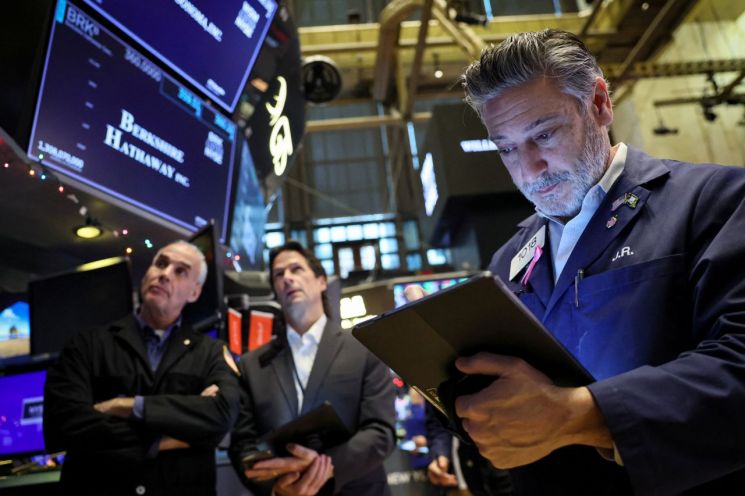
As the market enters the full December trading week, it is showing cautious trading while closely watching key variables that will affect the Federal Reserve's (Fed) monetary policy and the year-end Santa rally. In November, the three major New York stock indices rose between 8% and 10%. The Dow rose 8.77% over the month, marking its largest monthly gain since October last year. The S&P 500 and Nasdaq also surged 8.9% and 10.7%, respectively, posting their best performances since July last year.
This upward momentum was positively influenced by last week's slowdown in the core Personal Consumption Expenditures (PCE) inflation indicator favored by the Fed, which highlighted expectations for interest rate cuts. On Friday, Fed Chair Jerome Powell drew a line against market hopes for a pivot by stating that "it is premature to predict the timing of rate cuts," but this was also interpreted as dovish. It was seen as a fundamental remark expressing concern about a possible resurgence of inflation.
This week, various employment data releases are scheduled, including the October Job Openings and Labor Turnover Survey (JOLTs) report on the 5th, the November ADP employment report on the 6th, the November Challenger job cuts report on the 7th, and the November nonfarm payroll report on the 8th. If signs of easing are reconfirmed in the labor market following inflation, expectations for a December rate hold and rate cuts next year are likely to strengthen. Wall Street estimates that November nonfarm employment will increase by 190,000.
Additionally, starting midweek, the blackout period begins ahead of the December Federal Open Market Committee (FOMC) meeting, the last rate decision of the year, during which public comments from officials are prohibited. Therefore, no official remarks that could influence the market are expected during the week.
The market currently almost fully prices in a rate hold this month. According to the CME FedWatch tool, federal funds futures reflect a 99.7% probability that the Fed will hold rates steady this month. The probability of maintaining the hold through January next year exceeds 87%. The chances of a rate cut of 0.25 percentage points or more in March or May next year stand at 60% and 87%, respectively.
Renowned economist Jeremy Siegel appeared on CNBC's Squawk Box this morning and said that the Fed should acknowledge the possibility of a rate cut at the December meeting. He stated, "Considering the flexibility of the indicators seen over the past four weeks, this (rate cut) should be part of the discussion." He also added that he does not see a recession as inevitable.
As the year-end approaches, while expectations for a Santa rally are growing, caution is also evident. According to the Stock Trader's Almanac, December is typically the third-best month of the year for returns in the Dow and S&P 500 indices. However, Wells Fargo, Vital Knowledge, and others have pointed out that market expectations for rate cuts are excessive, suggesting that the New York stock market could face corrections as the year-end nears. Sam Stovall, Chief Investment Strategist at CFRA Research, conveyed that some traders remain optimistic about the remainder of the year, while others believe the market may have moved too far, too fast.
In the New York bond market, Treasury yields are rising. The benchmark 10-year yield rose to around 4.25%. The 2-year yield, sensitive to monetary policy, increased to about 4.62%. The dollar index, which measures the value of the dollar against six major currencies, is trading above 103.6, up more than 0.3%. Bitcoin, which surpassed the $40,000 mark, jumped nearly 5%, continuing its bullish trend.
European stock markets are mixed. Germany's DAX index showed slight gains, while the UK's FTSE and France's CAC indices traded slightly lower.
© The Asia Business Daily(www.asiae.co.kr). All rights reserved.
![Clutching a Stolen Dior Bag, Saying "I Hate Being Poor but Real"... The Grotesque Con of a "Human Knockoff" [Slate]](https://cwcontent.asiae.co.kr/asiaresize/183/2026021902243444107_1771435474.jpg)















