BOK Report on 'Causes, Impacts, and Measures of Ultra-Low Fertility and Ultra-Aged Society'
"If Korea Fails to Address Low Fertility and Aging, Growth and Distribution Will Face Major Challenges"
68% Probability of Below 0% Growth in the 2050s Without Policy Response
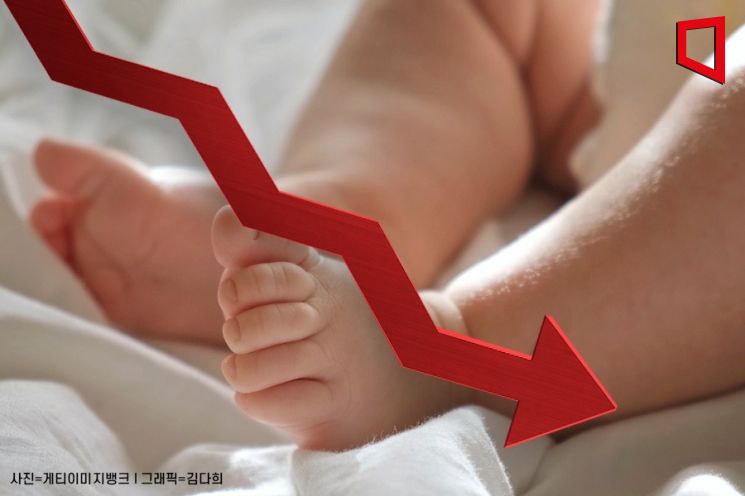
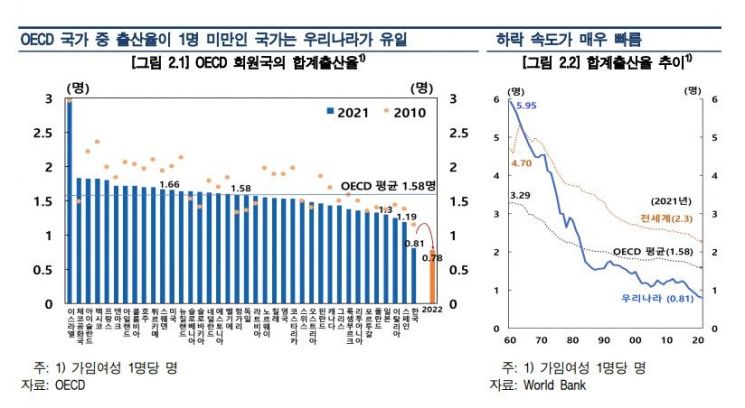
Last year, South Korea's total fertility rate was 0.78, the lowest among OECD countries. An analysis revealed that raising the youth employment rate and the actual duration of parental leave in Korea to the OECD average level could increase the fertility rate to the 1.0 range. If policy efforts such as increasing family-related government spending are made even now, the fertility rate could rise by about 0.2, and South Korea's potential growth rate could increase by an average of 0.1 percentage points in the 2040s.
On the 3rd, the Bank of Korea warned in its report titled "Causes, Impacts, and Measures of Extreme Population Structure in Ultra-Low Fertility and Ultra-Aged Society" that "if low fertility and aging are not properly addressed, significant difficulties are expected in both growth and distribution," and "without effective policy responses, the probability of zero or negative growth in the 2050s reaches 68%."
Total Fertility Rate of 0.7 Next Year... Led by Increasing Singlehood Rate
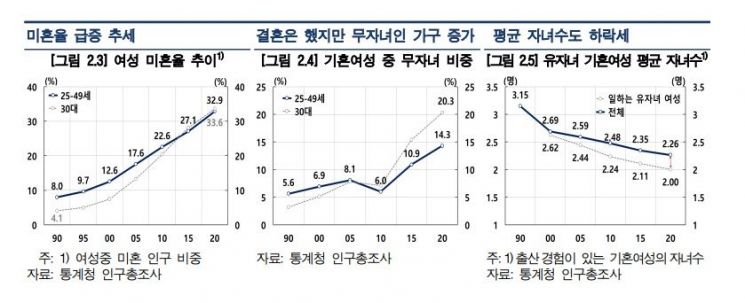
According to Statistics Korea's population projections, the total fertility rate is expected to fall to 0.73 this year and 0.70 next year. South Korea's ultra-low fertility rate is the lowest in the world except for the city-state of Hong Kong, and its duration is so severe that it is hard to find a precedent. This trend is especially driven by the rising singlehood rate. In fact, the singlehood rate among women aged 25-49 was very low at 8.0% in 1990 but increased significantly to 32.9% in 2020. The singlehood rate among women in their 30s was also 33.6% in 2020, meaning one-third of women in their 30s were unmarried.
The aging of the population structure is also progressing at the fastest rate in the world, with low fertility contributing 70% and increased life expectancy 30%. The proportion of the elderly population aged 65 and over was 17.5% of the total population last year, and it is expected to exceed 20% in 2025, entering an ultra-aged society. This is about seven years after entering an aged society in 2018, making South Korea the fastest among OECD countries to enter an ultra-aged society. According to the United Nations (UN) population projections, South Korea's elderly population proportion will surpass Japan's from 2046, becoming the highest among OECD member countries, and by 2062, it will surpass Hong Kong to become the country with the highest elderly population proportion worldwide.
Youth Do Not Have Children Due to High 'Competitive Pressure' and 'Anxiety'
The report analyzed the causes of ultra-low fertility, the fundamental cause of population aging, at various levels and found that ultra-low fertility is related to the high 'competitive pressure' felt by youth and 'anxiety' regarding employment, housing, and childcare. A survey conducted by the Bank of Korea through Gallup targeting 2,000 adults aged 25-39 nationwide showed that the higher the perceived competitive pressure, the fewer children people hope to have. The average desired number of children in the high competitive pressure group was 0.73, which was 0.14 fewer than the 0.87 in the low competitive pressure group. Additionally, an experiment analyzing which economic costs (housing, education, medical expenses) particularly cause low fertility confirmed that the 'burden of housing costs' lowers the intention to marry and have children.
Hwang In-do, head of the Macroeconomic Research Division at the Bank of Korea's Economic Research Institute, explained, "This study is the first to apply a randomized controlled trial methodology among domestic and international literature related to marriage and fertility intentions," and "it confirmed for the first time in Korea with a representative sample (2,000 people) that competitive pressure affects the desired number of children."
One of the main causes of low fertility in South Korea is the low employment rate. The employment rate for those aged 15-29 was 46.6% last year, significantly lower than the OECD average of 54.6%. Considering the typical university graduation and marriage ages, the employment rate for those aged 25-39 in South Korea was 75.3%, 12.1 percentage points lower than the OECD average of 87.4%. The quality of employment has also declined as non-regular jobs have increased. The proportion of non-regular workers among wage earners aged 15-29 rose from 31.8% in 2003 to 41.4% last year, an increase of 9.6 percentage points. When comparing the proportion of temporary workers, which is comparable across countries, South Korea ranked second highest among 34 OECD countries at 27.3%, just behind the Netherlands.
Widening Gap Between Regular and Non-Regular Workers, Intensified Low Fertility Due to Metropolitan Concentration
The gap between regular and non-regular workers continues to widen, closely related to the dual structure of the labor market. The dual labor market refers to the widening gap and blocked labor mobility between the high-quality primary labor market (large companies, regular workers) and the poor secondary labor market (small and medium enterprises, non-regular workers). The average monthly wage of regular workers compared to non-regular workers expanded from 1.5 times in 2004 to 1.9 times in 2023.
Also, the higher the population density and housing prices (jeonse prices), the lower the fertility rate. Looking at the total fertility rate by city and province, Sejong City had a total fertility rate of 1.12 last year, while Seoul, with the lowest rate, was only 0.59, showing a large regional disparity. Hwang emphasized, "We need to alleviate the dual labor market to reduce competition for quality jobs and ease employment insecurity," adding, "Housing prices should be stabilized to reduce housing anxiety, and measures should be prepared to reduce metropolitan concentration and competition pressure by moving away from entrance exam-focused education."
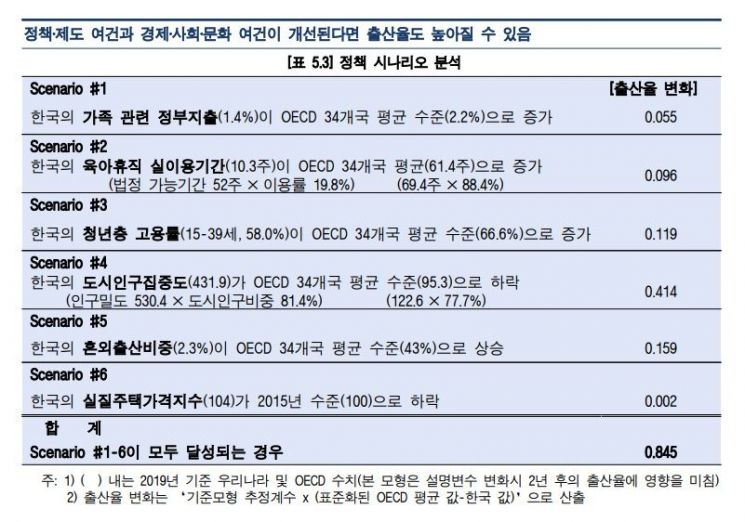
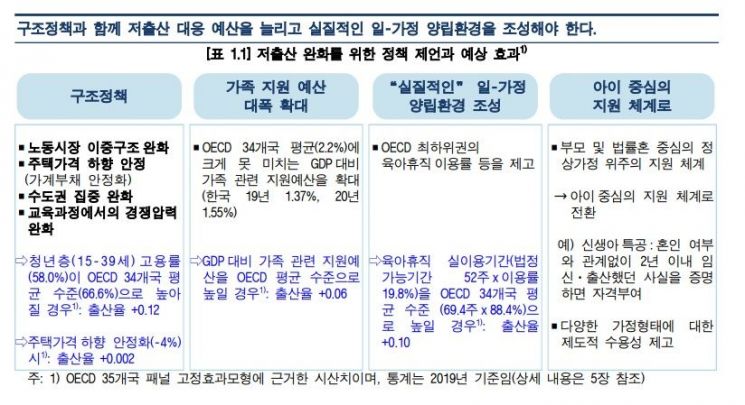
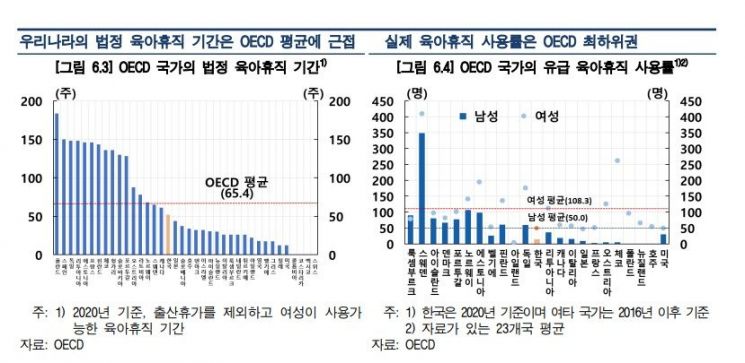
In this report, the Bank of Korea presented a policy scenario analysis suggesting that despite the bleak reality of the world's lowest fertility rate, if policy, institutional, economic, social, and cultural conditions improve, the fertility rate could rise to the 1% range. First, if South Korea's youth employment rate (ages 15-39, 58%) increases to the OECD average of 66.6%, the fertility rate would rise by 0.12. Especially, if the actual duration of parental leave in Korea, currently only 10.3 weeks, increases to the OECD average of 61.4 weeks, the fertility rate would increase by 0.1, allowing the total fertility rate to rebound to the 1.0 range. If family-related government spending, currently only 1.4% of GDP, rises to the OECD average of 2.2%, the fertility rate would increase by 0.06, and if South Korea's real housing price index (104) falls to the 2015 level (100), the fertility rate would increase by an additional 0.002.
South Korea's Actual Parental Leave Duration 10.3 Weeks vs. OECD Average 61.4 Weeks
Although difficult to change in the short term, if South Korea's urban population concentration (431.9) falls to the OECD average level (95.3), and the proportion of out-of-wedlock births (2.3%) rises to the OECD average, the fertility rate would increase by 0.41 and 0.16 respectively. If all six scenarios mentioned above are achieved, the fertility rate could increase by as much as 0.85 from the current level.
Researcher Hwang emphasized, "Although there are policies for work-family balance, the problem of 'practical inability to use them' must be improved," adding, "It is urgent to increase the use of parental leave among men and workers in small and medium enterprises, and workplace culture must also change." According to a survey by the Ministry of Employment and Labor, the top reason for not using parental leave was "workplace atmosphere or culture that does not allow use," accounting for 31.8%.
The report viewed that South Korea, facing rapid low fertility and aging, must prioritize 'adaptation' in the short term. It advised guiding a soft landing for labor force, industrial structure, pensions, and finances, and emphasized the need to alleviate severe elderly poverty. Since more than 80% of elderly assets are in real assets such as real estate, those with substantial assets should be encouraged to improve cash flow through housing pensions, and the working-age population should be enabled to increase earned income through promoting elderly employment and improving employment conditions.
Fertility Rate Increase of 0.2 Raises Potential Growth Rate by 0.1%p in 2040
It is necessary to encourage the elderly to work longer in their main jobs or be re-employed, but since this is difficult under the current seniority-based wage system, it is desirable to promote the introduction of continuous employment linked to wage system reform through social discussion as outlined in the "Basic Plan for Promoting Elderly Employment." It also suggested expanding budget support such as incentives for continuous employment of the elderly. Low-income and low-asset elderly groups should be supported through social safety nets. Selective increases in basic pensions for the bottom 20-30% income groups should be considered to strengthen support for lower-income groups.
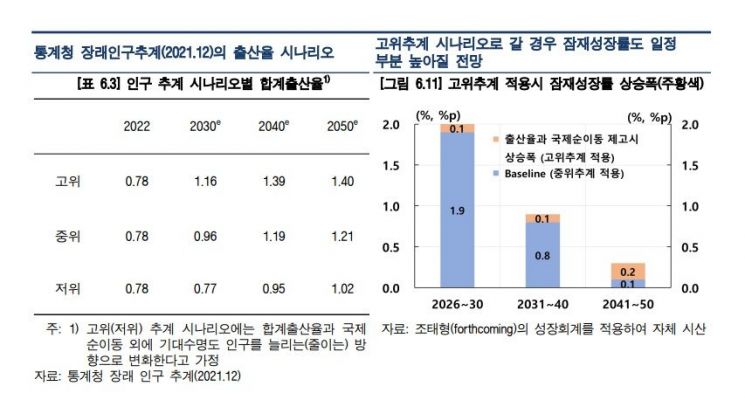
Hwang emphasized, "If effective measures are implemented to improve employment, housing, and childcare conditions, the fertility rate can be increased," and "if the fertility rate is raised by about 0.2 through various policy efforts, South Korea's potential growth rate could increase by an average of 0.1 percentage points in the 2040s."
© The Asia Business Daily(www.asiae.co.kr). All rights reserved.
![Clutching a Stolen Dior Bag, Saying "I Hate Being Poor but Real"... The Grotesque Con of a "Human Knockoff" [Slate]](https://cwcontent.asiae.co.kr/asiaresize/183/2026021902243444107_1771435474.jpg)

















