'Sustainable Media Ecosystem Conference' Held
Paid broadcasting services such as Internet TV (IPTV) are losing competitiveness amid the offensive of global online video services (OTT) including Netflix. There have been calls to reform media legislation to ensure regulatory fairness between paid broadcasting and OTT, and to find growth engines.
The Korea IPTV Broadcasting Association held the "5th Sustainable Media Ecosystem Conference" on the 29th in Jung-gu, Seoul.
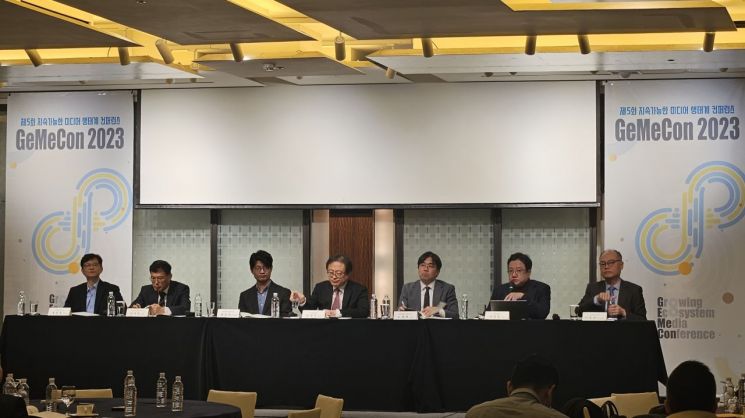 On the 29th, participants of the '5th Sustainable Media Ecosystem Conference' are engaged in discussion.
 [Photo by Oh Su-yeon]
No Chang-hee, director of the Digital Industry Policy Research Institute, suggested that regulatory reforms such as streamlining the licensing system for paid broadcasting are necessary to strengthen the competitiveness of paid broadcasting, which is facing a crisis in competition with OTT. Director No said, "In a situation where the differences in content and services between paid broadcasting and OTT are diminishing, excessively regulating only paid broadcasting could result in paid broadcasting becoming an inferior good," adding, "Consideration of fairness is necessary." He also mentioned that the abolition of the re-licensing system and simplification of M&A procedures should be considered. He further stated, "It is necessary to create a policy environment where paid broadcasting can provide services comparable to OTT," and "Expanding autonomy in channel composition is needed to enhance operational autonomy and viewer choice."
Hwang Yoo-sun, a research fellow at the Korea Information Society Development Institute (KISDI), said that as Netflix expands its influence in the Korean market, operators need to explore survival methods beyond Netflix. Researcher Hwang said, "As the global popularity of K-content continues, Netflix's investment in Korean content will continue, and Netflix's influence in the domestic content market will increase," adding, "For content providers to escape from declining advertising revenue, worsening profitability due to rising production costs, weakened bargaining power due to Netflix's monopolistic position, and hindered growth potential, it is important to secure global distribution channels other than Netflix." She also said, "Since paid broadcasting is experiencing growth slowdown due to market maturity and increasing OTT competition pressure, it is necessary to consider securing platform differentiation, partnerships and collaborations with content providers, securing global distribution channels for original content, and expanding subscriber business through economies of scope."
The comprehensive discussion, moderated by Moon Cheol-soo, professor of Media, Video, Advertising, and Public Relations at Hanshin University, was attended by Lee Sung-yeop, professor at Korea University Graduate School of Technology Management; Lee Jong-kwan, senior specialist at the law firm Sejong; Hong Jong-yoon, BK professor of the Department of Communication at Seoul National University; and Lee Ki-seon, director of the New Media Policy Division at the Ministry of Science and ICT.
Director Lee said, "In the business-to-consumer (B2C) domain, paid broadcasting and OTT compete, but in business-to-business (B2B) transactions, paid broadcasting will compete with free ad-supported streaming TV (FAST)," adding, "In regulatory improvements, the impact of FAST as well as OTT should be considered." He added, "In the long term, paid broadcasting platforms should be considered not as broadcasters but as media distribution businesses."
Professor Hong said, "Although Korean content is popular on Netflix, the problem is that the benefits do not return to the Korean media ecosystem," adding, "We need to ensure that the revenue earned in Korea benefits Korean producers. Measures such as legislating investments in Korean operators can be considered." Regarding paid broadcasting regulations, he said, "Regulations that cannot be applied to Netflix should not be applied to domestic platforms. We need to boldly enhance competitiveness."
The government believes that various funding sources are necessary for operators to sustain continuous growth. Director Lee said, "A sustainable media ecosystem is formed when content is nurtured and satisfaction is provided to the public. How to secure funding is important for this," adding, "Next year, we are preparing research projects for diversifying funding and soundness in the paid broadcasting market."
© The Asia Business Daily(www.asiae.co.kr). All rights reserved.
![Clutching a Stolen Dior Bag, Saying "I Hate Being Poor but Real"... The Grotesque Con of a "Human Knockoff" [Slate]](https://cwcontent.asiae.co.kr/asiaresize/183/2026021902243444107_1771435474.jpg)















