Locks on Large Corporations Released After 10 Years
Both Large and Small Businesses Hesitate
Half of Public Projects Once '1 Won Bids' Fail
"Need to Change Project Structure to Prevent System Failures"
The government has declared that it will lift restrictions on large companies participating in public software (SW) projects, but companies themselves are waving it off. Large companies respond that these projects are unprofitable and troublesome. Meanwhile, small and medium-sized enterprises (SMEs) fear they will be reduced to subcontractors for large companies. Once fiercely competitive to the point of "1 won bids," public SW projects have become neglected.
The gate for large companies opens after 10 years... but the industry is indifferent
The Ministry of Science and ICT will soon announce a policy improvement plan allowing large companies to participate in public SW projects. This move comes after a series of administrative network outages, marking the first relaxation in 10 years. Initially, the participation criterion for large companies was set at projects worth over 100 billion won, but lowering it to 70 billion won is now considered likely.
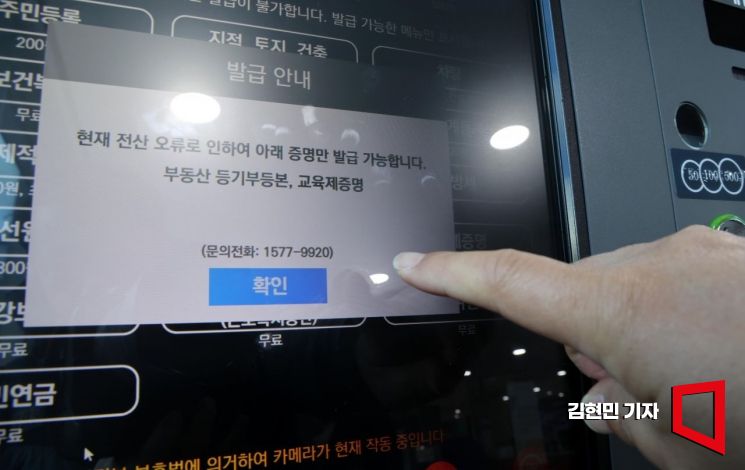 On the 17th, a network outage was reported on the unmanned civil service issuance machine in the civil service office of the National Assembly Members' Office Building in Seoul due to a failure in the nationwide local government administrative computer network. Photo by Kim Hyun-min kimhyun81@
However, the large companies whose shackles have been loosened remain indifferent. They do not want to participate in public projects that are unprofitable and require them to be at the government's beck and call. Large companies must form consortia with SMEs to participate, but they complain that it is difficult to find suitable partners. The policy that blocked large company participation ironically produced zombie companies that survive solely on public projects without technological development. A representative from a major IT service company pointed out, "If we partner with underperforming companies and problems arise, we bear all the responsibility," adding, "The diagnosis that problems will be solved if large companies step in is fundamentally wrong."
SMEs believe they will lose even the remaining turf. They say that if large companies enter low-cost projects, the structure will revert to large companies subcontracting to SMEs to maintain profitability. Jo Miriae, CEO of mid-sized IT service company VTW and chairperson of the SME SI·SW Council, expressed concern, saying, "If the public market, the only one SMEs can enter, closes, the already struggling industry will become even harder. If competitive SMEs are reduced to subcontractors, it will be a significant loss for the country."
"The more you do, the more you lose" ... Half of public projects fail to attract bids
Public SW projects were once popular. Until the mid-2000s, it was not uncommon for companies to submit bids as low as 1 won to win projects. Many companies were willing to take losses just to secure projects. This extraordinary situation occurred because they saw it as an opportunity to apply new technologies and build project references. However, the popularity of public projects has cooled sharply. Nearly half of the projects fail to attract bids each year.
The reason is simple: they are unprofitable. The share of public SW projects, which once accounted for 2-3% of the total government budget, has fallen below 1%. Due to widespread low-price bidding, there is talk that the more you do, the more you lose. According to the SW Policy Research Institute, companies with over 20% of their business in public projects had an average operating profit margin of only 0.5% in 2020. In contrast, companies with less than 20% had an operating profit margin of 6%. The rise in developer salaries during the COVID-19 period also had an impact. Chae Hyogeun, vice president of the IT Service Industry Association, explained, "Government investment stagnated in the 2010s, and the development environment worsened. Since there are few private projects where you can build references from public projects, the previous significance has disappeared."
Project execution has also become more haphazard. In the past, the government released a Request for Information (RFI) before distributing the Request for Proposal (RFP) to companies. This process gathered opinions from related companies before proceeding with the main project. Writing the RFP based on the RFI was customary, but this practice has disappeared. Instead, adding tasks during project execution has become routine. Jo said, "The budget remains the same, but they place orders first and keep making modifications. The government's way of contracting and managing projects is very outdated."
"Change the project structure rather than the participants"
Ultimately, the industry agrees that the project structure, not the participants, must be changed. Otherwise, whoever takes on the projects, network outages will recur. The most urgent task is to make project budgets realistic. There are also strong calls to improve project design and contract methods. For example, the U.S. Federal Procurement Service applies a hybrid method. Modules that must be included in the project are contracted at a fixed price within the budget, and additional work is settled later. Ahn Hongjun, head of industrial policy at the Korea SW Industry Association, diagnosed, "First, companies that make profits in the public market must emerge so that they can invest heavily in research and development (R&D) personnel and improve quality."
© The Asia Business Daily(www.asiae.co.kr). All rights reserved.
![Clutching a Stolen Dior Bag, Saying "I Hate Being Poor but Real"... The Grotesque Con of a "Human Knockoff" [Slate]](https://cwcontent.asiae.co.kr/asiaresize/183/2026021902243444107_1771435474.jpg)















