Geonjeongyeon Holds Forum on Improving Utilization of Foreign Workers in Construction Industry
Next year, it is projected that approximately 170,000 construction workers will be in short supply at domestic construction sites. There is a call to further expand the introduction of foreign workers and to efficiently utilize the capabilities of the private sector to increase their utilization.
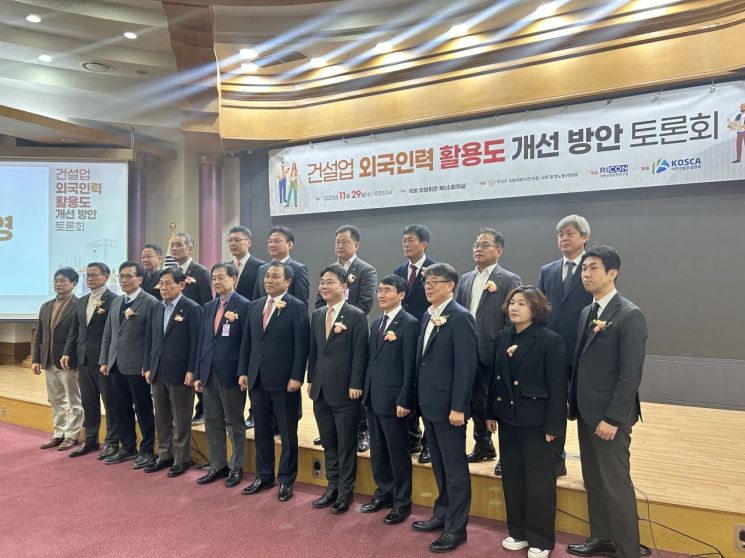 On the morning of the 29th, a discussion on improving the utilization of foreign labor in the construction industry was held at the 1st conference room of the National Assembly Members' Office Building in Yeouido, Seoul.
 [Photo by Kwak Minjae]
The Korea Construction Policy Institute, together with Congressman Ji Seong-ho of the People Power Party, held a "Discussion on Improving the Utilization of Foreign Workers in the Construction Industry" at 10 a.m. on the 29th in the first conference room of the National Assembly Members' Office Building.
Kang Seong-ju, head of the Labor Policy Team at the Korea Specialty Contractors Association, who presented at the discussion, said, "Currently, construction sites are experiencing a labor shortage due to the aging of Korean workers, a decrease in young workers entering the field, and harsh working conditions, making it difficult to secure domestic workers." He added, "It is expected that there will be a shortage of 173,500 construction workers next year." He also stated, "There is a need to compensate for the gap between construction labor demand and domestic labor supply with foreign workers."
Park Gwang-bae, senior research fellow at the Korea Construction Policy Institute, introduced overseas cases such as Taiwan and Japan and pointed out that expanding the role of the private sector is necessary to improve the utilization of foreign workers. He explained, "In Japan, a non-profit organization monitors the status of illegal residents and provides counseling on difficulties, creating an institution that resolves issues between employers and foreign workers." He also said, "Taiwan allows intermediary agencies abroad to directly recruit foreigners for a fee."
There was also an opinion that employment restrictions and other systems should be reformed to allow foreign students to be utilized in the construction industry. Research fellow Park said, "Foreign students receive education in domestic universities for a minimum of two years and up to four years, so they can communicate to some extent." He added, "Since communication is very important at construction sites, it is necessary to consider measures to allow them to work in the domestic construction industry."
In the subsequent discussion, chaired by Professor Lee Bok-nam of the Seoul National University Construction Environment Comprehensive Research Institute, participants included Woo Jeong-hoon, Director of the Construction Industry Division at the Ministry of Land, Infrastructure and Transport; Lee Sang-im, Foreign Workforce Officer at the Ministry of Employment and Labor; Lee Gyu-yong, senior research fellow at the Korea Labor Institute; Lee Jae-gyun, CEO of Ganggu Construction; Jang Se-hyun, CEO of Donggeuk Construction; and Kim Hwan-joo, head of the Management Policy Headquarters at the Korea Specialty Contractors Association, who shared various opinions on ways to utilize foreign workers.
Woo Jeong-hoon, Director of the Construction Industry Division at the Ministry of Land, Infrastructure and Transport, stated, "Although the government has made many improvements so far, there may still be shortcomings at the field level, so we will have additional discussions with various departments." He added, "The use of foreign workers in the construction industry is inevitable, but since the shortage remains, we will communicate with the industry to expand the foreign worker quota."
Kim Hee-soo, president of the Korea Construction Policy Institute, which organized this discussion, said, "As the expansion of foreign worker introduction is inevitable in the future, we will actively reflect the opinions of the industry, which is the user of the workforce, across the entire system operation including introduction, training, placement, and management of foreign workers, and consider a more flexible and field-appropriate labor supply system by efficiently utilizing private sector capabilities."
© The Asia Business Daily(www.asiae.co.kr). All rights reserved.
![Clutching a Stolen Dior Bag, Saying "I Hate Being Poor but Real"... The Grotesque Con of a "Human Knockoff" [Slate]](https://cwcontent.asiae.co.kr/asiaresize/183/2026021902243444107_1771435474.jpg)















