As automobile sales in the North American market continue to perform well, South Korea's export value index turned positive for the first time in 13 months. The terms of trade have risen for five consecutive months, influenced by import prices falling more sharply than export prices.
According to the 'Trade Index and Terms of Trade' (based on the dollar) statistics released by the Bank of Korea on the 29th, the export value index in October increased by 2.4% compared to the same month last year. This index had been declining for 12 consecutive months until September, since October last year (-6.6%), before turning upward in October.
The export value index rose 2.4% year-on-year as decreases in computers, electronics, and optical equipment (-4.6%) and chemical products (-3.5%) were offset by increases in transport equipment (13.2%) and coal and petroleum products (17.4%).
Yoo Sung-wook, head of the Price Statistics Team at the Bank of Korea’s Economic Statistics Bureau, explained, "The increase in value was driven by continued strong sales of eco-friendly vehicles and sports utility vehicles (SUVs), mainly in the North American market. For coal and petroleum products, the end of regular maintenance periods at refineries led to higher operating rates, resulting in increased export volumes centered on gasoline and diesel."
The export volume index in October rose 7.4% year-on-year, marking a second consecutive month of increase. This upward trend was supported by growth in coal and petroleum products (28.6%) and computers, electronics, and optical equipment (6.1%).
The import value index in October fell 10.5% compared to the same month last year, continuing a downward trend for eight consecutive months since March (-6.6%). Although coal and petroleum products (13.5%) and electrical equipment (3.4%) increased, declines in mining products (-20.1%) and computers, electronics, and optical equipment (-10.3%) contributed to the overall decrease.
The import volume index dropped 5.0% year-on-year, marking four consecutive months of decline. This was due to increases in coal and petroleum products (15.6%) and electrical equipment (5.0%), offset by decreases in mining products (-11.7%) and computers, electronics, and optical equipment (-7.9%).
The net barter terms of trade index, which indicates the quantity of goods that can be imported per unit of exports, rose 1.1% year-on-year. This marks five consecutive months of increase as import prices (-5.8%) fell more sharply than export prices (-4.7%).
This index has been on an upward trend for five months since turning positive in June for the first time in 27 months.
The income terms of trade index, representing the total quantity of goods that can be imported with South Korea’s total export value, also rose 8.6% compared to a year ago, marking five consecutive months of increase.
Yoo said, "The income terms of trade index rose 8.6% year-on-year as both the export volume index (7.4%) and the net barter terms of trade index (1.1%) increased."
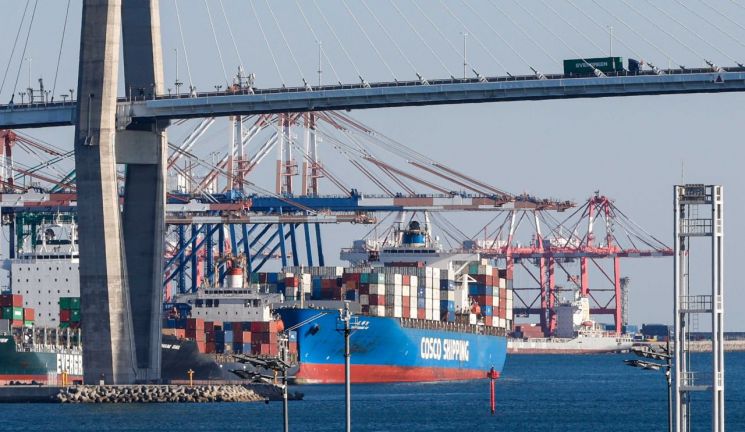 Export containers are being loaded onto a ship at Busan North Port. Photo by Jinhyung Kang aymsdream@
© The Asia Business Daily(www.asiae.co.kr). All rights reserved.
![Clutching a Stolen Dior Bag, Saying "I Hate Being Poor but Real"... The Grotesque Con of a "Human Knockoff" [Slate]](https://cwcontent.asiae.co.kr/asiaresize/183/2026021902243444107_1771435474.jpg)
















