Inflation Slowdown and Economic Contraction Concerns
Execution Timing Accelerated Compared to Previous Forecasts
Due to the downward trend in the economy, there are forecasts that the European Union (EU) and the United Kingdom will cut their benchmark interest rates before the United States. Although the EU and the UK have prioritized inflation control and maintained a tightening stance, analyses suggest that a shift to monetary easing is urgent due to the slowdown in inflation and signs of cooling in the labor market.
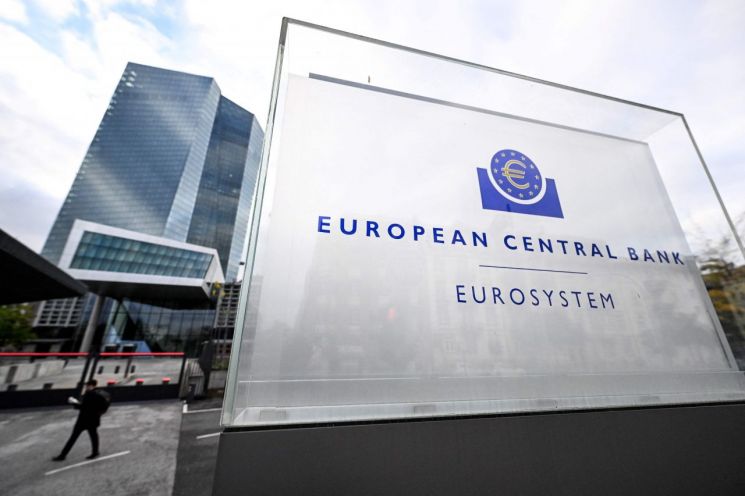
According to major foreign media on the 21st (local time), investors have begun betting that the European Central Bank (ECB) will make its first rate cut in April next year, lowering the benchmark interest rate from 4.5% to 3.5%. This timing is about two months earlier than the previous forecast (June). Earlier this month, the prevailing view was that the ECB would make its first cut in September next year.
The outlook for an early rate cut by the ECB reflects changes brought about by a significant slowdown in inflation. The consumer price index (CPI) for the Eurozone in October was 2.9%, lower than the market expectation (3.1%) and sharply down from the previous month (4.3%). Inflation rates, which exceeded 10% just a year ago in major countries including Germany, the largest economy in the Eurozone, and France, have recently fallen to around 3%, showing a clear deceleration in inflation.
A British foreign media outlet evaluated, "Concerns that inflationary pressures would rise again due to the recent decline in international oil prices have eased, weakening the justification for further rate hikes by the ECB."
The Eurozone's manufacturing Purchasing Managers' Index (PMI) has shown a declining trend for three consecutive months from August to October, raising concerns about economic contraction. France's unemployment rate soared to 7.4% in the third quarter of this year, the highest in two years, and Germany's unemployment rate also remained high at 5.8% in October, up 0.1 percentage points from the previous month. Although pressure from the slowdown in the real economy is increasing, consumer sentiment recovery remains slow.
Thomas Wieladek, Chief European Economist at U.S. investment management firm AlloWiprice, said, "While inflationary pressures are easing, real economic indicators are deteriorating, making it highly likely that the timing of rate cuts will be brought forward."
As a result, there are forecasts that the ECB will cut rates before the U.S. Federal Reserve (Fed). The market expects the Fed to cut its benchmark interest rate around June next year. While many forecasts predict that the U.S. economy will continue to grow without a hard landing, the ECB's executive body, the Executive Board, has downgraded its Eurozone economic growth forecast again within two months.
The EU Executive Commission, in a report released on the 15th, lowered the Eurozone economic growth forecast for this year to 0.6%, marking a further downgrade within two months following May (1.1%) and September (0.8%). The Commission diagnosed, "High interest rates have discouraged loans and investments, causing the Eurozone economy to lose momentum."
The UK, trapped in a long-term low-growth slump, is also highly likely to cut rates before the Fed. Economist Wieladek forecasted, "Due to the deterioration of the real economy, the Bank of England (BOE) will cut rates in May next year." UBS also suggested that the BOE might cut rates before the Fed or ECB, proposing May next year as the timing for the cut.
On the other hand, ECB President Christine Lagarde said in Berlin, Germany, on the same day, "Now is not the time to declare victory over inflation," adding, "We must focus on bringing inflation down to our target and avoid drawing hasty conclusions based on short-term situations."
She mentioned, "We need to pay attention to the risk of persistent inflation," warning that the pace of price increases could accelerate again. The ECB has raised its benchmark interest rate to 4.50% through ten rate hikes since July last year.
© The Asia Business Daily(www.asiae.co.kr). All rights reserved.
![Clutching a Stolen Dior Bag, Saying "I Hate Being Poor but Real"... The Grotesque Con of a "Human Knockoff" [Slate]](https://cwcontent.asiae.co.kr/asiaresize/183/2026021902243444107_1771435474.jpg)
















