As mentioned earlier in the previous part, the core contents of the amendment to the Labor Union Act, the so-called ‘Yellow Envelope Act,’ are ▲expansion of the concept of ‘employer,’ ▲expansion of the concept of ‘labor dispute,’ and ▲limitation of the union’s liability for damages. The Yellow Envelope Act expands the concept of ‘labor dispute’ along with the concept of ‘employer.’
This reflects the labor sector’s argument that the scope of issues that can be resolved through disputes is too narrow, limiting workers’ enjoyment of collective action rights. However, there are concerns that this does not conform to the legal principles regarding the concept of labor disputes established through precedents and that it may lead to a tendency to resolve various labor-management issues through dispute actions rather than labor-management agreements. When disagreements arise between labor and management, the tendency to resolve them through strikes may spread, which could undermine the stability of the labor market and ultimately harm both labor and management.
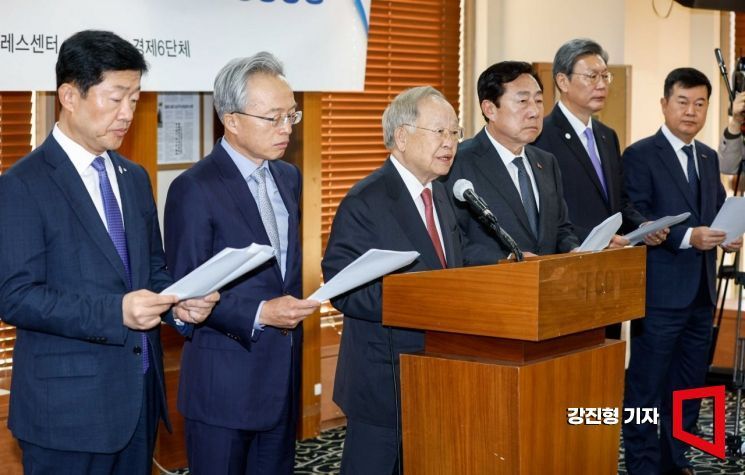 On the 13th, Sohn Kyung-shik, Chairman of the Korea Employers Federation, held a press conference with economic organization officials at the Press Center in Jung-gu, Seoul, and announced the "Joint Statement Condemning the Deterioration of the Labor Union Act and Proposing the Exercise of Veto Power." From the left: Woo Tae-hee, Vice Chairman of the Korea Chamber of Commerce and Industry; Choi Jin-sik, Chairman of the Federation of Medium-Sized Enterprises; Chairman Sohn; Kim Ki-moon, Chairman of the Korea Federation of Small and Medium Business; Kim Chang-beom, Executive Vice Chairman of the Korea Economic Association; and Kim Go-hyun, Executive Director of the Korea International Trade Association. Photo by Kang Jin-hyung aymsdream@
‘Decision’ Removed from Definition Clause... Expansion of Disputes to Include Rights Disputes Beyond Interest Disputes
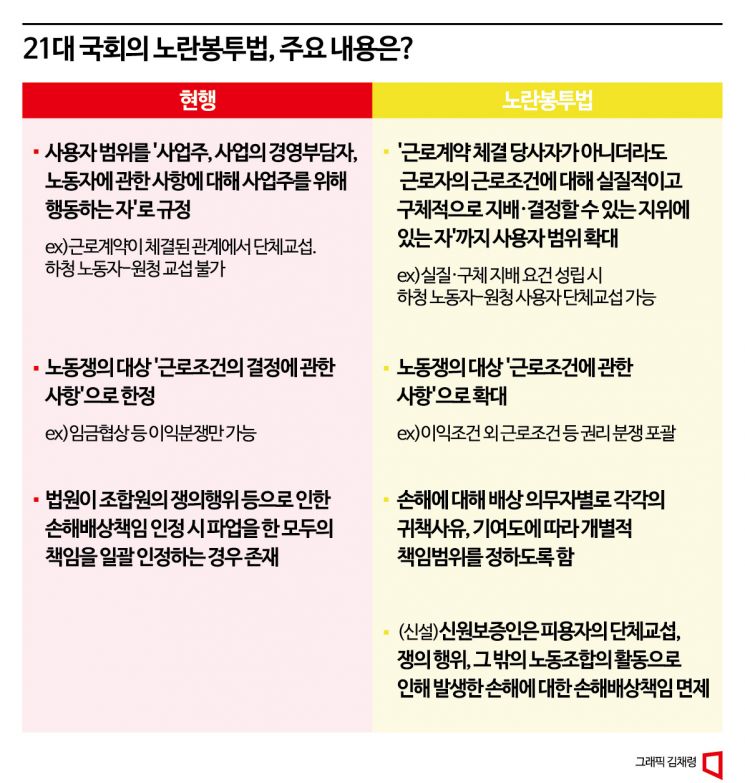
Article 2(Definitions) Clause 5 of the current Labor Union Act defines labor disputes as “a state of dispute arising from disagreements over claims related to the determination of working conditions such as wages, working hours, welfare, dismissal, and other treatment between labor unions and employers or employer organizations.”
The amendment deletes the word ‘decision’ from the current definition clause and changes it to “a state of dispute arising from disagreements over claims related to working conditions such as wages, working hours, welfare, dismissal, and other treatment between labor unions and employers or employer organizations.”
In summary, the concept of labor disputes has been expanded from ‘disputes concerning the determination of working conditions’ to ‘disputes concerning working conditions.’ Although the only change is the removal of the single word ‘decision,’ the actual difference is enormous.
The reason for the amendment states, “The current law limits the subject of labor disputes to matters concerning ‘the determination of working conditions,’ so labor unions cannot engage in dispute actions regarding unfair labor practices by employers or non-fulfillment of collective agreements. Therefore, the subject of labor disputes has been expanded to matters concerning ‘working conditions’ to broaden the scope of legitimate dispute actions.”
Labor disputes are the prerequisite situations for dispute actions such as strikes or slowdowns; without the occurrence of a labor dispute, dispute actions cannot proceed. Under current law, labor disputes are limited to disputes arising during the process of ‘determining’ working conditions. This is called ‘interest disputes.’ For example, disputes over wage increases or the conclusion of collective agreements.
On the other hand, disputes arising over already determined working conditions, or disputes concerning the interpretation and realization of already established rights, are called ‘rights disputes.’ By deleting the term ‘decision,’ the Yellow Envelope Act expands the scope of labor disputes to include rights disputes beyond the existing interest disputes.
Strikes to Resolve Rights Disputes That Should Be Judged by Courts... Concerns Over ‘Proliferation of Strikes’
Originally, matters belonging to rights disputes should be resolved through court judgments. If dispute actions are allowed for these as well, it effectively means recognizing self-help remedies, which our legal system prohibits, according to business circles.
For example, business measures such as organizational restructuring including mergers and abolitions, or dismissals for business reasons (layoffs), could become subjects of strikes. Strikes opposing layoffs or restructuring, which have not been allowed under precedents, would become possible. If a union raises objections to business measures such as organizational restructuring on the grounds that they affect working conditions like wages, working hours, or dismissal, it could be interpreted as a dispute concerning working conditions.
The Supreme Court holds that to recognize the legitimacy of a strike, it must be justified in three aspects: the ‘purpose (subject),’ ‘procedure,’ and ‘method (means)’ of the strike. Business circles worry that if the Yellow Envelope Act is enforced, strikes targeting business measures could become legitimate strikes exempt from civil and criminal liability, significantly infringing on the employer’s inherent management rights.
Furthermore, if the concept of labor disputes is expanded, dispute actions currently only possible during collective bargaining could also be conducted after collective bargaining has ended and collective agreements have been concluded. Especially when connected with the expansion of the ‘employer’ concept examined earlier, if a prime contractor refuses a subcontractor union’s request for collective bargaining, the subcontractor union could strike against the prime contractor for that reason.
For these reasons, business circles view the expansion of the concept of labor disputes as inevitably leading to the spread of ‘strike absolutism’ and the normalization of strikes. In particular, there is a forecast that the normalization of strikes could occur as strikes are used as a means to resolve rights disputes that should be addressed through judicial relief procedures, such as reinstatement of dismissed workers or non-fulfillment of collective agreements.
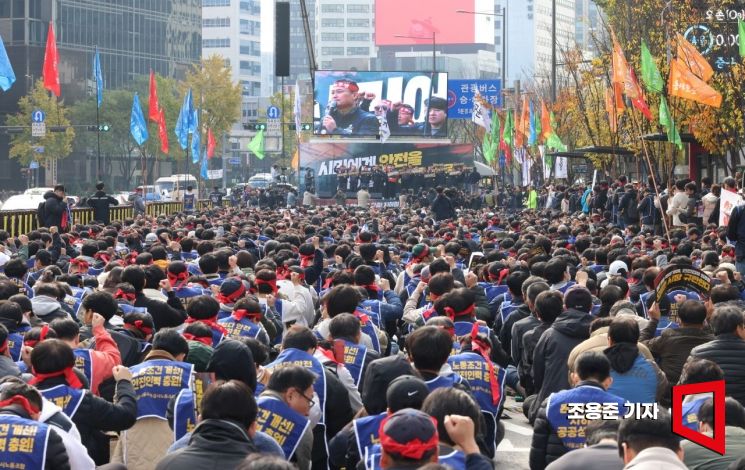 On the 9th, when the Seoul Metro Lines 1 to 8 operated by Seoul Metro Union began a two-day warning strike, the Korean Confederation of Trade Unions Public Transport Union and the Seoul Metro Union held a general strike rally in front of Deoksugung Palace in Seoul. Photo by Jo Yongjun jun21@
Allowing Workplace Occupation and Prohibiting Substitute Labor... “Labor and Management Are Already Unequal in Arms”
Even now, South Korea experiences frequent strikes, and the resulting economic damage is significant. According to International Labour Organization (ILO) statistics, from 2012 to 2021, the average annual work loss days per 1,000 wage workers due to strikes was 38.8 days, which is 194 times that of Japan (0.2 days), 4.6 times that of Germany (8.5 days), and 4.5 times that of the United States (8.6 days).
Moreover, under current law, workplace occupation during strikes is allowed, and substitute labor is prohibited, meaning that union strike rights are more broadly guaranteed than employer defensive rights. Business circles fear that if the concept of labor disputes is further expanded, the proliferation of strikes will be unavoidable.
As of 2021, unlike South Korea, countries such as the United States, Japan, Germany, the United Kingdom, and France allow substitute labor (Germany and the UK prohibit dispatch, France prohibits both dispatch and fixed-term employment), and workplace occupation is not allowed in the United States, Germany, the UK, and France.
Meanwhile, the labor sector views these business circle criticisms as ‘fear marketing.’ They argue that even if subcontractor unions request bargaining with the prime contractor, the prime contractor can ignore it and claim “not the actual employer,” buying time through lawsuits. Since it usually takes years to reach a final Supreme Court ruling, the prime contractor, which has capital and time, is not significantly burdened, whereas subcontracted workers are likely to lose their jobs due to replacement of service providers. Therefore, they argue that dispute actions will not be abused as business circles fear. However, once the law is enforced and the Supreme Court issues a ruling on such disputes, the same legal principles will apply to similar cases thereafter, making it difficult to dismiss business circles’ concerns as mere fear marketing.
© The Asia Business Daily(www.asiae.co.kr). All rights reserved.
![Clutching a Stolen Dior Bag, Saying "I Hate Being Poor but Real"... The Grotesque Con of a "Human Knockoff" [Slate]](https://cwcontent.asiae.co.kr/asiaresize/183/2026021902243444107_1771435474.jpg)


















