Korea Institute for Industrial Economics and Trade Announces '2024 Economic and Industrial Outlook'
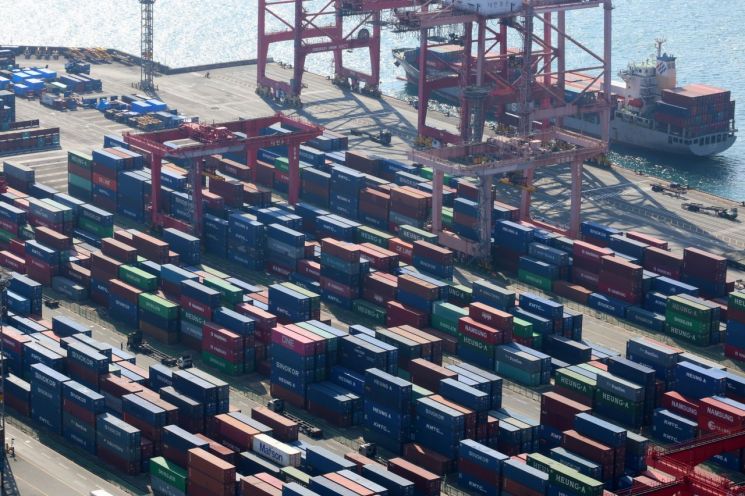 On November 1, 2023, Busan Port's Sinsundae Pier is bustling with activity as export containers are being loaded. [Image source=Yonhap News]
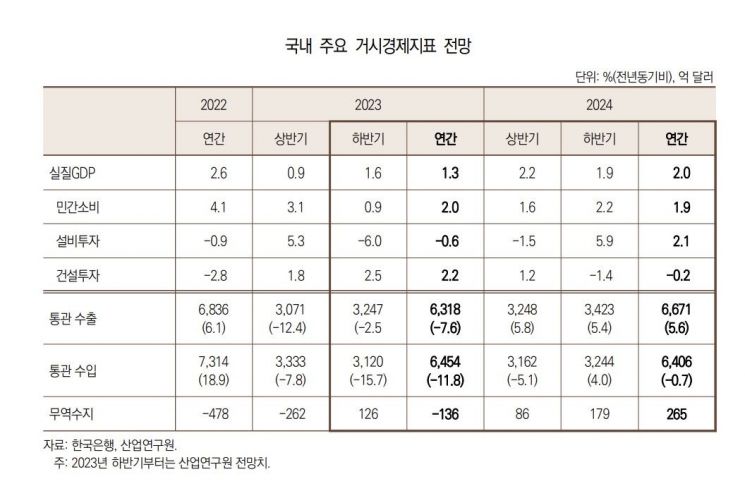
Despite a recovery in exports, South Korea's economy is expected to record a moderate growth rate of 2.0% next year due to the impact of high inflation and high interest rates. By sector, significant growth is anticipated in information and communication technology (IT) such as semiconductors and shipbuilding, while construction, secondary batteries, and petrochemicals are expected to generally underperform.
On the 20th, the Korea Institute for Industrial Economics & Trade (KIET) released the '2024 Economic and Industrial Outlook' report containing these projections.
The institute stated, "In 2024, despite an increase in exports and a turnaround in facility investment driven by a moderate recovery in the IT sector, the negative effects of high inflation and high interest rates will intensify, leading to a slowdown in consumption growth and contraction in construction investment, resulting in a moderate growth rate of around 2.0% compared to the previous year."
By segment, private consumption is expected to grow by 1.9% year-on-year, constrained by increased interest burdens due to high interest rates and elevated household debt, declines in asset values caused by financial sector and geopolitical uncertainties, and weakened purchasing power due to high inflation.
Facility investment is forecast to increase slightly by 2.1%, supported by expanded investment in the automobile sector responding to steady demand for eco-friendly vehicles, a moderate recovery in the semiconductor industry, planned investments by major related companies, and base effects.
Construction investment is expected to decline by 0.2% compared to this year, despite anticipated increases in government social overhead capital (SOC) budgets and civil engineering orders, as leading indicators such as unsold housing, new permits and construction starts, and construction orders show weakness.
Exports are projected to increase by 5.6% year-on-year, driven by improvements in the semiconductor industry, steady export volumes of automobiles, base effects from the previous year, and a moderate recovery in global trade. Imports are expected to decrease by 0.7% year-on-year, resulting in an annual trade surplus of approximately $25.6 billion.
Exports of the 13 major key industries are expected to expand in most sectors except petrochemicals (-0.5%) and secondary batteries (-2.6%), reaching $504.7 billion, a 5.2% increase from this year's $479.9 billion. In particular, shipbuilding exports are forecast to grow double digits (10.2%) due to increased deliveries of high-value vessels. Accordingly, the machinery industry group, including general machinery (1.0%) and automobiles (2.0%), is expected to grow overall by 2.7%.
Material industries such as steel (1.4%), textiles (2.0%), and refining (1.0%) are expected to see export growth due to increased demand from emerging markets, expanded exports of advanced materials, and base effects. However, petrochemicals (-0.5%) are expected to remain flat due to price declines.
The IT and new industry sectors are anticipated to lead export expansion with an 11.4% increase overall, driven by growing global demand for IT products and innovative pharmaceuticals, as well as base effects. This includes semiconductors (15.9%), information and communication devices (12.7%), and biohealth (4.6%). However, secondary batteries are expected to see a slight decline (-2.6%).
In domestic demand, shipbuilding is expected to maintain strong growth at 84%, while automobiles are projected to decline by 2.0% due to realization of accumulated deferred demand and worsening purchasing conditions. Semiconductors (9.4%), information and communication devices (5.4%), and biohealth (10.7%) are expected to experience rapid growth, but secondary batteries (3.3%) are forecast to slow down compared to last year's 68.8% growth due to a slowdown in electric vehicle growth.
With recovery in exports and domestic demand, production in IT and new industry sectors such as semiconductors and information communication devices is expected to expand, whereas production in material industries like steel and refining is projected to see only limited growth.
Automobile production is expected to decline by 2.3% due to sluggish domestic and export demand. Regarding the automobile industry, KIET explained, "Despite positive factors such as steady demand growth in the U.S. and European markets and rising export prices, volume is expected to slightly decrease due to a base effect following strong performance last year."
© The Asia Business Daily(www.asiae.co.kr). All rights reserved.
![Clutching a Stolen Dior Bag, Saying "I Hate Being Poor but Real"... The Grotesque Con of a "Human Knockoff" [Slate]](https://cwcontent.asiae.co.kr/asiaresize/183/2026021902243444107_1771435474.jpg)
















