"Not Likely External Attacks Such as Hacking"
"Should Be an Opportunity to Overhaul Public Data Systems"
The administrative network used by local government officials nationwide was paralyzed, causing delays in civil service processing at frontline administrative welfare centers on the 17th.
The Ministry of the Interior and Safety reported that a problem occurred in the verification path when officials log in to the Information Resource Management Center and is investigating the exact cause. Experts emphasized the need to reorganize the public data management system to prevent recurrence.
That morning, the exclusive administrative network for officials, 'Saeol,' experienced a failure due to user authentication issues, delaying on-site civil service processing.
The online civil service platform 'Government24' was also completely suspended. Around 2 p.m. that day, Government24 posted a notice on its homepage stating, "Due to a network equipment error at the National Information Resource Management Center, the service is temporarily suspended," and added, "We will take prompt measures to restore the service to normal."
Because of this issue, not only were local government officials nationwide unable to handle civil service tasks, but citizens who came to process civil affairs also experienced inconvenience.
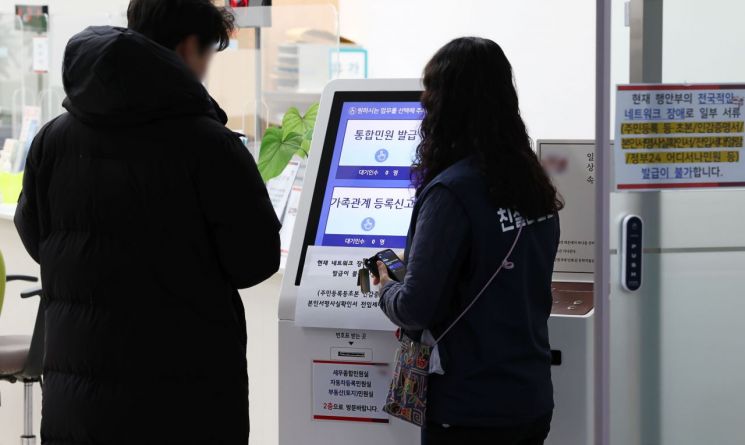 On the morning of the 17th, when a failure occurred in the administrative computer network of local governments nationwide, an employee at the comprehensive civil service office of a district office in Seoul is explaining to a civil petitioner that the unmanned civil service issuance machine is unavailable due to the network failure. [Image source=Yonhap News]
The Ministry of the Interior and Safety reported that a problem occurred in the verification path when officials log in to the Information Resource Management Center and is investigating the exact cause.
However, it does not appear to be due to hacking or external attacks. Professor Yeom Heung-yeol of Soonchunhyang University’s Department of Information Security appeared on YTN's 'News & Issue' that day and speculated that the cause of this incident was an internal configuration error.
The causes of network failures are broadly divided into ▲external attacks (cyberattacks) and ▲configuration errors by internal administrators. According to Professor Yeom, Korea’s administrative information sharing system is separated from external networks, making external cyberattacks difficult without internal cooperation.
Professor Lim Jong-in, Chair Professor at Korea University Graduate School of Information Security, also appeared on YTN's 'News Live' that day and said, "Previously, hacker groups presumed to be from North Korea attacked several times, but unless it is such a deliberate attack, recovery is expected within three hours." He added, "After looking into the situation, the possibility of an external attack is almost none, and it is highly likely an internal failure. We are currently doing our best internally to quickly identify the cause and take measures."
Professor Lim emphasized that this incident should serve as an opportunity to reorganize the public data management system.
He stated, "The manual originally requires prompt recovery," and pointed out, "The fact that (cause identification and recovery) is taking this long shows external forces that Korea’s crisis management manuals and systems are not functioning sufficiently well."
Professor Yeom also stressed, "Preventing recurrence requires thorough cause identification, experienced experts, and security monitoring functions capable of overseeing the entire network," adding, "Not only technical aspects but also management and organizational aspects must be properly operated to prevent such failures from recurring."
© The Asia Business Daily(www.asiae.co.kr). All rights reserved.
![Clutching a Stolen Dior Bag, Saying "I Hate Being Poor but Real"... The Grotesque Con of a "Human Knockoff" [Slate]](https://cwcontent.asiae.co.kr/asiaresize/183/2026021902243444107_1771435474.jpg)















