Agreement on Supply Chain, Clean Economy, and Fair Economy
President Yoon Suk-yeol attended the Indo-Pacific Economic Framework (IPEF) summit held in conjunction with the Asia-Pacific Economic Cooperation (APEC) summit on the 16th (local time) to discuss measures for restoring regional supply chains, including the supply of critical minerals.
On the afternoon of the same day, President Yoon held the IPEF summit in San Francisco, USA, together with 14 participating country leaders, including U.S. President Joe Biden and Japanese Prime Minister Fumio Kishida. President Yoon had previously attended the IPEF launch summit held in Tokyo, Japan, on May 23 last year via video conference shortly after his inauguration.
IPEF is an economic and trade cooperation body established by 14 major Indo-Pacific countries including South Korea, the United States, Japan, Australia, New Zealand, Singapore, Thailand, Vietnam, Brunei, Malaysia, the Philippines, Indonesia, India, and Fiji to jointly respond to complex crises such as supply chains and climate change. It accounts for 40% of the world’s GDP and 28% of global goods and services trade. It also serves as a countermeasure to the China-led Regional Comprehensive Economic Partnership (RCEP).
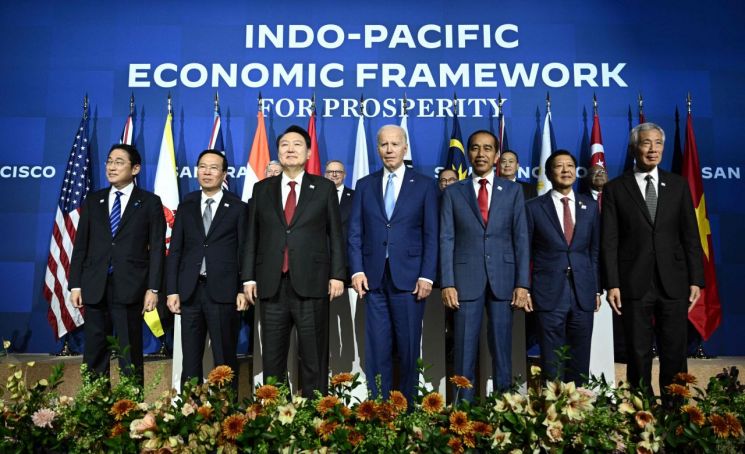 President Yoon Suk-yeol attended the Indo-Pacific Economic Framework (IPEF) on the 16th (local time) and took a commemorative photo with U.S. President Joe Biden and other participating country leaders.
 [Image source=Yonhap News]
This meeting was held to review the outcomes of seven rounds of negotiations conducted over the past year and a half since the launch in May last year and to discuss concrete cooperation plans going forward. The leaders highly evaluated the agreement on three out of the four pillars in a short period, from the supply chain agreement (Pillar 2) concluded in May to the clean economy agreement (Pillar 3) and the fair economy agreement (Pillar 4). Negotiations on the trade agreement (Pillar 1) will continue.
The supply chain agreement, scheduled to take effect next year, includes provisions that when a regional supply chain crisis is detected, a high-level intergovernmental consultative body called the 'Crisis Response Network' will be activated within 15 days upon request from the affected country to establish alternative supply sources and procurement plans. The clean economy agreement aims to strengthen cooperation on technologies, standards, and norms related to the production processes of all clean energy sources, carbon reduction technologies, and trading markets. The fair economy agreement includes measures for punishing illegal activities and enhancing tax administration efficiency.
The leaders also agreed to establish a 'Critical Minerals Dialogue' to build a stable supply chain for critical minerals and an 'IPEF Network' to promote people-to-people exchanges among participating countries, ensuring that IPEF functions as a platform responding to new issues. Furthermore, they decided to hold the summit biennially and ministerial meetings annually, laying the foundation for IPEF to deliver continuous results.
The Presidential Office stated, "With this summit and the conclusion of negotiations, the resilience of supply chains in the Indo-Pacific region is expected to significantly improve." It added, "The agreement to promote $155 billion in new investments in the clean energy sector by 2030 will open substantial business opportunities for our companies. In addition, by preventing illegal activities in government procurement and enhancing tax administration efficiency, the stability and transparency of the regional business environment will improve, leading to more active expansion of our companies."
© The Asia Business Daily(www.asiae.co.kr). All rights reserved.
![Clutching a Stolen Dior Bag, Saying "I Hate Being Poor but Real"... The Grotesque Con of a "Human Knockoff" [Slate]](https://cwcontent.asiae.co.kr/asiaresize/183/2026021902243444107_1771435474.jpg)
















