During the COVID-19 pandemic in South Korea, public hospitals were found to have accommodated more patients than private hospitals. However, private hospitals accounted for the majority of severe and critical patient admissions.
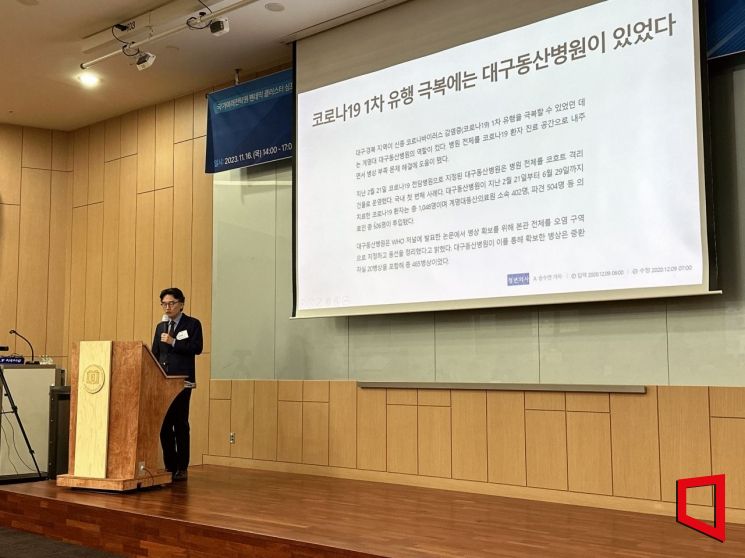 Professor Lim Jae-jun of Seoul National University College of Medicine (Deputy Director of Public Affairs at Seoul National University Hospital) is giving a presentation on the topic "Public Hospitals and Private Hospitals: Same Goal, Different Roles" at the symposium "COVID-19 Pandemic and South Korea: Let's Talk About Healing and Recovery" held at Seoul National University on the afternoon of the 16th.
 [Photo by Lee Myung-hwan]
On the afternoon of the 16th, Professor Lim Jae-jun of Seoul National University College of Medicine (Deputy Director of Public Affairs at Seoul National University Hospital) made this announcement during a presentation titled "Public Hospitals and Private Hospitals: Same Goal, Different Roles" at Seoul National University in Gwanak-gu, Seoul.
According to Professor Lim, there are a total of 229 public healthcare institutions (public hospitals) in South Korea, accounting for about 5% of all medical institutions. This figure is far below the average public hospital proportion of 53% among OECD member countries. However, Professor Lim explained, "There is also an argument that all hospitals in South Korea are required to enroll in the National Health Insurance and operate as non-profit institutions, so in practice, there is little difference from public medical institutions."
Professor Lim analyzed hospitalization data of COVID-19 patients from some public and private hospitals in South Korea from 2020 to 2021 through a quantitative comparative study. The study utilized databases from the National Health Insurance Service, Ministry of Health and Welfare, and Ministry of the Interior and Safety. Data on hospitalized patients from last year have not yet been released and were therefore excluded from this study.
The analysis showed that over the two years, about 200,000 COVID-19 patients were admitted to public hospitals, while private hospitals admitted approximately 95,000 patients, showing a difference of about twice as many in public hospitals. In terms of ratio, public and private hospitals showed about a 7:3 ratio, indicating a higher COVID-19 patient admission rate in public hospitals.
On the other hand, the trend was reversed for severe and critical COVID-19 patients. During the same period, the number of severe and critical COVID-19 patient admissions was about 5,300 in private hospitals and about 3,500 in public hospitals, with private hospitals accommodating more cases. The dedicated proportion of severe and critical patients was approximately 4:6 between public and private hospitals.
When examining the admission rates of COVID-19 patients over time, the admission rate in private hospitals increased as the pandemic intensified. In 2020, the early phase of the pandemic, most hospitalized patients were cared for by public hospitals regardless of mild or severe conditions. However, during the first wave in the Daegu and Gyeongbuk regions, Daegu Dongsan Hospital, a private hospital, took charge of treating COVID-19 patients, temporarily increasing the patient care rate in private hospitals. From February 2021, as COVID-19 cases spread nationwide and severe cases increased, the admission rate in private hospitals began to rise.
Regarding the patient-sharing ratio during the pandemic, Professor Lim evaluated that public and private hospitals played roles suited to their respective characteristics. He explained, "Public hospitals were responsible for early pandemic response and treating a large number of patients, while private hospitals actively admitted patients from the period of rapid patient increase and took charge of treating patients with higher severity. It can be assessed that during the early to mid-phase of the pandemic, public and private hospitals fulfilled roles appropriate to their characteristics."
Based on these research findings, Professor Lim emphasized the need for discussions on the division of roles between public and private hospitals in preparation for the next pandemic. He said, "Through this research, we plan to develop a plan on how public and private hospitals will allocate roles at different times and in what ways to prepare for the next pandemic."
Meanwhile, the symposium hosted by the Seoul National University Institute for National Future Strategies was held under the theme "COVID-19 Pandemic and South Korea: Talking about Healing and Recovery." Organized by the Institute’s Pandemic Cluster, the symposium was arranged to discuss how our society can heal and recover from the wounds caused by COVID-19. In addition to Professor Lim’s presentation, a total of eight thematic presentations on healing and recovery from the pandemic were delivered.
© The Asia Business Daily(www.asiae.co.kr). All rights reserved.
![Clutching a Stolen Dior Bag, Saying "I Hate Being Poor but Real"... The Grotesque Con of a "Human Knockoff" [Slate]](https://cwcontent.asiae.co.kr/asiaresize/183/2026021902243444107_1771435474.jpg)















