Headwind in Fast-Paced Investment Funding
LG Energy Solution Q3 221.9 Billion KRW... 314% YoY Increase
Due to the impact of high interest rates, the interest expenses borne by battery companies have significantly increased, expected to exceed 1 trillion won this year alone. As they make large-scale investments ahead to secure a leading position in the electric vehicle battery market, the financial costs associated with securing investment funds are snowballing.
LG Energy Solution's interest expenses reached 221.9 billion won by the third quarter of this year, a staggering 314% increase compared to 70.5 billion won during the same period last year. Considering this trend, interest expenses are expected to reach 300 billion won by the end of the year.
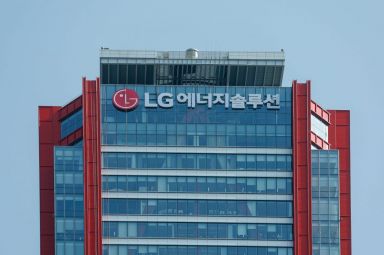 On the 10th, LG Energy Solution headquarters on Yeouidaero, Yeongdeungpo-gu, Seoul. Photo by Jinhyung Kang aymsdream@
After issuing 1 trillion won in corporate bonds for the first time since its launch in June, LG Energy Solution also issued private corporate bonds worth 1 billion dollars, approximately 1.3 trillion won, in September to Citibank, Morgan Stanley, and Bank of America Merrill Lynch (BoAML).
The bonds were issued in two tranches of 400 million dollars and 600 million dollars, maturing in 2026 and 2028 respectively. The interest rates are 5.625% and 5.75%. The interest rate on the bonds issued in June was in the 4% range, but it rose by more than 1 percentage point in just three months. Borrowings increased by 2.5 trillion won (31.4%) from 8.1092 trillion won at the end of last year to 10.6607 trillion won.
The reason why funding cannot be delayed despite high interest rates is due to planned investments. LG Energy Solution has spent a whopping 7.6454 trillion won on new and expanded battery production facilities this year. The estimated capital expenditure for LG Energy Solution next year is around 12 trillion won.
Although the electric vehicle market is shrinking due to recent reductions in government subsidies worldwide, it is difficult to delay the timing of planned investments. This is because batteries must be delivered to customers as scheduled. However, for new facilities that have not yet begun construction, such as the halted joint factory project in Turkey, the company is responding by adjusting the pace of investment.
Samsung SDI also spent 195.9 billion won on interest expenses this year, nearly quadrupling from 50.8 billion won during the same period last year. Samsung SDI is building a joint factory with Stellantis in Indiana, USA, and plans trillion-won scale investments including expansion of the Ulsan plant and joint investments with GM. Recently, it also decided on a paid-in capital increase of 1.1398 trillion won for StarPlus Energy, a joint venture with Stellantis. Samsung SDI's borrowings increased by 5.7% from 5.1482 trillion won at the end of last year to 5.4442 trillion won as of the third quarter.
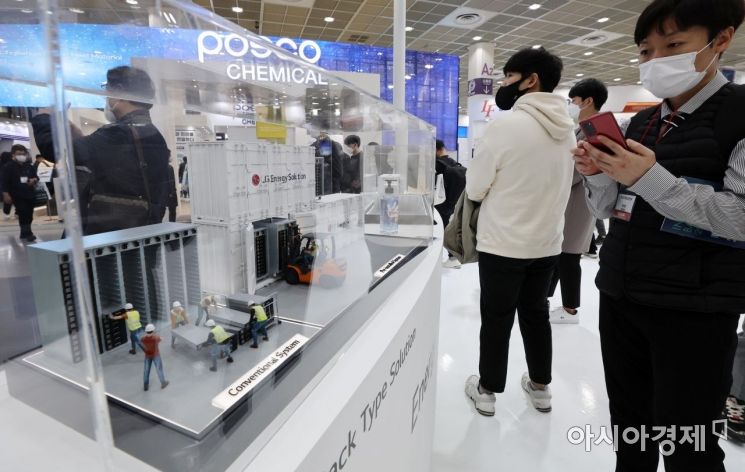 On the 17th, visitors attending 'InterBattery 2022' held at COEX in Samseong-dong, Gangnam-gu, Seoul, are examining LG Energy Solution's portable energy storage system (ESS) model. Photo by Hyunmin Kim kimhyun81@
Among the three battery companies, SK On pays the highest interest. Its cumulative interest expenses reached 336.5 billion won by the third quarter, more than triple the 112.8 billion won during the same period last year.
LG Energy Solution and Samsung SDI, which generate operating profits exceeding 1 trillion won, still have the capacity to bear the interest. In contrast, SK On, which has yet to escape losses, is bearing the full burden.
Battery material companies have also seen their interest expenses double or triple due to high interest rates. EcoPro and EcoPro BM bore interest expenses of 73.7 billion won and 45.9 billion won respectively by the third quarter, increases of 228% and 340% compared to the same period last year. POSCO Future M's interest expenses also rose from 9.9 billion won last year to 29.2 billion won.
Despite the heavy interest burden, battery companies are continuously seeking additional funding. SK On signed a financial cooperation memorandum of understanding (MOU) with NH Nonghyup Bank earlier this month, and five EcoPro affiliates signed a financial support agreement worth 500 billion won with DGB Daegu Bank on the 10th.
© The Asia Business Daily(www.asiae.co.kr). All rights reserved.
![Clutching a Stolen Dior Bag, Saying "I Hate Being Poor but Real"... The Grotesque Con of a "Human Knockoff" [Slate]](https://cwcontent.asiae.co.kr/asiaresize/183/2026021902243444107_1771435474.jpg)
















