Rider Union Demands Meeting with Kakao Mobility
"Unclear Transport and Commission Fee Policies... No Surcharge Standards"
Appealing for Low Rate Improvement... "About 6,000 to 8,000 KRW per Hour"
Kakao Mobility has fallen into a worsening situation. Following Kakao Taxi, now a problem has erupted in the quick service called 'Kakao Quick.' The delivery platform labor union, 'Rider Union Branch,' is demanding a meeting with Kakao Mobility tomorrow (the 15th). They pointed out that there are no standards for rider commissions and transportation fees. They claimed that the quick service rates are absurdly low, even below the minimum wage.

Angry Riders: "Commission Policy Lacks Transparency"
On the 14th, the Rider Union Branch of the Korean Confederation of Trade Unions Public Transport Workers' Union announced the formation of the 'Union Quick Service Council' on the 15th and stated they would demand a meeting with Kakao Mobility. They are preparing to take collective action near Gangnam Express Bus Terminal on the morning of the 15th.
The main reason riders are taking collective action is the "lack of transparency in the commission policy." Kakao Mobility started its quick service business in June 2021. It is estimated that about 200,000 quick service workers are registered with Kakao Quick. The Rider Union stated, "There are no standards for commissions and transportation fees in Kakao Quick," and "Riders have no way of knowing how much commission is deducted or how transportation fees are calculated."
However, regarding the important criterion of distance fees, it is calculated based on straight-line distance rather than actual distance, which lowers riders' income. They also claimed that surcharge fees based on distance, item weight, and size are not properly set.
A Rider Union official said, "While prices for fuel, maintenance, and labor costs are rising, quick service rates are falling," adding, "Riders have no choice but to work longer hours during the off-season when rates are lower, which also makes safety vulnerable."
"Rates Below Minimum Wage... Need for Countermeasures"
They also cited the hardship that the number of times a rider can cancel an accepted dispatch is limited to five per day, and once exhausted, they must perform the calls. They said, "Even if a rider accidentally accepts a low-rate call worth 2,000 to 3,000 won per case, they cannot cancel the order and are forced to work."
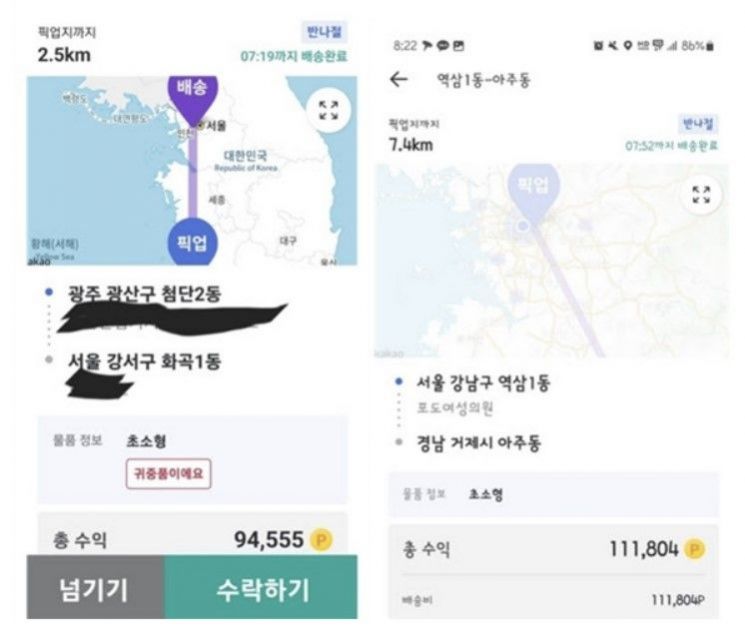
There were also criticisms of low-rate calls that do not meet the minimum hourly wage (9,620 won). For example, for a call from Gwangsan, Gwangju to Gangseo, Seoul, the rider's revenue is about 94,000 won. However, with fuel costs at 50,000 won and driving time of 5 hours, the actual income is about 44,000 won. Dividing this by the hours worked results in 8,800 won per hour, which is below the minimum wage.
The revenue for a call from Gangnam, Seoul to Geoje, Gyeongnam is about 111,800 won. Considering fuel costs of 67,000 won and driving time of 8 hours and 30 minutes, riders say the actual income is at the 6,000 won level.
Jeon Seok-gyu, chairman of the Quick Service Council, said, "Clear answers are needed for riders regarding Kakao Quick's basic fare system and surcharges, and countermeasures must be prepared," adding, "We will formally establish the Rider Union Quick Service Council and demand dialogue with Kakao Mobility."
© The Asia Business Daily(www.asiae.co.kr). All rights reserved.
![Clutching a Stolen Dior Bag, Saying "I Hate Being Poor but Real"... The Grotesque Con of a "Human Knockoff" [Slate]](https://cwcontent.asiae.co.kr/asiaresize/183/2026021902243444107_1771435474.jpg)
















