Agreement on the 55th SCM Joint Statement on the 13th
Real-time Sharing of Early Warning Satellite Information
TDS Also Reflects North Korean Threat... Revised for the First Time in 10 Years
U.S. Secretary of Defense Lloyd Austin stated on the 13th regarding the suspension of the 9·19 Inter-Korean Military Agreement, “We have agreed to closely consult on how to resolve this moving forward.”
At a press conference held after chairing the Security Consultative Meeting (SCM) with South Korean Minister of National Defense Shin Won-sik, Secretary Austin responded to a question asking, “Does the U.S. also believe the 9·19 Agreement should be revised to prevent provocations by North Korea similar to Hamas?” The SCM, which began in 1968, is an annual consultative body primarily addressing issues related to the Korea-U.S. alliance in military and security fields, including security on the Korean Peninsula and the combined defense posture. It is held alternately in Seoul and Washington, and this year marks the 55th meeting.
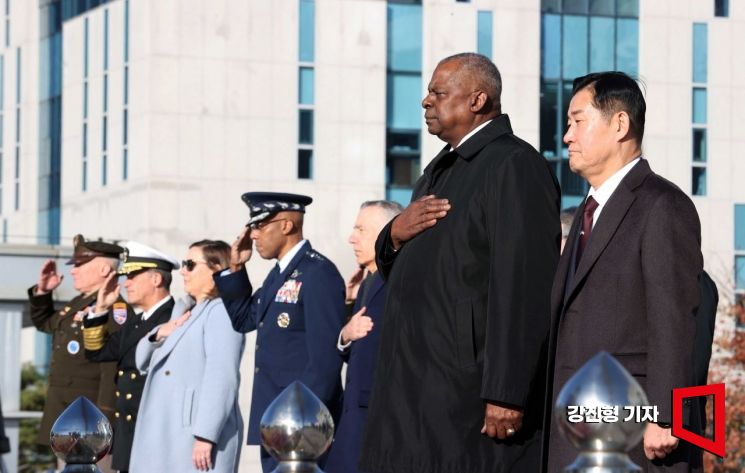 On the morning of the 13th, Shin Won-sik, Minister of National Defense, and Lloyd Austin, U.S. Secretary of Defense, along with the U.S. delegation of the Security Consultative Meeting (SCM), attended the 55th SCM Chairmanship event held at the Ministry of National Defense parade ground in Yongsan-gu, Seoul, saluting the national flag. Photo by Joint Press Corps
Minister Shin has argued that the establishment of no-fly zones under the 9·19 Military Agreement limits the South Korean military’s surveillance and reconnaissance capabilities against North Korean artillery and multiple rocket launcher targets, and has called for the suspension of the agreement’s effectiveness as soon as possible. In response to a question about whether the U.S. can maintain the current frequency of strategic asset deployments to South Korea amid ongoing wars in Ukraine and the Middle East, Austin said, “My answer is yes. We can do that.” He emphasized, “The U.S. has the most powerful military in the world. The important point is that wherever the U.S. deploys strategic assets, it does so not alone but in cooperation with allies and partners.”
He added, “The 'Washington Declaration' includes a commitment to increase the frequency of strategic asset deployments to the Korean Peninsula. As part of efforts to fulfill that promise, a strategic nuclear submarine (SSBN) recently made a port call in Busan, and a strategic bomber B-52H landed on the Korean Peninsula. Another aircraft carrier is also scheduled to arrive soon.”
Furthermore, he stated, “The U.S. Department of Defense budget has been structured to allocate historically the largest amount directly related to strategy. It was not easy, but we achieved it. If anything is needed to ensure freedom and peace in the Indo-Pacific region, we will mobilize the necessary assets and do what our allies want at any time. There may be questions about whether this will continue under the administration following the Biden administration, but it will continue going forward.”
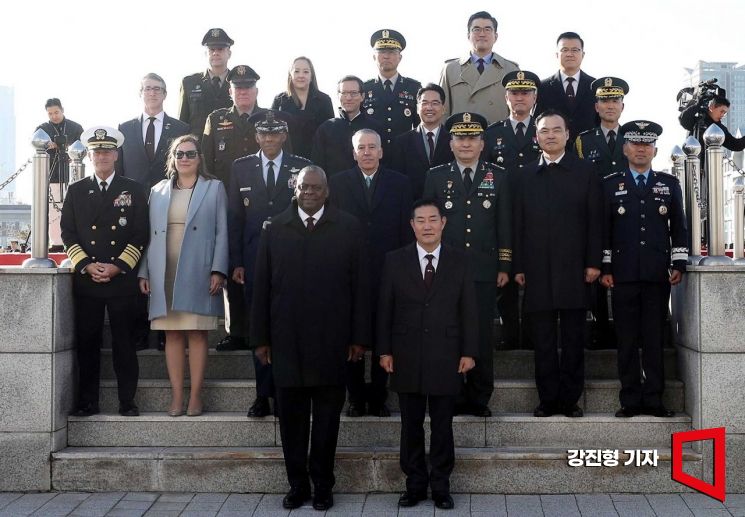 On the morning of the 13th, Shin Won-sik, Minister of National Defense, and Lloyd Austin, U.S. Secretary of Defense, are taking a commemorative photo with attendees at the 55th SCM (Security Consultative Meeting) chairmanship event held at the Ministry of National Defense parade ground in Yongsan-gu, Seoul. Photo by Joint Press Corps
In response to a question asking whether the U.S. believes it can adequately respond if a crisis arises in North Korea while dealing with the Ukraine war, Middle East situation, and China issues, Minister Shin warned, “If North Korea provokes a war, what will disappear is the Kim Jong-un regime, and what will be gained is unification based on the free democratic order led by the Republic of Korea.”
He said, “Secretary Austin and I confirmed that any nuclear attack by North Korea is absolutely unacceptable, and if North Korea uses nuclear weapons, it will face an immediate, overwhelming, and decisive response from the Korea-U.S. alliance, leading to the end of the Kim Jong-un regime. The combined forces of Korea and the U.S. maintain a firm readiness posture with a 'Fight Tonight' stance.”
Meanwhile, through the consultations held that day, U.S. military authorities agreed to share real-time information with South Korea regarding North Korea’s ballistic missile launches and related data obtained through early warning satellites. They also decided to revise the 'Tailored Deterrence Strategy' (TDS), enacted in 2013, for the first time in 10 years in response to North Korea’s advanced nuclear and missile threats. Both sides reaffirmed their commitment to continuously enhance and expand trilateral security cooperation among Korea, the U.S., and Japan, including ▲high-level policy consultations ▲triangular exercises ▲information sharing ▲and defense exchange cooperation.
© The Asia Business Daily(www.asiae.co.kr). All rights reserved.
![Clutching a Stolen Dior Bag, Saying "I Hate Being Poor but Real"... The Grotesque Con of a "Human Knockoff" [Slate]](https://cwcontent.asiae.co.kr/asiaresize/183/2026021902243444107_1771435474.jpg)
















