"Pilot Project Restructuring Plan to Be Announced Soon"
The government is gathering opinions from various sectors to reform the pilot project for non-face-to-face medical consultations. In the current pilot project, most services have effectively been suspended due to strengthened conditions such as restrictions on initial consultations via non-face-to-face methods.
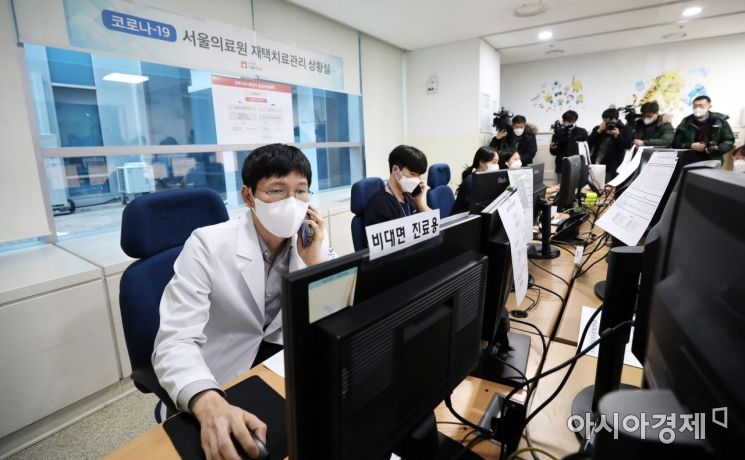 Last year, medical staff at the Seoul Medical Center's COVID-19 Home Treatment Management Situation Room in Jungnang-gu, Seoul, provided remote medical care to COVID-19 patients undergoing home treatment. Photo by Joint Press Corps
According to the Ministry of Health and Welfare on the 13th, the ministry plans to announce a reform plan for the non-face-to-face medical consultation pilot project soon, after collecting opinions from advisory groups and patient organizations. A ministry official stated, "We are finalizing the details while proceeding with the reform work in line with the direction of the non-face-to-face medical consultation pilot project," but added, "No specific details have been finalized yet."
Earlier, on the 7th, the Ministry of Health and Welfare issued a clarification regarding the reform of the non-face-to-face medical consultation pilot project, stating, "The pilot project is currently gathering opinions from advisory groups and various sectors, and no supplementary measures have been finalized yet." The ministry released this clarification following a media report that the ministry was considering maintaining the principle of non-face-to-face consultations centered on follow-up patients while relaxing the criteria for follow-up visits.
The currently implemented non-face-to-face medical consultation pilot project restricts initial consultations. In principle, non-face-to-face consultations are only possible for follow-up visits for the same illness after an initial face-to-face consultation, and follow-up consultations must be conducted through the same medical institution as the initial visit. Exceptions allowing non-face-to-face initial consultations are made only for residents of remote islands and mountainous areas or elderly and disabled individuals with mobility difficulties. The criteria for follow-up non-face-to-face consultations require that, except for chronic diseases, patients must have had a face-to-face consultation for the same illness within 30 days, and for chronic diseases, at least one face-to-face consultation within one year.
Because of these restrictions, most non-face-to-face medical consultation services have effectively been suspended. Since the pilot project began in earnest in September, initial consultations have been practically restricted, and the number of non-face-to-face consultations has sharply declined. According to the Remote Medical Industry Association (Wonsanhyeop), as of September, the average daily number of non-face-to-face consultation requests on platforms operated by member companies was only about 300.
Of these, only 15% (around 40 cases) actually led to consultations, and the number of cases where prescriptions were issued and delivered after completing non-face-to-face consultations was fewer than 10 per day on each platform. This appears to be due to users applying for non-face-to-face consultations without knowing that initial consultations were restricted after the pilot project started. Industry insiders explain that the number of non-face-to-face consultations has continued without significant change since then. A Wonsanhyeop official said, "After the guidance period of the non-face-to-face medical consultation pilot project ended, users have effectively stopped using the platforms."
Digital healthcare companies providing non-face-to-face medical consultation services are seeking new opportunities. Representative examples include health consultations with medical professionals such as doctors and nurses and hospital appointment services, as well as new services like nutritional supplement subscriptions and direct-to-consumer (DTC) genetic testing.
Some providers are even discontinuing non-face-to-face medical consultation services. Hudadak Care, operated by Ildong Pharmaceutical, ended its non-face-to-face consultation service at the end of last month due to a decrease in users. Prior to Hudadak Care, platforms such as Namanui Doctor, Padak, and Maedup also terminated their non-face-to-face consultation services. According to Wonsanhyeop, as of the September survey, nearly half of the 31 non-face-to-face consultation services?14 services?had stopped offering non-face-to-face consultations.
However, reforming the pilot project system is expected to face challenges due to opposition from the medical community and concerns about potential side effects such as overmedicalization. The Korean Medical Association has expressed opposition to allowing initial non-face-to-face consultations, citing that the safety and efficacy of such consultations have not been verified. The medical community also points out the risk of prescription misuse during non-face-to-face consultations. In early last month’s National Assembly Health and Welfare Committee audit, the issue of 'medical shopping' related to non-face-to-face consultations was also raised.
© The Asia Business Daily(www.asiae.co.kr). All rights reserved.
![Clutching a Stolen Dior Bag, Saying "I Hate Being Poor but Real"... The Grotesque Con of a "Human Knockoff" [Slate]](https://cwcontent.asiae.co.kr/asiaresize/183/2026021902243444107_1771435474.jpg)















