Experts and Local Residents Participate in Samdo and Bonryang Area Policy Discussion Meeting
A debate was held on solutions amid claims that the Gwangju-type job policy is facing a crisis.
The issue arose from concerns that although Gwangju Global Motors, the first company under the Gwangju-type job policy, has settled in the Bitgreen Industrial Complex, the promised residential complex for workers has not been developed as agreed.
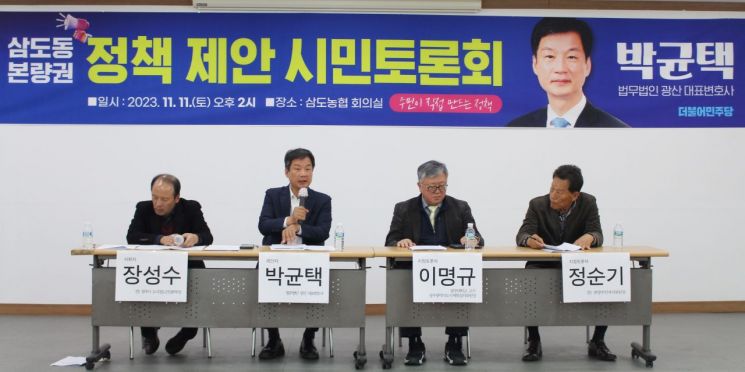
On the afternoon of the 11th, Park Gyuntaek, legal special advisor to Lee Jae-myung, leader of the Democratic Party of Korea, held a policy proposal and debate meeting with residents of the Samdo and Bonryang areas at the Samdo Nonghyup meeting room in Gwangju Metropolitan City.
At this event, in-depth discussions were held on the creation of a dedicated residential complex to complete the Gwangju-type job policy.
The debate, which began with a presentation by Attorney Park, was moderated by Jang Seongsu, former head of the Gwangju Urban Railway Construction Headquarters. Designated discussants included Lee Myunggyu, professor at Gwangju University (former vice chairman of the Gwangju Urban Planning Committee), and Jeong Sunggi, former chairman of the Bonryang Residents' Autonomous Committee. About 80 residents participated and exchanged opinions.
Attorney Park stated, “The core of the Gwangju-type job policy is that as the nominal wages of participating company workers decrease, the state must faithfully provide indirect support such as housing, education, and medical security as promised. To ensure the normal operation of the companies already settled and to attract excellent companies to Gwangju in the future, it is necessary to develop a public housing site with a population scale of 50,000 in the Samdo and Bonryang areas adjacent to the Bitgreen Industrial Complex and the future car national industrial complex, and to create a dedicated residential complex that can provide indirect support to workers.”
Lee Myunggyu, professor at Gwangju University (former vice chairman of the Gwangju Urban Planning Committee), said, “The housing support promises made at the time of introducing the Gwangju-type job policy must be kept. Since it is difficult to bear the costs with Gwangju City's resources alone, it is necessary to establish legal grounds to receive national support.”
Meanwhile, various opinions were exchanged regarding the redevelopment plans for natural villages within the development restriction zones such as Samdo and Bonryang, which face a population cliff and have very poor living environments.
Attorney Park said, “To improve living conditions in natural villages and prevent rural extinction, it is necessary to expand project funding for environmental improvements such as achieving 100% water supply coverage, constructing separate sewage systems, and administrative agencies managing old vacant houses. Additionally, to enhance welfare for natural village residents, increase population, and boost income, it should be possible to partially lift development restrictions within three times the existing residential area to allow for housing expansion, new housing construction for incoming residents, and construction of rural experience-type short-term rental housing. For this, an amendment to the Development Restriction Zone Special Act is required.”
Jeong Sunggi, former chairman of the Bonryang-dong Residents' Autonomous Committee, said, “There is a sense of frustration wondering if there is any other area as underdeveloped as Samdo and Bonryang among metropolitan local governments. If redevelopment conditions for natural villages within the development restriction zones improve through legal amendments, it will greatly help regional development through improved living environments and population inflow for residents who have suffered for a long time.”
Meanwhile, Attorney Park will hold policy proposal and debate meetings on Gwangsan development plans every Saturday at 2 p.m. until December, touring the region. On the 18th, a meeting will be held at the Pyeongdong Nonghyup meeting room with residents of the Pyeongdong and Donggok areas to discuss topics such as ‘Relocation and utilization plans for the Pyeongdong shooting range,’ ‘Creation of a premium Pyeongdong Lake Park and Kimchi Village,’ and ‘Operation plans for a direct transaction market for locally produced agricultural products.’
© The Asia Business Daily(www.asiae.co.kr). All rights reserved.
![Clutching a Stolen Dior Bag, Saying "I Hate Being Poor but Real"... The Grotesque Con of a "Human Knockoff" [Slate]](https://cwcontent.asiae.co.kr/asiaresize/183/2026021902243444107_1771435474.jpg)
















