JobKorea Survey of 1,935 Office Workers
"81.3% Have Recently Considered Changing Jobs"
Among 10 office workers who considered changing jobs, about 6 regretted giving up on the job change. On the other hand, the number of workers who regretted attempting to change jobs was less than half of that, meaning regret over giving up on a job change was more than twice as common as regret over attempting one.
JobKorea recently conducted a survey on 'job change postponement experiences' targeting 1,935 office workers who had planned to change jobs. The results showed that 81.3% of respondents answered that they had 'recently considered changing jobs.'
When asked the reasons for considering a job change, the most common answer was 'dissatisfaction with salary' (32.5%, multiple responses). This was followed by 'lack of work-life balance (WLB)' (18.6%) and 'for long-term career management' (17.4%).
Also, a significant number of workers who considered changing jobs revealed that they did not follow through and remained at their current company.
Among those who said they had considered changing jobs, 44.8% answered that they 'attempted to change jobs but ended up staying at their previous company,' while 55.2% said they 'attempted to change jobs and moved to a new company.'
When asked why they postponed changing jobs and stayed at their current company, the most common answer was 'could not find a suitable company to apply to' (30.6%, multiple responses). The second most common was 'postponed due to timing issues but plan to try again' (16.5%). This was followed by similar proportions of answers such as 'lacked confidence in succeeding in the job change' (13.5%), 'because of colleagues I worked with' (10.6%), and 'the company offered economic compensation such as a salary increase' (10.1%). A minority opinion was 'the cause or problem that made me consider changing jobs was resolved' (6.0%).
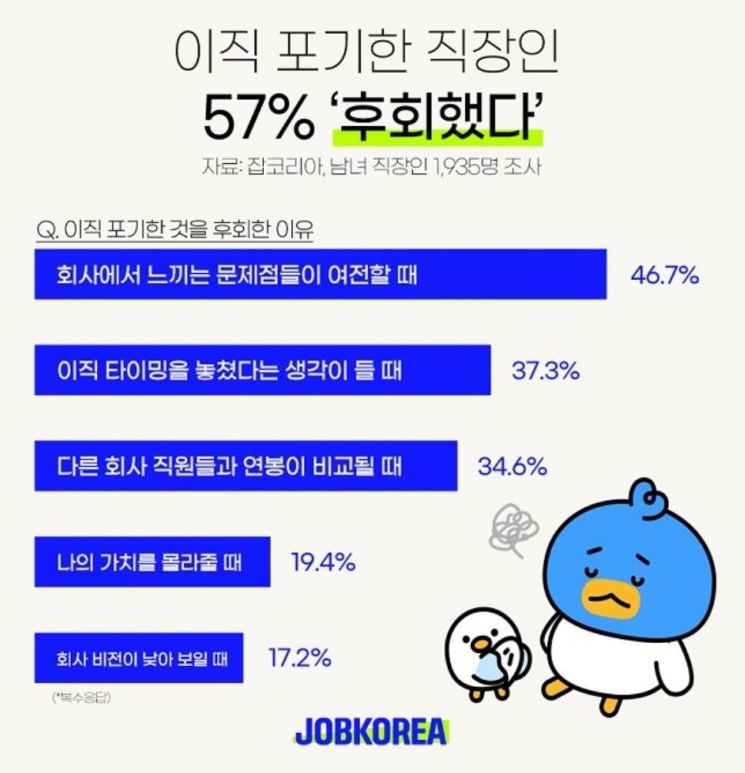
At the crossroads of whether to change jobs or not, those who chose to postpone regretted it more than twice as much as those who chose to change jobs. Only 25.6% responded that they regretted attempting to change jobs, whereas 57.0% said they regretted giving up on changing jobs.
Those who regretted giving up on changing jobs most commonly regretted 'when the problems felt at the company remain unresolved and only time passes' (46.7%, multiple responses). They also regretted 'when they felt they missed the appropriate timing for a job change' (37.3%) and 'when comparing treatment with workers at other companies, such as industry average salaries' (34.6%).
Additionally, office workers regretted giving up on changing jobs 'when they felt the company or their boss did not properly recognize their value' (19.4%) and 'when they felt the company’s prospects were not good' (17.2%). They also felt regret 'when they felt they failed in career management due to too many years of service or high rank' (7.4%) and 'when acquaintances who succeeded in changing jobs were thriving' (6.8%).
Conversely, when respondents who regretted attempting to change jobs were asked when they regretted that choice, the top answers were 'when they realized after changing jobs that the new company was just like the previous one' (37.8%) and 'when salary, rank, or other treatment worsened compared to before the job change' (33.5%, multiple responses). Following these were 'when the workload at the new company was too intense' (24.8%), 'when results were poor or the job change failed' (24.2%), and 'when they were very disappointed with colleagues or bosses met after the job change' (18.4%). Some also mentioned 'when they heard about noticeable performance bonuses or rewards given at the previous company after changing jobs' (10.1%) and 'when they had difficulties adapting to the new organization' (9.7%).
© The Asia Business Daily(www.asiae.co.kr). All rights reserved.
![Clutching a Stolen Dior Bag, Saying "I Hate Being Poor but Real"... The Grotesque Con of a "Human Knockoff" [Slate]](https://cwcontent.asiae.co.kr/asiaresize/183/2026021902243444107_1771435474.jpg)















