Impact of Gimpo's Incorporation into Seoul on Education Rights
Transfer of Education Grants Between Gyeonggi and Seoul Needed
Over 200 Students Leaving Rural Admissions in Gimpo Annually
Joining Competition with Seoul-Area Foreign Language and Autonomous Private High Schools
As the incorporation of Gimpo City into Seoul becomes an issue, it is expected that the impact on education will also be significant if the incorporation is realized. Budget transfers, including local education finance grants (education grants) allocated to the Gyeonggi Provincial Office of Education and the Seoul Metropolitan Office of Education, will take place, and with Gimpo City students being incorporated into Seoul, support for more than 200 students annually under the rural and fishing village special admission quota will disappear.
◆ Seoul Metropolitan Office of Education budget increases by about 150 billion KRW = First, budget transfers of education grants from the Gyeonggi Provincial Office of Education, the Seoul Metropolitan Office of Education, and the Gimpo City Office of Education Support are expected to occur. According to the Enforcement Decree of the Local Education Finance Grant Act, when two or more cities or provinces are merged to establish a new city or province, the previous education grants are granted as is to the new city or province. However, in cases like Gimpo City where the jurisdictional area changes, the education grants to be granted to the new city or province must be recalculated based on the education grants previously granted to the former city or province.
However, in recent cases of administrative district incorporation, the previous education grant amount was considered during recalculation. For example, Gunwi County, which was incorporated from Gyeongsangbuk-do to Daegu Metropolitan City in July this year, had its education grant increased by the amount allocated in the previous administrative district. According to the Gyeongbuk and Daegu Offices of Education, next year's budget shows a decrease of 23.5 billion KRW in education grants for Gyeongbuk Office of Education and an increase of 26.3 billion KRW for Daegu Office of Education.
If the education grant amount of the previous administrative district is maintained as is, the scale can be estimated through the current operating expenses of the Gimpo City Office of Education Support and the budgets allocated to each school. According to the Gyeonggi Provincial Office of Education, this year’s budget for the Gimpo City Office of Education Support is 103 billion KRW, and the basic operating expenses for public schools within Gimpo City amount to 48.7 billion KRW. Including other budgets such as personnel expenses, a total of more than 151.7 billion KRW is expected to be transferred from the Gyeonggi Provincial Office of Education to the Seoul Metropolitan Office of Education.
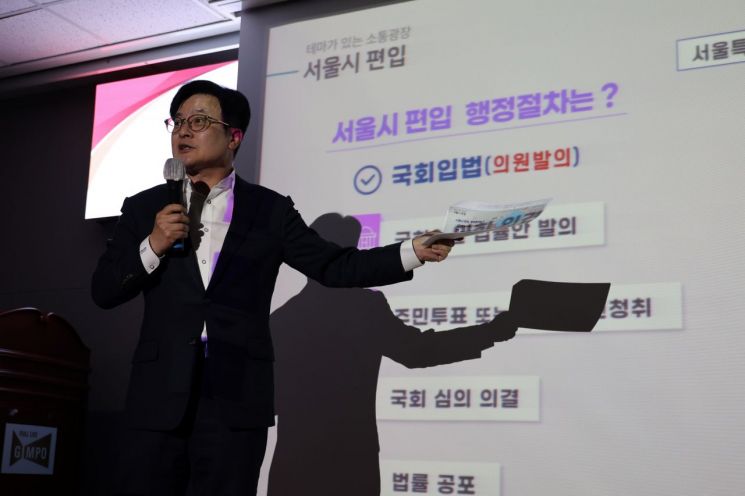
◆ Loss of rural and fishing village special admission for Gimpo residents = Currently, students living in some areas of Gimpo City are expected to be affected in college admissions due to the disappearance of the rural and fishing village special admission quota. Students living in the mixed urban-rural areas of Tongjin, Gochon, and Yangchon-eup, as well as the eup and myeon areas of Daegot, Wolgot, and Haseong in Gimpo City, are currently eligible to apply for opportunity-equalizing admissions such as the rural and fishing village special admission quota as students from rural areas under the Local Autonomy Act. Currently, Gochon, Masong, Haseong, Yanggok, and Tongjin High Schools are among the eligible schools.
According to data on 'Rural and Fishing Village Special Admission Status within Gimpo City' obtained by the office of Park Sang-hyuk, a member of the Democratic Party, a total of 228 students were admitted through the rural and fishing village special admission quota at high schools within Gimpo City last year. The number of students admitted through this quota ranged from as few as 10 to as many as 75 per school. If Gimpo City is incorporated into Seoul and becomes a district, it will only have administrative neighborhoods (dong) as lower administrative units, making it difficult to apply for the rural and fishing village special admission quota. A representative from Park Sang-hyuk’s office explained, "Examinees have recently experienced great confusion due to the exclusion of killer questions in the CSAT, and if administrative district reorganization occurs, even greater confusion is expected."
◆ Increased competition rates for specialized high schools such as foreign language high schools and autonomous private high schools = If Gimpo City is incorporated into Seoul, residents will be able to apply to Seoul-area special purpose high schools (specialized high schools) and autonomous private high schools (Jasago) that recruit on a metropolitan-wide basis. Currently, Seoul has 2 science high schools, 6 foreign language high schools, 1 international high school, and 16 regional autonomous private high schools.
Accordingly, it is predicted that competition rates for autonomous private high schools in Seoul will rise. According to analysis data from Jongro Academy, last year the competition ratios for science high schools in Seoul were 4.43:1, foreign language high schools 1.23:1, international high schools 1.76:1, and autonomous private high schools 1.22:1. This year, the number of recruits is 300 for science high schools, 1,400 for foreign language high schools, 150 for international high schools, and 6,472 for autonomous private high schools, totaling 8,322 students. Each year, about 4,000 to 5,000 third-year students from 24 middle schools in Gimpo City advance to high school, so if Gimpo is incorporated into Seoul, it is expected to be a considerable factor in increasing competition rates.
© The Asia Business Daily(www.asiae.co.kr). All rights reserved.
![Clutching a Stolen Dior Bag, Saying "I Hate Being Poor but Real"... The Grotesque Con of a "Human Knockoff" [Slate]](https://cwcontent.asiae.co.kr/asiaresize/183/2026021902243444107_1771435474.jpg)















