If Gimpo City is incorporated into Seoul, Seoul's contribution increases
National funding decreases if Siul City participates
As the incorporation of Gimpo City into Seoul City becomes a topic of public discussion, attention is being drawn to whether the deadly traffic congestion in Gimpo can be alleviated. This is because the Gimpo Gold Line has earned the notorious nickname 'GimGolla (Gimpo Golbyeong Line)', known as a hellish subway, leading to a consensus that a new alternative is needed. Currently, Gimpo City is promoting projects to connect Seoul Subway Line 5 and Incheon Subway Line 2 to Gimpo, respectively. Among these, what Gimpo residents want the most is the extension of Seoul Subway Line 5.
The government also plans to continue the Line 5 extension regardless of the ongoing integration discussions. On the 6th, at the National Assembly Budget and Accounts Committee plenary session, Won Hee-ryong, Minister of Land, Infrastructure and Transport, emphasized regarding the ruling party's push for 'Gimpo City's incorporation into Seoul' that "the issue of extending (Seoul Subway) Line 5 (to Gimpo) will be pursued without being affected by that." If the connection is confirmed, the remaining issue is the cost. The extension of Seoul Subway Line 5 is expected to require project costs in the trillions of won. Because of this, there are concerns that Seoul City may have to pay several hundred billion won more, which it would not have to pay if Gimpo City is not incorporated.
▲If incorporated, Seoul City will also participate in the Line 5 cost-sharing= The biggest issue is that Seoul City will have to bear additional costs for the extension of Seoul Subway Line 5, which connects Gimpo City and Incheon City.
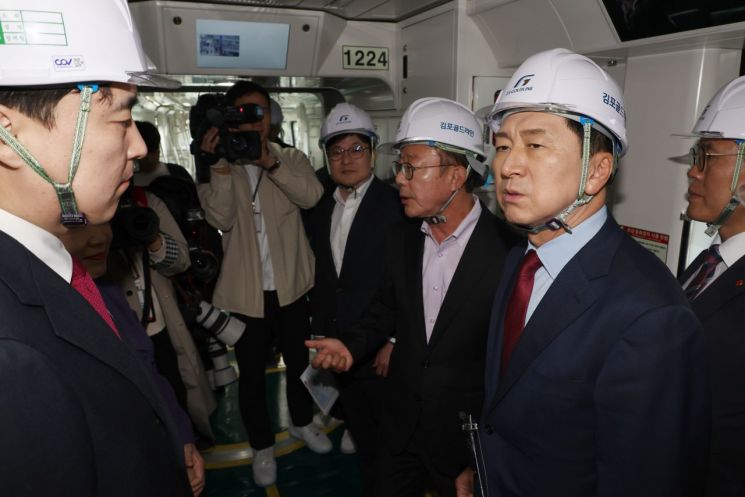 Kim Ki-hyun, leader of the People Power Party, visited the Gimpo Hangang Vehicle Base, which manages the Gimpo Gold Line, on the 30th of last month and toured the inside of the train. Photo by Yonhap News
The extension of Seoul Subway Line 5 is a new 23.89 km section project connecting Seoul Banghwa Station, Incheon Geomdan New Town, and Gimpo Hangang New Town. Currently, Gimpo City advocates for a route that passes only north of Geomdan by installing one station. On the other hand, Incheon City insists on a route that passes through the southern part in a U-shape by installing at least 2 to 3 stations in the Geomdan New Town section, leading to sharp disagreements. Depending on each city's route plan, there is a significant difference in costs, but the total cost is expected to be around 3 trillion won.
About half of this will be raised and borne as transportation cost-sharing fees by the Korea Land and Housing Corporation (LH), the project implementer of the Gimpo Hangang 2 (Compact City) public housing district. On the 30th of last month, Kim Byung-soo, Mayor of Gimpo City, said at a 'Metropolitan New Town Transportation Measures Meeting' with the leadership of the People Power Party, "The extension of Line 5 will be built by securing 1.6 trillion won from the Compact City transportation cost-sharing fees."
The remaining costs will be borne by the national government and local governments including Seoul City, Gyeonggi Province, Incheon City, and Gimpo City. According to the 'Railway Work Guidelines' published by the Ministry of Land, Infrastructure and Transport, for metropolitan railways, the national government covers 70% and local governments cover 30%. However, Seoul City bears costs at a 50:50 ratio because it is relatively more financially capable than other local governments. According to this cost-sharing ratio, for the extension of Line 5, Seoul City will bear 50% of the costs up to the Seoul city boundary in consultation with Gangseo-gu, through which the line passes. For the section beyond Seoul, Incheon City will bear 30%, and Gyeonggi Province and Gimpo City will each bear 30% for the Gimpo section.
However, if Gimpo City is incorporated into Seoul City, Seoul City and Gimpo City will share the costs for all sections except the Incheon section. The cost share itself will increase from 30% to 50% due to incorporation into Seoul City. Ultimately, Seoul City will have to bear additional costs with Gimpo City amounting to 20% of the total project cost, including Gyeonggi Province's share. Although exact estimates are difficult, this cost is expected to reach up to several hundred billion won.
▲An even more troublesome 'urban railway plan'= If Seoul City incorporates Gimpo City and excludes Incheon City to accelerate the Seoul Subway Line 5 extension project by converting it into an urban railway, the situation could become more difficult. Urban railways require cost-sharing of 60% national government and 40% local governments, but Seoul is an exception where the cost-sharing ratio is reversed to 40% national government and 60% local governments, similar to metropolitan railways. Moreover, since Gyeonggi Province and Incheon are excluded from local government cost-sharing, the cost-saving effect from route straightening cannot be guaranteed.
Meanwhile, the subway extension cost-sharing amount Seoul City must pay if it incorporates Gimpo City varies greatly depending on the timing of incorporation and the start of construction. However, estimates can be made by referring to Gimpo City's predictions.
On June 15 of this year, the Administrative Welfare Committee of the Gimpo City Council held a meeting to review the 2022 fiscal year settlement. At the meeting, Yoo Young-sook, chairperson of the Administrative Welfare Committee, criticized that Gimpo City's budget was in the red and demanded, "Please prepare and submit a plan on how to prepare 500 billion won for the railway cost-sharing related to Incheon Line 2 and Seoul Line 5 preparations." More specifically, Gimpo City predicts that 349.4 billion won will be needed for the extension of Seoul Subway Line 5, 93.3 billion won for the extension of Incheon Line 2, and 54.3 billion won for the GTX-D line.
Additionally, if Seoul City incorporates Gimpo City, Seoul City will also have to bear part of the subway operating costs. According to the 'Railway Work Guidelines,' subway operating costs are borne by local governments.
© The Asia Business Daily(www.asiae.co.kr). All rights reserved.
![Clutching a Stolen Dior Bag, Saying "I Hate Being Poor but Real"... The Grotesque Con of a "Human Knockoff" [Slate]](https://cwcontent.asiae.co.kr/asiaresize/183/2026021902243444107_1771435474.jpg)















