A bill has been proposed to mandate the inclusion of estimation models and error rates in the revenue budget forecast analysis report submitted to the National Assembly in order to prevent large-scale tax revenue discrepancies by the government. This comes from the judgment that fundamental improvements in forecasting capabilities are necessary due to the government's large-scale tax revenue errors, with a revenue shortfall approaching 60 trillion won just this year.
On the 1st, Jin Sun-mi, a member of the National Assembly's Planning and Finance Committee from the Democratic Party of Korea, announced that she has taken the lead in proposing a partial amendment to the National Finance Act. The amendment adds the government's revenue budget forecast model, methods, and error rates to the revenue budget forecast analysis report and requires it to undergo management equivalent to the regular statistical quality diagnosis under the Statistics Act.
Under current law, the government is required to attach a revenue budget forecast analysis report when submitting the next year's budget proposal to the National Assembly, but it does not include the display of revenue forecast models, methods, or error rates. The amendment aims to have the government disclose tax revenue forecasting models and methods so that the private sector can also utilize and verify tax revenue information.
Specifically, the core of the amendment is to newly establish provisions in Article 32-2 (Revenue Budget Forecast) of the National Finance Act that require the report to include changes if the revenue forecast model differs from the previous year, the methods and basis of revenue forecasting, as well as an evaluation and cause analysis of the total and itemized differences between the previous year's revenue budget and revenue settlement. Additionally, the previous year's tax revenue error rate and the first half's tax revenue deviation rate will also be disclosed. To improve statistical quality, the report must also undergo quality diagnosis and management.
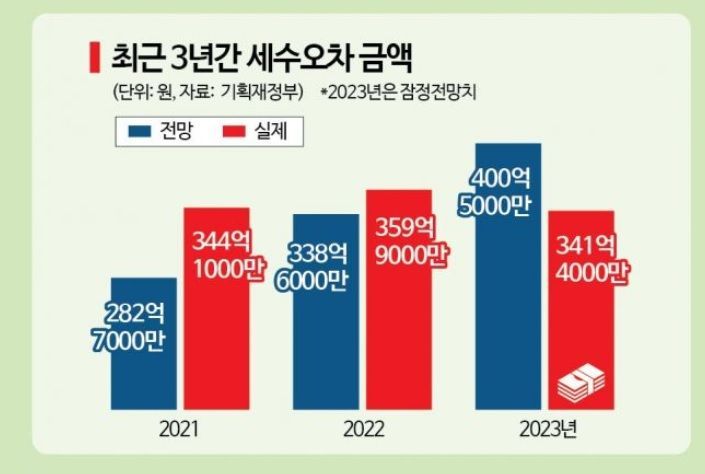
Representative Jin said, "If unexpected tax revenue shortfalls occur due to overestimation of tax income, it can lead to instability in fiscal balance, such as large-scale expenditure cuts or supplementary budget (Chugyeong) formulation to compensate for the shortfall." She added, "Repeated large-scale tax revenue errors cause errors and distortions in fiscal policy, weakening the fiscal responsiveness to economic cycles."
The government previously forecasted that, based on the tax revenue re-estimation this year, national tax revenue by the end of the year would be around 341.4 trillion won, down 59.1 trillion won from the budgeted 400.5 trillion won. The resulting tax revenue error rate is -17.3%, the largest ever based on years with deficits. The tax revenue error rates were 17.9% in 2021 and 13.3% last year, marking three consecutive years of double-digit error rates.
As the tax revenue error rate increases, it becomes difficult for the government to establish fiscal policies to respond to economic fluctuations. If the government issues deficit bonds because it cannot cover national expenditures with tax revenue, it must accurately understand tax revenue to minimize market shocks. Improving the accuracy of tax revenue forecasts enables more efficient allocation of fiscal resources. The amendment plans to apply the requirement to submit the estimation model and methods as attachments to the revenue budget forecast analysis report starting with the 2025 budget proposal submitted to the National Assembly.
© The Asia Business Daily(www.asiae.co.kr). All rights reserved.
![Clutching a Stolen Dior Bag, Saying "I Hate Being Poor but Real"... The Grotesque Con of a "Human Knockoff" [Slate]](https://cwcontent.asiae.co.kr/asiaresize/183/2026021902243444107_1771435474.jpg)















