September Business Workforce Survey Results
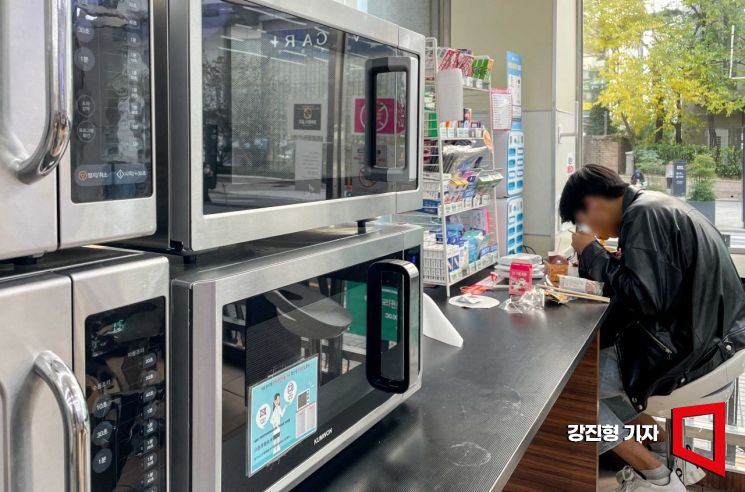 Although the recent consumer price inflation rate remains in the 3% range, the perceived inflation rate is much higher, increasing the burden on ordinary citizens. On the 30th, during lunchtime, people visiting a convenience store in Seoul were eating lunch boxes and ready-to-eat meals. Photo by Jang Jin-hyeong aymsdream@
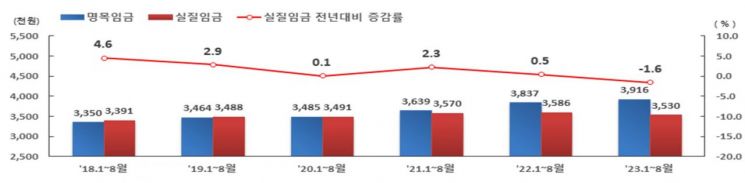
The decline in real wages adjusted for inflation has become steeper. This is due to the widening gap between nominal wage growth and inflation rates.
According to the September Business Labor Force Survey results released by the Ministry of Employment and Labor on the 31st, the average monthly real wage per worker from January to August was 3.53 million won, down 1.6% (-56,000 won) compared to the same period last year (3.586 million won).
The real wage from January to July was 3.559 million won, a 1.5% (-53,000 won) decrease compared to the same period last year. The rate of decline increased by 0.1 percentage points in just one month.
The widening decrease in real wages is because inflation rose more than nominal wages. From January to July this year, nominal wages increased by 2.2%, while the Consumer Price Index (CPI) rose by 3.7%. However, as of January to August, the cumulative CPI increase remained at 3.7%, but the nominal wage growth slowed to 2.1%.
As of September, the number of employees in businesses with one or more workers was 19.907 million, an increase of 310,000 (1.6%) compared to the same month last year (19.597 million). The number of regular workers increased by 234,000 (1.4%), temporary and daily workers by 70,000 (3.6%), and other workers by 5,000 (0.4%) compared to the previous year.
The industries with increased employment were health and social welfare services (104,000; 4.7%), accommodation and food services (55,000; 4.9%), and professional, scientific, and technical services (43,000; 3.4%), in that order. Industries with decreased employment were construction (-21,000; -1.5%), education services (-11,000; -0.7%), and electricity, gas, steam, and air conditioning supply (-1,000; -1.3%). Among all industries, manufacturing, which accounts for the largest share of employees (about 19%), increased by 26,000 workers.
As of August, the average monthly working hours per worker was 161.1 hours, down 1.8 hours compared to the same month last year. A Ministry of Employment and Labor official explained, "Although the number of working days according to the 'Public Office Holiday Regulation' remained the same as last year (22 days), the decrease in working hours is due to reduced hours in construction, accommodation and food services, and health and social welfare sectors."
The number of vacant jobs has been declining since January this year. In September, the number of vacant jobs was 215,000, a decrease of 12,000 compared to the previous year.
© The Asia Business Daily(www.asiae.co.kr). All rights reserved.
![Clutching a Stolen Dior Bag, Saying "I Hate Being Poor but Real"... The Grotesque Con of a "Human Knockoff" [Slate]](https://cwcontent.asiae.co.kr/asiaresize/183/2026021902243444107_1771435474.jpg)
















