Demolished Due to Maintenance and Safety Issues
Reinstalled as Tourists Increase and "No Place to Dispose of Trash" Emerges
Street trash bins, which had disappeared in Japan due to concerns over terrorism and management issues, will be reinstalled after 30 years. The resumption of trash bin installation comes as major tourist spots have been suffering from illegal dumping by the rapidly increasing number of foreign tourists after COVID-19. The Japanese government plans to apply new waste disposal systems, including smart devices that automatically compress trash and a paid disposal system.
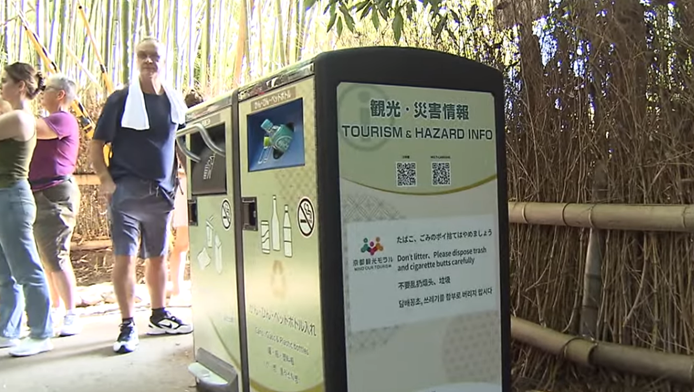
According to the Nihon Keizai Shimbun (Nikkei) on the 25th, Osaka City announced that it will newly install trash bins on major streets such as the famous tourist spot Dotonbori. Earlier, Osaka City said that after a trial introduction of street trash bins in January, illegal dumping decreased by about 40%, and they intend to resume installing trash bins going forward.
Until now, the Japanese government had removed trash bins nationwide for nearly 30 years following the 1995 subway sarin gas attack by the Aum Shinrikyo cult. In Osaka City, the approximately 5,000 street trash bins that once existed have now completely disappeared. Even in Tokyo’s Shinjuku, where 310 trash bins were installed around busy stations, all were removed in 2004.
Nikkei reported that another reason the Japanese government removed all trash bins was the difficulty of management. When trash bins overflow, according to the broken windows theory, more trash tends to be dumped nearby, but frequent collection is costly.
Convenience stores, which at least had trash bins outside their shops, began moving them indoors during the COVID-19 pandemic to reduce infection risk, making street trash bins virtually nonexistent in Japan. Until now, individuals were encouraged to collect cigarette butts and tissues themselves and take them home for disposal.
However, after the end of the COVID-19 pandemic, the situation changed with a sharp increase in foreign tourists. Without trash bins, illegal dumping of leftover food waste especially increased. Public opinion showed that foreign tourists’ biggest complaint about traveling in Japan was the lack of trash bins, prompting the Japanese government to resume installing trash bins at major tourist sites.
The newly installed trash bins will mainly be ‘smart trash bins’ incorporating new technology to reduce concerns about management and safety. For example, the bins recently installed around Ikaho Onsen in Gunma Prefecture can compress contents to one-fifth or one-sixth of their volume and notify via voice when full to prevent overflow. They are also designed with covers over the trash input to prevent suspicious items from being inserted during large events.
Some regions are also considering charging fees for trash bin use. In Saitama Prefecture, a policy was introduced where users can voluntarily pay a cooperation fee via smartphone, and 20,000 yen (about 180,000 won) was collected within one month of implementation.
Experts point out that not only expanding trash bin installation but also carefully planning management measures is necessary. Satoshi Mizutani, a professor of waste engineering at Osaka Metropolitan University, said, "Installing bins may actually increase collection and disposal costs. We need to consider pros and cons and decide what benefits the community."
© The Asia Business Daily(www.asiae.co.kr). All rights reserved.
![Clutching a Stolen Dior Bag, Saying "I Hate Being Poor but Real"... The Grotesque Con of a "Human Knockoff" [Slate]](https://cwcontent.asiae.co.kr/asiaresize/183/2026021902243444107_1771435474.jpg)















