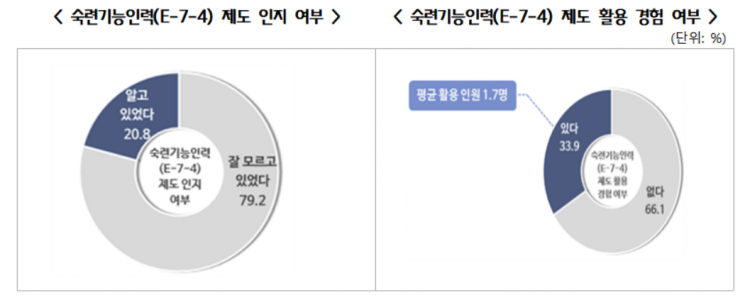
Eight out of ten small and medium-sized enterprises (SMEs) are unaware of the 'Skilled Worker (E-7-4)' system, which grants foreign workers (E-9) the opportunity to switch to a long-term employment visa.
The Korea Federation of SMEs announced the results of the 'Survey on Industry Awareness of the Skilled Worker Visa Status Change System and Foreign Workforce Utilization' conducted on 631 companies employing foreign workers on the 23rd. In this survey, 79.2% of respondents said they were unaware of the Skilled Worker system. The main reason cited by companies unaware of the system was 'lack of promotion (62%).'
Among companies that knew about the Skilled Worker system, only 33.9% had experience utilizing it (an average of 1.7 workers). Those without experience accounted for 66.1%.
With improvements to the system in the second half of this year, including easing the requirements for switching to the Skilled Worker visa and expanding the quota, 55.5% of companies plan to utilize it (an average of 3.6 workers planned). Based on 52,552 companies employing foreign workers (E-9), it is estimated that 29,166 companies have demand for approximately 105,000 skilled workers. This indicates that despite the recent expansion of the Skilled Worker quota to 35,000, the demand in the SME sector remains far from being met.
Regarding the current Employment Permit System (E-9), 88.3% of SMEs responded that they are unable to fully utilize the maximum allowed number of foreign workers per workplace. The main reasons cited were frequent requests by workers to change workplaces and difficulties in management related to providing dormitories and meals, accounting for 53.6%.
Additionally, 91.9% of SMEs said that the limit on the appropriate number of foreign workers allowed per company is insufficient. The average number of additional foreign workers needed per company was 5.9, with 43.7% needing '5 or more,' 31.6% needing '1-2,' and 24.7% needing '3-4.'
Regarding the government's current method of determining the appropriate scale of foreign worker introduction once a year, 79.1% responded that it is 'undesirable.' There is a call for a more flexible approach to introducing foreign workers.
For the 2024 foreign workforce introduction scale, 85.9% favored 'maintaining or expanding' it. Among recent system improvements, 81% of SMEs believed that benefits for long-term employment without workplace changes would be effective. However, among suggestions and improvements related to foreign workforce utilization, the opinion to 'strengthen restrictions on workplace changes' was the most common, indicating a need for continuous monitoring and resolution of related difficulties.
Lee Myung-ro, Head of the Workforce Policy Division at the Korea Federation of SMEs, said, "When non-professional employment visa workers return home due to visa expiration, SMEs face significant burdens such as workforce gaps at workplaces and costs related to hiring replacement workers. While increasing quotas is important, efforts to widely promote system improvements are also necessary."
© The Asia Business Daily(www.asiae.co.kr). All rights reserved.
![Clutching a Stolen Dior Bag, Saying "I Hate Being Poor but Real"... The Grotesque Con of a "Human Knockoff" [Slate]](https://cwcontent.asiae.co.kr/asiaresize/183/2026021902243444107_1771435474.jpg)















