Professor Park Won-woo, Seoul National University Business School & GEC Chairman Interview
"Blockchain Utilization Needed to Activate 'Voluntary Carbon Market'"
"Carbon Emissions from Land Degradation Also a Problem... Must Prepare"
Seminar for Net Zero Achievement to be Held on the 23rd of Next Month
"To achieve carbon neutrality (Carbon Neutrality or Carbon Net Zero), where net carbon emissions become zero, efforts must extend beyond the level led by the United Nations (UN) or governments to include companies and individuals. Companies should provide benefits to enable individuals to realize carbon neutrality, and the government should offer incentives to companies that develop carbon neutrality ideas."
Park Won-woo, Professor of Business Administration at Seoul National University and Chairman of the Green Earth Community (GEC), said in an interview with Asia Economy on the 16th at the GEC office in Gangnam-gu, Seoul, "Due to greenhouse gases, the Earth's average temperature has risen nearly 1.5 degrees compared to pre-industrial times," adding, "The golden time to achieve carbon neutrality by 2050 is more urgent than the low birthrate issue."
Chairman Park emphasized, "Net zero can only be achieved if individuals and ordinary companies voluntarily strive to erase their carbon footprints." A carbon footprint refers to the total amount of greenhouse gases directly or indirectly generated by an individual or organization. He stated, "For them to continuously participate in the carbon neutrality ecosystem, everyone must be able to easily erase their carbon footprint, and sufficient rewards must follow."
Chairman Park explained, "The key is to increase transparency of transactions and strengthen fairness by utilizing blockchain technology, which will increase market participants." He analyzed that with increased rewards for carbon offset credits and emission trading, transactions between companies and consumers (B2C) as well as between individuals (C2C) will become more active. He argued that both the Compliance Carbon Market (CCM), where the government allocates and manages emission allowances to companies with high carbon emissions, and the Voluntary Carbon Market (VCM), operated by the private sector, must be activated for true net zero realization.
Chairman Park also said, "Efforts for Land Degradation Neutrality (LDN) must be pursued together." LDN is the concept of restoring degraded land to prevent further degradation. He noted, "Even a 1% increase in carbon in the top 1 meter of Earth's soil contains more carbon than the amount of carbon dioxide generated by humanity burning fossil fuels for one year," forecasting, "LDN could become an issue even more important than carbon neutrality in the future."
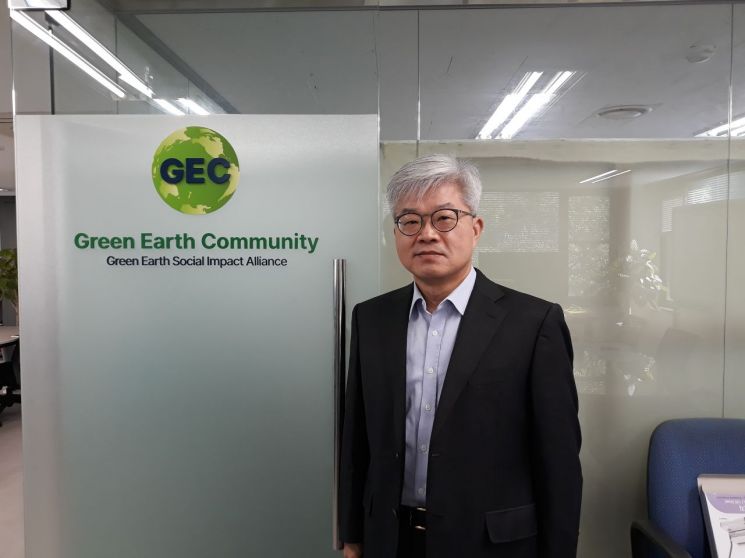 Professor Park Won-woo, Chairperson of GEC and Professor at Seoul National University Business School, is posing for a commemorative photo after an interview at the GEC office located in Gangnam-gu, Seoul on the 16th.
Below is a Q&A with Chairman Park.
Q. What is the current status of carbon neutrality implementation in Korea?
▷As of 2019, Korea is the 9th largest greenhouse gas emitter in the world. In 2020, the Moon Jae-in administration declared the realization of carbon neutrality by 2050 and promised the international community to reduce the national greenhouse gas reduction target (NDC) by 40% compared to 2018 by 2030. According to the Paris Agreement, once an NDC target is set, it cannot be rolled back. The public-private '2050 Carbon Neutral Green Growth Committee,' which serves as the control tower for the government's carbon neutrality policy, is facing difficulties in achieving the set goals. The situation is not much different for companies. Although about 90% appear to be pursuing carbon neutrality, about half remain at the initial stage and do not even know specific methods.
Q. What is CCM for carbon neutrality?
▷To erase a carbon footprint, one must purchase carbon emission allowances or carbon offset credits in the carbon market. The carbon market is broadly divided into CCM and VCM. CCM sets a total allowable amount of carbon dioxide emissions by country, and each government allocates emission allowances to companies emitting more than 125,000 tons of carbon annually. If the emission allowance is surplus, there is no problem, but if insufficient, companies must purchase allowances from others to cover the shortfall. Because of this, companies are reluctant to become targets for government carbon allowance distribution. Carbon emission allowances are managed only within each country and cannot be purchased from abroad. Failure to secure allowances results in a penalty three times the amount. CCM is a vertical and restrictive business-to-business (B2B) market where the government allocates allowances to high-emission companies. It does not apply to transactions between individuals.
Q. Are you suggesting activating VCM for individual carbon neutrality?
▷Yes. While faithful implementation of CCM is fundamental, the Voluntary Carbon Market (VCM) should also be activated to increase the number of entities reducing carbon emissions. The idea is that ordinary companies and individuals, who are not targets for carbon allowance distribution, must also erase their carbon footprints to lead true net zero. Carbon offset credits are internationally certified certificates for carbon reduction activities such as tree planting. These certificates can be traded through VCM. Although smaller in scale than CCM, VCM transactions already cross borders.
Q. Since ordinary companies and individuals have no carbon neutrality obligations, do you expect transactions to increase?
▷Individuals and ordinary companies have no carbon neutrality obligations. Therefore, a social ecosystem must be created for them to realize carbon neutrality. There are five major conditions for ecosystem creation. First, there must be rewards. Whether individuals or organizations, appropriate incentives are necessary when participating in the carbon neutrality ecosystem. For example, when using a full-service carrier (FSC), mileage is awarded. This is a definite reward system. Mileage can be used to purchase tickets or upgrade seats. A corresponding reward system must also be established when securing carbon offset credits. Currently, discussions are underway with SPC Group regarding the reward system. Additionally, an application to measure individual carbon emissions is planned to be launched within the year.
Q. Please explain specifically the effect of applying blockchain technology to VCM.
▷Integrating blockchain technology into VCM primarily makes transactions easier. Along with rewards, it enhances transparency, measurability, mobility, and decentralization. Until now, a drawback of VCM was that the actual profit returned to carbon reduction entities was less than 10%. This is because specialized intermediaries are needed for transactions, and the complex distribution process reduces the amount sellers actually receive. Blockchain technology can tokenize (digitally convert assets with attributes) and fragment (divide into smaller units) carbon offset credits. Anyone can purchase fragmented carbon offset credits using a coin wallet. The price of carbon offset credits can be calculated quickly and accurately with blockchain technology, reducing intermediaries and increasing profits for sellers. As profits increase, the scale of VCM is expected to naturally expand. However, in Korea, blockchain is often associated with illegal coins. I want to emphasize that blockchain technology itself is not bad at all.
Q. Are you saying that the investment value of carbon offset credits could increase in the future?
▷Yes. Whether companies or individuals, all activities require rewards and profits to motivate action and ensure sustainability. Through the aforementioned tokenization and fragmentation, liquidity and convertibility of carbon offset credits will be secured. Then, carbon offset credits can become a means to overcome the climate crisis and an investment tool for both ordinary companies and the public.
Q. Please explain Land Degradation Neutrality (LDN) in more detail.
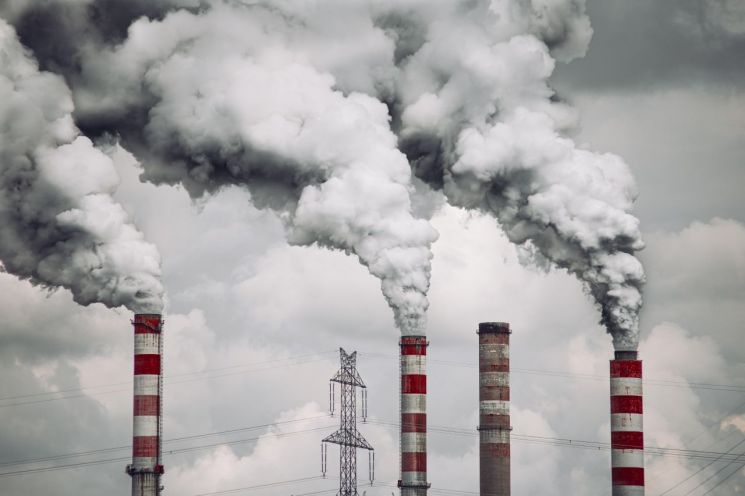
▷LDN started from the idea of preventing carbon emissions from desertified soil. Until now, carbon neutrality mainly focused on air pollution caused by industrial activities symbolized by factory smokestacks. LDN is a concept that supplements carbon neutrality by addressing not only air pollution but also land degradation. Carbon sinks containing carbon on Earth include the atmosphere, vegetation, and soil. Among these, the atmosphere contains 830 gigatons of carbon (GtC), vegetation up to 680 GtC, and soil up to 2000 GtC. Already, 40% of the Earth's land is degraded. An additional 2 billion hectares of soil are degraded annually. Recent extreme environmental changes such as droughts and floods are also related. The carbon neutrality issue will be concluded through faithful CCM implementation, VCM activation, and ultimately solving the LDN problem.

Q. What is Korea's status regarding LDN realization?
LDN is overseen by the United Nations Convention to Combat Desertification (UNCCD), an international organization formed to promote international efforts to prevent desertification. Korea is recognized globally as a country that proposed, established, and contributed to the concept of LDN. This is evidenced by the successful forest greening projects started during the Park Chung-hee administration. In 2011, at the UNCCD Conference of the Parties (COP) held in Changwon, Gyeongnam, LDN was proposed and played a key role in becoming a core concept of UNCCD. However, recently many countries are striving to take leadership in this area. Saudi Arabia is hosting UNCCD COP16, scheduled for December next year in Riyadh. If Korea prepares a social production base to lead LDN well, it can enhance its national status.
Chairman Park will hold a seminar titled "Activation of VCM Ecosystem and LDN for Net Zero" on the 23rd of next month at the Mondrian Hotel in Itaewon, together with GEC, the Carbon Neutral Green Growth Committee, the Korea Forest Service, and UNCCD.
© The Asia Business Daily(www.asiae.co.kr). All rights reserved.
![Clutching a Stolen Dior Bag, Saying "I Hate Being Poor but Real"... The Grotesque Con of a "Human Knockoff" [Slate]](https://cwcontent.asiae.co.kr/asiaresize/183/2026021902243444107_1771435474.jpg)

















