Valeo LiDAR CTO "Mass Production at German Factory Next Year"
5 Times Performance Improvement Over Existing Products
French automotive supplier Valeo has decided to mass-produce an improved version of its LiDAR, a key component that enables vehicle driving assistance technology, starting next year. LiDAR is a product that uses lasers to detect the surrounding environment and serves as the "eyes" of autonomous vehicles currently under active development.
Most major automakers, except Tesla, intend to use LiDAR as an important component to advance autonomous driving technology. Valeo is the company that has supplied the most mass-produced LiDAR products with enhanced versatility, and the new LiDAR to be introduced next year will offer performance approximately five times better than existing products.
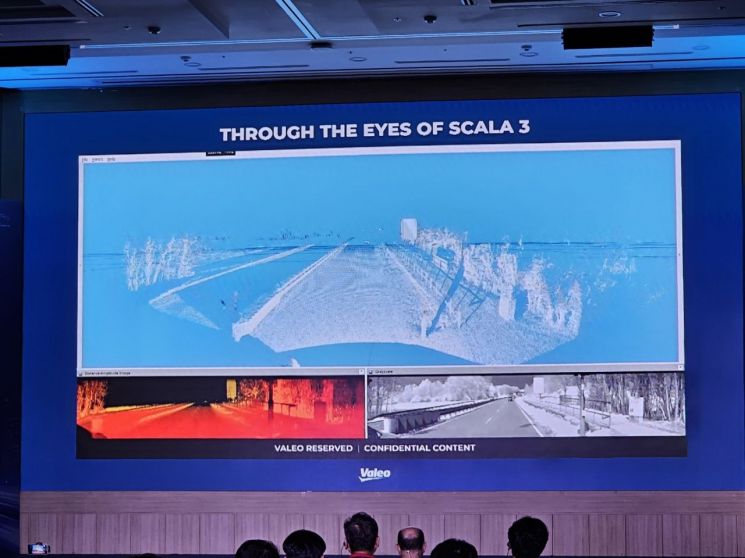 The landscape recognized through Valeo's LiDAR. Typically, LiDAR detects with lasers and is represented as unstructured data, whereas this 3rd generation LiDAR shows results resembling camera images. While cameras have difficulty securing night vision, LiDAR can recognize even in areas where visibility is limited.
 [Photo by Korea Automobile Journalists Association]
Clemence Nouvel, Chief Technology Officer (CTO) of Valeo LiDAR, explained the third-generation LiDAR under development to domestic reporters at the Korea Future Mobility Expo held in Daegu on the 19th. Valeo is a global parts company headquartered in France that manufactures various automotive parts such as transmissions, as well as measurement-related products like sensors and cameras. A company official stated that the business unit responsible for LiDAR research, development, and production recently spun off into a separate legal entity.
CTO Nouvel said, "We have invested 1 billion euros (approximately 1.4 trillion KRW) to mass-produce the third-generation improved 'Scala' and plan to start production next year," adding, "It uses artificial intelligence (AI) technology to recognize the environment as if taking a photo with a camera." The new LiDAR product will be manufactured at a factory in Germany.
Valeo has been developing LiDAR since 2011. Scala is the product name for their LiDAR. LiDAR offers higher accuracy compared to previously used ultrasonic or radar sensors. However, it is sensitive to weather conditions and expensive. Its use has mainly been limited to high-cost military applications due to difficulties in mass production and high prices. Automakers use various sensing technologies to refine autonomous driving, typically combining cameras, radar, and LiDAR appropriately in their technology development.
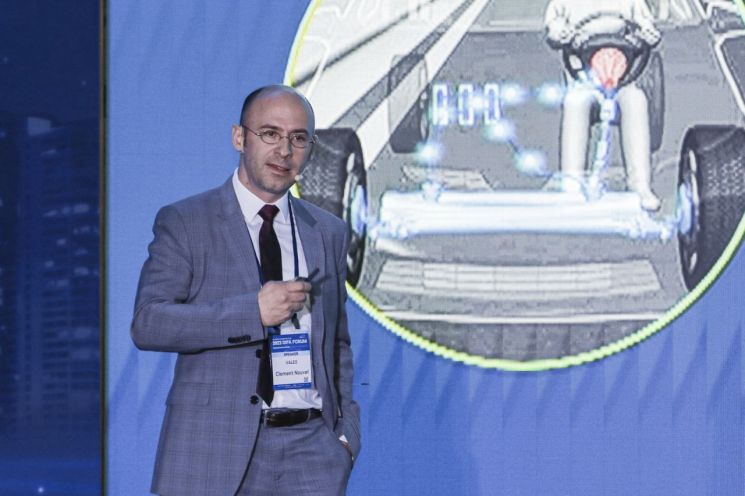 Clement Nouvelle, Chief Technology Officer (CTO) of Valeo LiDAR
 Photo by Korea Automobile Journalists Association
Valeo's first-generation Scala was used by Audi in 2017 and Honda in 2021. The second-generation product was used by Mercedes-Benz in 2022. The second-generation product was noted as the first mass-produced LiDAR. The third-generation improved product to be released next year has been nicknamed SATELLITE. CTO Nouvel explained that it can detect weather conditions such as snow or fog.
The performance of the company's LiDAR is rapidly improving. The first-generation product had a detection range of about 60 meters and generated 44,000 points per second. The initial third-generation product developed so far can detect up to 200 meters and generate 2.6 million points per second. The third-generation improved product to be launched next year will be capable of generating 12.5 million points per second. Simply put, this is about a fivefold improvement over the current product.
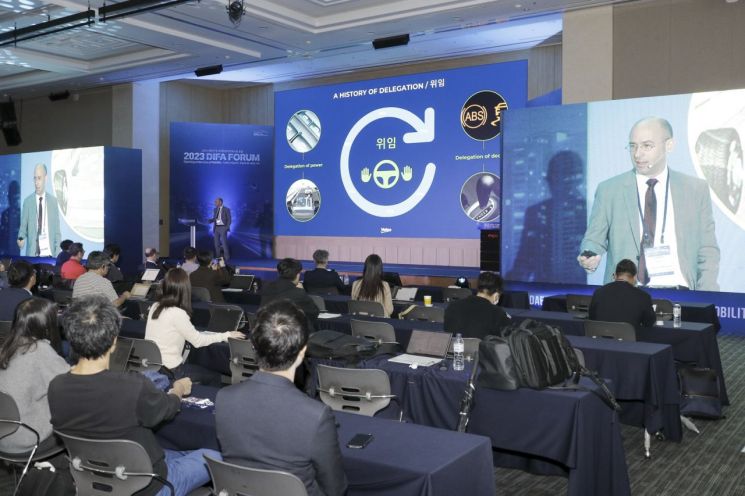 Clement Nouvelle, Chief Technology Officer (CTO) of Valeo LiDAR
 Photo by Korea Automobile Journalists Association
Valeo has already signed or is negotiating LiDAR supply contracts with various automakers. CTO Nouvel stated that they are discussing the third-generation Scala with automakers in Europe, including Stellantis, as well as North American and Asian automakers. It is also known that they are coordinating specific specifications with Hyundai Motor Group.
CTO Nouvel said, "LiDAR is not necessary for level 1 and 2 autonomous driving stages, but for higher levels 3 and 4, multiple sensing and detection devices are required," adding, "I believe LiDAR must be used to enhance vehicle safety."
© The Asia Business Daily(www.asiae.co.kr). All rights reserved.
![Clutching a Stolen Dior Bag, Saying "I Hate Being Poor but Real"... The Grotesque Con of a "Human Knockoff" [Slate]](https://cwcontent.asiae.co.kr/asiaresize/183/2026021902243444107_1771435474.jpg)

















