The three major indices of the U.S. New York stock market showed mixed trends in early trading on the 19th (local time) as corporate earnings announcements continued and investors awaited the scheduled speech by Jerome Powell of the Federal Reserve (Fed) later that day.
At around 10:05 a.m. at the New York Stock Exchange (NYSE), the Dow Jones Industrial Average, which focuses on blue-chip stocks, was trading at around 33,640, down 25.01 points (0.07%) from the previous close. Meanwhile, the S&P 500, which centers on large-cap stocks, rose 2.33 points (0.05%) to around 4,316, and the Nasdaq, which is tech-heavy, increased by 26.10 points (0.20%) to about 13,340.
Among the S&P 500 sectors, all except telecommunications, technology, and industrial stocks were in decline. Tesla fell more than 7% compared to the previous close after releasing earnings that fell short of expectations following the market close the day before. Tesla CEO Elon Musk stated that it would take 12 to 18 months for the newly launched Cybertruck to contribute to the company’s cash flow, confirming investors’ disappointment over profitability. Concerns over weakening electric vehicle demand also led to declines in Rivian, Lucid, and NIO. Netflix surged more than 16% on better-than-expected earnings and revenue expectations from subscription fee hikes. AT&T also rose nearly 7% following earnings released before the market opened. Airline stocks rebounded. American Airlines, despite lowering its annual profit guidance due to increased costs and one-time expenses related to a recent contract with the pilots’ union, rose over 4% after stating that travel demand remains resilient.
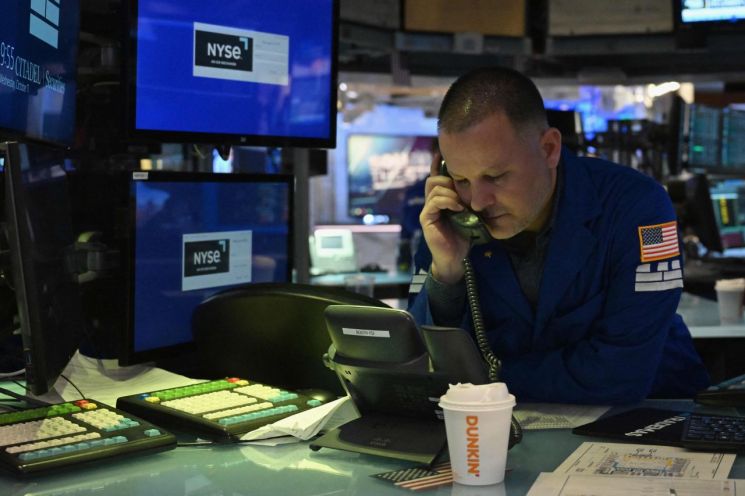
Investors are awaiting Powell’s remarks scheduled for noon Eastern Time while closely monitoring corporate earnings, Treasury yields, and key economic indicators. They appear to be seeking hints regarding the Federal Open Market Committee (FOMC) monetary policy decision scheduled for October 31 to November 1.
Powell is expected to reaffirm his commitment to achieving price stability in his speech at the New York Economic Club while emphasizing a cautious approach to monetary policy decisions based on incoming new data. Krishna Guha, Chief Strategist at Evercore ISI, said, "Although indicators are stronger than expected, financial conditions have tightened due to the sharp rise in Treasury yields," adding, "The November policy response is not urgent, and the Fed will maintain a message of cautious response." Besides Powell, Raphael Bostic, President of the Federal Reserve Bank of Atlanta, and Austan Goolsbee, President of the Chicago Fed, are also scheduled to speak that day.
With recent sharp increases in Treasury yields, dovish analyses suggesting that the need for further rate hikes has disappeared are emerging both inside and outside the Fed. Fed Governor Christopher Waller emphasized a cautious stance before the rate decision the day before, saying, "We need to wait and see how the economy unfolds." He also added that he is reviewing various indicators to assess the cumulative impact of the Fed’s tightening. As a result, attention is focused on what evaluation Powell will provide regarding the recent surge in Treasury yields.
In the New York bond market, the benchmark 10-year U.S. Treasury yield continued its upward trend after surpassing the 4.9% level the previous day. It briefly touched the 4.98% range during the session, nearing 5%. The 10-year yield has risen for four consecutive trading days and has increased by more than 40 basis points (1 bp = 0.01 percentage points) so far this month. This reflects confirmed economic strength due to robust consumer spending amid expectations of prolonged high interest rates. Ian Linsen and Benjamin Jeffrey of BMO stated in an investor memo the day before, "The next step for the 10-year yield is 5.0%," calling it "natural at this point."
The weekly initial jobless claims released that morning fell to their lowest level in nine months. According to the U.S. Department of Labor, initial jobless claims for the week of October 8?14 totaled 198,000, down 13,000 from the previous week. This is the lowest weekly figure since January 21 and below Wall Street’s forecast of 210,000. Despite cumulative tightening, this suggests that the labor market remains solid. Such data further supports the Fed’s outlook for prolonged high interest rates. Economic media CNBC described it as "another sign that the economy continues to show strength."
The Beige Book of the Fed, released the previous afternoon, stated that "most regions have seen little change since September" and that "the near-term economic outlook is generally stable or showing modest growth." The Beige Book also noted that "inflation is rising moderately" and that "tight labor markets are easing nationwide."
Meanwhile, investors are also closely watching the developments in the war between Israel and the Palestinian militant group Hamas. As the conflict enters its 13th day, casualties on both sides have exceeded 5,000. Following U.S. President Joe Biden’s visit the day before, British Prime Minister Rishi Sunak visited the Middle East on this day. Although the timing of Israel’s ground troop deployment is delayed compared to expectations, tensions between the two sides show little sign of easing.
International oil prices are declining amid ongoing geopolitical risks in the Middle East and the U.S. partially easing its oil export ban sanctions on Venezuela. West Texas Intermediate (WTI) crude oil prices are trading around $87 per barrel, down about 0.7% from the previous close. However, concerns about escalation, including Iran’s involvement in the Middle East, have limited the decline.
European stock markets are all down. The UK FTSE index fell more than 1%. Germany’s DAX and France’s CAC indices declined by 0.17% and 0.57%, respectively.
© The Asia Business Daily(www.asiae.co.kr). All rights reserved.
![Clutching a Stolen Dior Bag, Saying "I Hate Being Poor but Real"... The Grotesque Con of a "Human Knockoff" [Slate]](https://cwcontent.asiae.co.kr/asiaresize/183/2026021902243444107_1771435474.jpg)















