Publication of the '2024 Economic and Financial Market Outlook' Report
South Korea's economic growth rate for next year is forecasted to reach 2.1% due to the recovery of the global and IT economies. While interest rates and exchange rates are expected to show a gradual decline following the end of monetary tightening, volatility caused by various factors is anticipated to remain significant. Meanwhile, the real estate market is expected to see a slight price increase amid a deepening preference for the Seoul metropolitan area.
Hana Financial Management Research Institute announced on the 12th that it has published the "2024 Economic and Financial Market Outlook" report, which forecasts the global and domestic economy, interest rates, exchange rates, and financial markets for 2024.
The institute expects that global monetary tightening aimed at curbing inflation will end next year, gradually easing the "three highs" phenomenon characterized by high inflation, high interest rates, and high exchange rates.
However, it noted that the levels of inflation, interest rates, and exchange rates themselves may still remain high compared to the past. Structural inflationary pressures, such as the global supply chain restructuring and demographic changes following COVID-19, are expected to persist, making a return to a low inflation and low interest rate environment difficult. Additionally, the won-dollar exchange rate may establish a new level due to factors like weakening export momentum and increased overseas investment, which also requires attention.
Research Fellow Oh Hyun-hee stated, "In 2024, financial tightening conditions are expected to ease somewhat, and global trade is likely to recover slightly, improving the overall environment surrounding the domestic economy. However, with limited resilience in global trade due to economic fragmentation caused by global supply chain restructuring and reduced economic integration, coupled with accelerating low birth rates and aging population, concerns about prolonged structural low growth are increasing. Therefore, efforts should be made to create growth engines and other measures to expand the growth potential of our economy."
Accordingly, the institute forecasted that the domestic economy will grow by only 1.3% (estimated) this year due to the negative ripple effects of high inflation and high interest rates. Next year, however, it expects growth to improve to 2.1% as disinflation trends, the end of major countries' interest rate hikes, and manufacturing sector recovery boost exports and facility investment.
Private consumption is expected to continue recovering due to improved consumer sentiment from economic recovery and eased financial conditions, as well as real income improvement from price stabilization. However, factors such as weakening pent-up demand, slowing employment and wage growth, and increased principal and interest repayment burdens are expected to limit the growth rate to a moderate 2.2% (compared to 2.0% this year).
Construction investment is likely to contract by 0.3% next year, considering increased civil engineering investment due to the government's expanded SOC (social overhead capital) budget and easing financial costs, but also the deepening weakness in leading indicators such as housing starts and orders caused by this year's real estate market slowdown.
Facility investment is expected to improve, turning from a 1.7% decline this year to a 3.0% increase next year, driven by easing inventory burdens, expanded semiconductor investment due to IT sector recovery, and proactive investment in next-generation technologies in non-IT sectors.
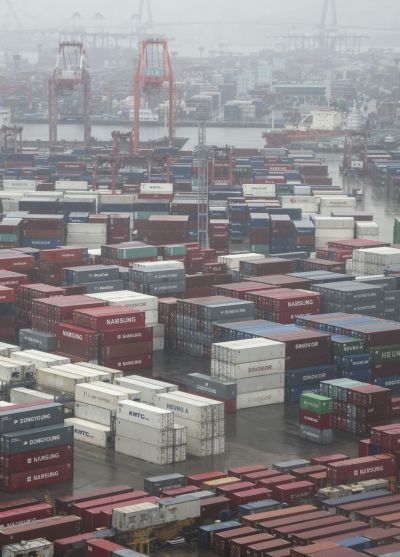
Exports (based on customs clearance) are predicted to shift from an 8.0% decline this year to an 8.2% increase next year, as global demand for goods and manufacturing recovers, semiconductor production cuts raise unit prices, and IT demand rebounds, improving export volumes.
The consumer price inflation rate is forecasted to moderately decline to 2.6% next year from 3.6% this year, due to stabilization of the won-dollar exchange rate and easing upward pressure on service prices. However, uncertainties remain regarding the slowdown path due to accumulated cost pressures amid raw material supply instability.
Research Fellow Oh said, "The domestic economy in 2024 is expected to grow at a rate close to the potential growth rate, but considering the base effect from the sharp slowdown in 2023, the growth momentum will not be significant."
The institute also expects the base interest rate to be maintained at the current level (3.5%) until the first half of next year due to lingering inflation risks and the burden of increasing household debt. After confirming a policy shift by the U.S. Federal Reserve (Fed) in the second half, when inflation stabilizes around 2%, interest rate cuts are expected to follow.
However, market interest rates are expected to show a gradual downward trend throughout the year, reflecting expectations of domestic and foreign interest rate cuts amid a shift to lower external interest rates as the U.S. growth slowdown caused by tightening becomes visible and recognition of the peak in U.S. policy rates spreads.
Researcher Yoon Seok-jin said, "Although the Fed has left the possibility of additional rate hikes open until the end of 2023, market interest rates in 2024 are expected to show a pattern of rising early in the year and falling later due to easing inflationary pressures and expectations of interest rate cuts domestically and abroad. Competition for renewing fixed deposits and concerns about increased net issuance due to the government's removal of bank bond issuance limits may limit the decline in interest rates."
The won-dollar exchange rate is estimated to show a pattern of rising early and falling later, with levels around 1,293 won in the first half and 1,268 won in the second half, considering the end of Fed tightening, easing dollar strength pressure, trade balance improvement from export recovery, and expectations of foreign capital inflows due to semiconductor sector improvement.
The housing market is expected to continue recovering, but due to heavy household debt burdens and low borrowing capacity caused by the Debt Service Ratio (DSR) regulations, the buying demand is projected to rise only slightly compared to this year. Additionally, with similar regulatory levels in the Seoul metropolitan area and other regions and increased preference for high-quality assets amid concerns over further price declines, the preference for the Seoul metropolitan area is expected to intensify.
Senior Researcher Ha Seo-jin stated, "In 2 to 3 years, concerns over supply shortages will intensify, concentrating buying demand in the Seoul metropolitan area, where price growth potential is high. However, if high interest rates persist amid reduced policy mortgage availability and heavy loan repayment burdens, buying demand could be significantly weakened."
© The Asia Business Daily(www.asiae.co.kr). All rights reserved.
![Clutching a Stolen Dior Bag, Saying "I Hate Being Poor but Real"... The Grotesque Con of a "Human Knockoff" [Slate]](https://cwcontent.asiae.co.kr/asiaresize/183/2026021902243444107_1771435474.jpg)















