784 Subway Sexual Crimes This Year
Crime Incidents Increase While Arrest Rate Decreases Annually
Miniaturization of Cameras and Other 'Detection Obstacles'
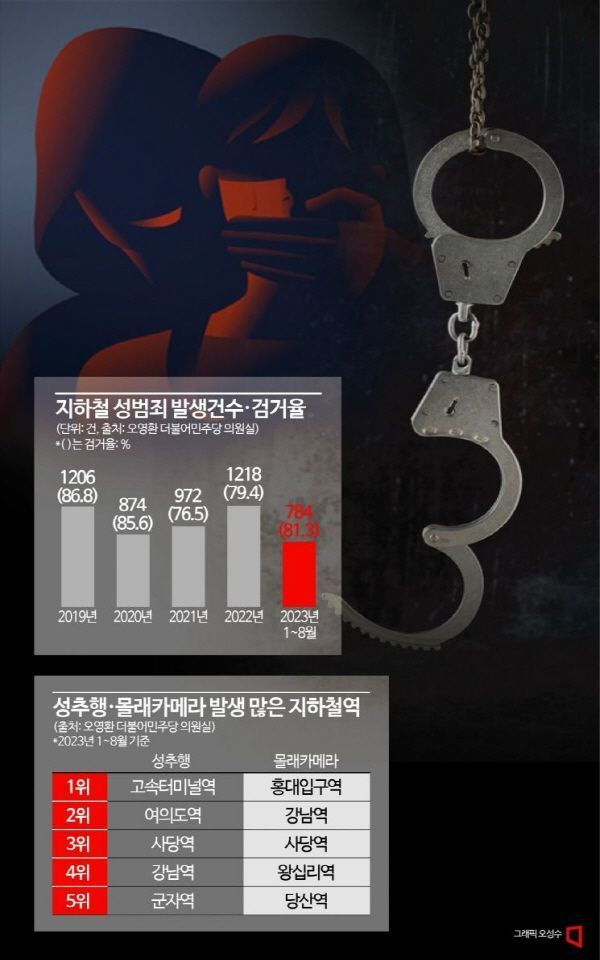
Sexual crimes on the subway, which had decreased during the COVID-19 pandemic, are increasing again. Sexual harassment frequently occurred at Express Bus Terminal Station, a transfer station for Seoul Subway Lines 3, 7, and 9, while illegal filming was most common at Hongdaeipgu Station, a transfer station for Line 2 and the Gyeongui-Jungang Line. The arrest rate, which once approached 90%, dropped to the 70% range in 2021 and last year.
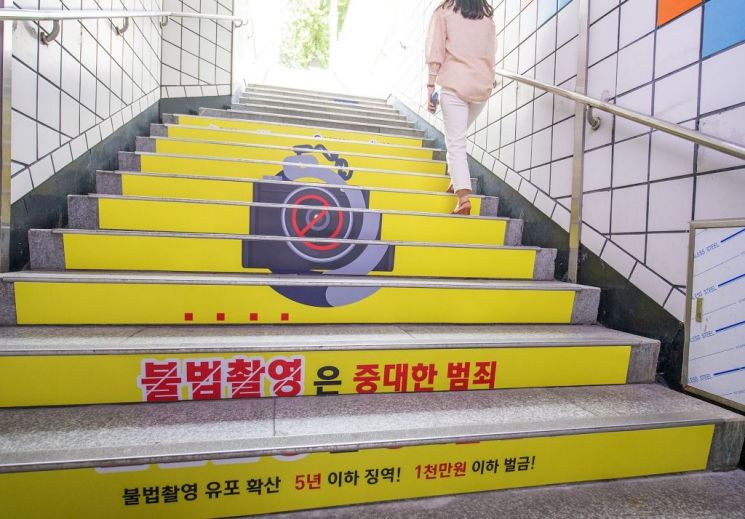
◆ Targeted ‘Packed Subway’ = According to data submitted by the Subway Police Unit and the Railway Special Judicial Police Unit to the office of Oh Young-hwan, a member of the National Assembly’s Public Administration and Security Committee from the Democratic Party, 784 sexual crimes occurred on the subway from January to August this year, with an arrest rate of 81.3%. Among these, sexual harassment incidents and arrest rates were 529 cases and 75.8%, respectively, while illegal filming incidents and arrest rates were 255 cases and 92.5%. The number of sexual crimes and arrest rates by year were recorded as 1,206 cases and 86.8% in 2019, 874 cases and 85.6% in 2020, 972 cases and 76.5% in 2021, and 1,218 cases and 79.4% in 2022.
The number of sexual crimes on metropolitan railways is also increasing. According to the sexual crime status over the past five years, there were 248 cases in 2018, 215 in 2019, 245 in 2020, 299 in 2021, and 358 in 2022. By crime type last year, there were 169 cases of sexual harassment in crowded public places, 125 cases of illegal filming, 38 cases of forced sexual assault, and 6 cases of public obscenity. By train line, there were 78 cases on the Gyeongbu Line, 62 on the Gyeongin Line, 47 on the Gyeongsu Line, 4 on the Bundang Line, and 167 cases on other lines.
Most sexual crimes occur on the ‘packed subway.’ Perpetrators inappropriately touch victims’ bodies and cause sexual humiliation. According to the police, even when caught, many offenders claim it was accidental rather than intentional, and in cases of illegal filming, the miniaturization of devices and the advancement of smartphone applications pose obstacles to detection.
◆ Transfer Stations and Entertainment Districts as Danger Zones = This year, the station with the highest number of sexual harassment cases was Express Bus Terminal Station (29 cases), which has held the dubious distinction of being number one for the past five years. Express Bus Terminal Station is a major transportation hub where Lines 3, 7, and 9 intersect. As of the 6th of this month, the number of passengers boarding and alighting at Express Bus Terminal Station was 106,131. Considering transfer passengers and express bus terminal users, the floating population is likely even higher. Following were Yeouido Station (20 cases), Sadang Station (18 cases), Gangnam Station (16 cases), Gunja Station (13 cases), Dongdaemun History & Culture Park Station (12 cases), Dangsan Station (11 cases), Jamsil Station and Gasan Digital Complex Station (10 cases each), and Yeomchang Station (9 cases). Except for Yeomchang Station, all these stations are transfer stations where two or more lines intersect.
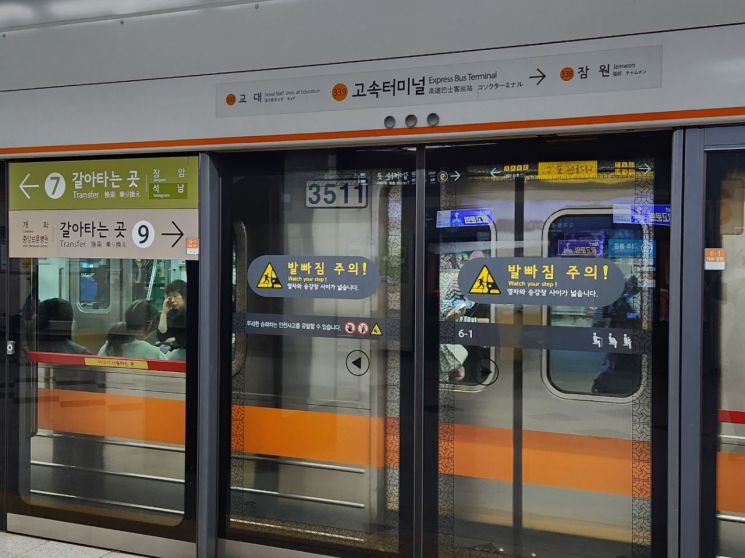 A subway is being constructed at the Express Bus Terminal Station in Seocho-gu, Seoul.
 [Photo by Im Chunhan]
Illegal filming was most frequent at Hongdaeipgu Station (31 cases), followed by Gangnam Station (14 cases), Sadang Station (10 cases), Wangsimni Station and Dangsan Station (8 cases each), Jamsil Station, Sillim Station, and Hapjeong Station (6 cases each), Yeouido Station (5 cases), and Express Bus Terminal Station (4 cases). Hongdaeipgu Station is known as a youthful street bustling with people in their 20s and 30s. Traditionally, it has been a commercial area with food, bars, and clubs where university students gather to eat and enjoy themselves, and illegal filming crimes targeting people in their 20s are rampant. Other subway stations also share characteristics of having large floating populations and dense entertainment districts. A subway police unit official explained, “Analysis of crime occurrences shows a tendency for many incidents to happen in transfer areas. Express Bus Terminal Station has three overlapping transfer sections, which is why it has more cases than other stations.” He added, “There are limits to proving criminal intent with CCTV. During rush hours, accidental contact can happen due to crowding, and in such cases, it must be proven that the contact was intentional.”
Professor Lee Yun-ho, Chair of the Department of Police Science at Korea Cyber University, emphasized, “The decrease in arrest rates is due to the sophistication of criminal methods and also police manpower issues. It is necessary to actively respond to subway sexual crimes by strengthening patrol personnel.” Professor Kwak Dae-kyung of Dongguk University’s Department of Police Administration said, “The high number of sexual harassment attempts in subway stations is because crowded situations make it difficult for victims to defend themselves.” He added, “It is also important to inform citizens about the typical situations where subway sexual crimes occur and appropriate countermeasures.”
© The Asia Business Daily(www.asiae.co.kr). All rights reserved.
![Clutching a Stolen Dior Bag, Saying "I Hate Being Poor but Real"... The Grotesque Con of a "Human Knockoff" [Slate]](https://cwcontent.asiae.co.kr/asiaresize/183/2026021902243444107_1771435474.jpg)

















