"Reasonable Suspicion of Circumventing Employment with Competitors"
Former Employee Non-Compete Injunction Granted
"No Need to Clearly Prove Employment with Competitor"
Samsung Display's application for a provisional injunction prohibiting job change was accepted against a worker who, after resigning, was employed by a Chinese company in a completely different industry.
Although the move was not to a competitor included in the non-compete agreement with the company, there were reasonable circumstances to suspect that the worker had indirectly joined a competitor.
The court stated that when judging the necessity of preservation, a requirement for a provisional injunction prohibiting job change, it is not always necessary for the debtor to clearly prove that they have been employed by a prohibited competitor.
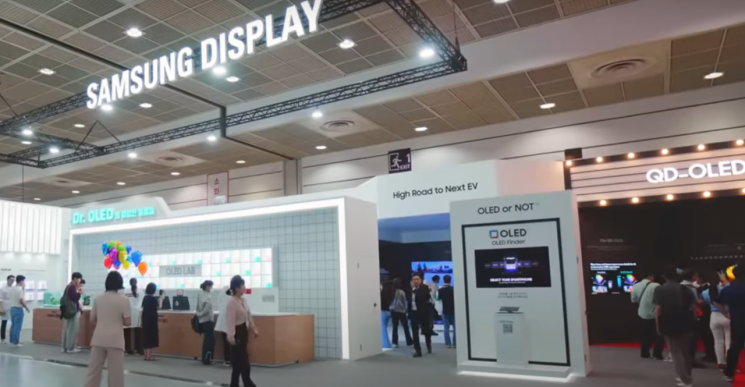 The Samsung Display exhibition booth at K-Display 2023 Korea Display Industry Exhibition held last August at COEX, Samseong-dong, Seoul.
 [Photo by Samsung Display website]
According to the legal community on the 3rd, the Seoul Central District Court Civil Division 50 (Presiding Judge Park Beom-seok) recently granted Samsung Display's application for a provisional injunction prohibiting job change against the former employee Kim.
The court ordered Kim, "You shall not be employed or dispatched to work at any of the competitors listed in the attached document, their offices, branches, research institutes, business sites, or affiliates, nor engage in research and development work related to organic light-emitting diode (OLED) display technology through indirect employment, advisory contracts, or consulting agreements with these companies."
It also stated, "If this order is violated, you shall pay the creditor 5 million KRW per day of violation."
The court fully accepted Samsung Display's application except for reducing the daily fine for indirect enforcement from 10 million KRW to 5 million KRW.
Kim joined Samsung Display in September 2008 and worked in the ELA process, one of the core OLED processes, from 2009. From 2012, he served as the group leader (PL) for ELA process development until his resignation on January 15, 2022.
Before resigning, on January 11, 2022, Kim submitted a "Confidentiality and Non-Compete Agreement" to the company, which included a clause prohibiting job changes to competitors.
Specifically, the agreement stated that ▲ for two years after resignation, Kim would not start a company or move to domestic or international competitors where trade secrets learned during employment could be leaked or used ▲ he would not engage in joint ventures, advisory contracts, service contracts, attend meetings, provide consulting or labor, or collaborate in any way that would involve using trade secrets in research and development at competitors ▲ in return for this non-compete agreement, he received 112.7 million KRW from the company, and if violated, he would pay a penalty of 225 million KRW (twice the amount received) plus interest until repayment.
On January 28, 2022, Kim received approximately 88 million KRW after tax deduction from the company as compensation for the non-compete agreement, an amount equivalent to his annual salary.
Subsequently, on April 21, 2022, Kim obtained a foreign employment permit from Huizhou City, Guangdong Province, China, to work at A Industrial Co., Ltd., and started working in China from August 2022.
The company Kim joined produces small medical laser treatment devices. According to local business information, A Industrial Co. is a small-scale company manufacturing plastic molds and machinery, with only seven employees, a capital of 10 million yuan (about 1.9 billion KRW), and its headquarters is a rather old three-story building.
Samsung Display filed for a provisional injunction prohibiting job change against Kim in March this year, arguing that although Kim did not directly join a competitor, he violated the agreement by indirectly joining a competitor.
Kim argued that A Industrial Co. is not a prohibited competitor and that he was only responsible for developing semi-finished products for laser treatment devices.
The court first examined the validity of the non-compete agreement between Samsung Display and Kim.
Kim claimed that in December 2020, the company asked him to step down from his group leader position and that he resigned due to health issues, not to join a competitor.
However, the court rejected Kim's claim, noting that the submitted documents suggested the company had tried to dissuade Kim from resigning, and although it would have been more convenient for treatment to stay in Korea rather than China, Kim chose to work overseas, making it difficult to hold the company responsible for his resignation.
Considering that Samsung Display's AMOLED panel design, process, manufacturing, and driving technologies are designated as national core technologies in the display field under the Industrial Technology Protection Act and related notifications, the court found that even though Kim's freedom to choose his occupation was partially restricted by the non-compete agreement, there is a public interest justifying its validity.
Regarding the necessity of preservation, a requirement for granting the provisional injunction, the court pointed out, "If information learned by Kim during employment is leaked, restoration is practically impossible, and competitors can significantly shorten the time needed to acquire business capabilities equivalent to Samsung Display in the same competitive field, while Samsung Display would lose a substantial part of its competitiveness. Moreover, if Samsung Display files a main lawsuit, the two-year non-compete period is likely to expire before the judgment is finalized."
The court continued, "Considering these circumstances, damages suffered by Samsung Display due to Kim's violation of the non-compete obligation cannot be sufficiently compensated by post-remedies such as damages or removal of the violation."
Meanwhile, the court dismissed Kim's claim that he did not join a competitor, stating, "There are reasonable grounds to suspect that Kim indirectly joined a competitor."
The court cited the following reasons: ▲ considering Kim's career, previous salary level, and health issues he claimed, it is doubtful that he genuinely resigned from Samsung Display to work at the small Chinese company A Industrial Co. ▲ A Industrial Co., which manufactures semi-finished products for medical laser treatment devices, does not appear to focus on laser-related products, making it hard to accept Kim's employment there as unrelated to his skills or information ▲ Samsung Display confirmed that Kim did not attend work at A Industrial Co. from May 15 to 19, 2023, during the hearing period; when Samsung Display pointed this out, Kim claimed he was on sick leave due to a positive COVID-19 test and submitted attendance records but did not provide official medical proof of infection ▲ Kim continues to actively dispute the non-compete obligation despite claiming he is not employed by a competitor ▲ if Kim is indeed working at A Industrial Co., the provisional injunction would not cause significant disadvantage to him?these factors support suspicion of indirect employment at a competitor.
Furthermore, the court stated, "When judging the necessity of preservation for a provisional injunction prohibiting job change, it is not necessary that the debtor clearly prove employment at a prohibited competitor. If there are substantial circumstances to suspect employment at a competitor or plans or intentions to move to a competitor, the necessity of preservation can be recognized."
Although Kim did not join a competitor company stipulated in the non-compete agreement, if there is suspicion based on various circumstances that he indirectly joined a competitor, the court can recognize the necessity of preservation to grant the provisional injunction prohibiting his job change.
© The Asia Business Daily(www.asiae.co.kr). All rights reserved.
![Clutching a Stolen Dior Bag, Saying "I Hate Being Poor but Real"... The Grotesque Con of a "Human Knockoff" [Slate]](https://cwcontent.asiae.co.kr/asiaresize/183/2026021902243444107_1771435474.jpg)















