Agreement on Handling Livelihood Bills Between Ruling and Opposition Parties Signals Green Light for Bill Passage
Realization of Simplified Claims for Silseon Insurance Imminent
Expansion of Insurance Premium Card Payment Remains Uncertain

Attention is focused on whether the bill related to the digitization of claims for indemnity health insurance, which has been stalled for 14 years, will pass this month. Last month, the plenary session was canceled and the National Assembly's schedule was paralyzed after the arrest motion for Lee Jae-myung, leader of the Democratic Party of Korea, was approved, causing the bill to fail. However, with the ruling and opposition parties agreeing again to handle livelihood bills, it is expected that the bill will be approved at the plenary session to be held this month. During the national audit, the issue of insurance premium payments by card is also expected to be reexamined, drawing attention from both the insurance industry and consumers.
Automatic Claims for Indemnity Insurance on the Horizon
According to the insurance industry on the 2nd, the amendment to the Insurance Business Act, which includes provisions to allow automatic claims for indemnity health insurance, is increasingly likely to be processed at the plenary session scheduled for this month.
Originally, the bill was scheduled to be approved at the plenary session on the 21st of last month, but all schedules were paralyzed when the arrest motion for Lee Jae-myung was approved that day. Out of 98 agenda items scheduled, including the amendment to the Insurance Business Act, only 8 were processed. Although the bill barely passed the National Assembly subcommittee 14 years after the Anti-Corruption and Civil Rights Commission recommended improving the indemnity insurance claim procedure in 2009, it was effectively stalled near the final stage.
However, with Lee Jae-myung's arrest warrant being dismissed on the 27th of last month, a new path has opened. The ruling and opposition parties agreed to hold a plenary session on the 6th of next month to handle livelihood bills. Accordingly, the bill to simplify indemnity insurance claims is also expected to pass.
The bill contains provisions to change the procedure so that indemnity insurance subscribers do not need to submit various paper documents but can simply request the hospital after treatment to automatically claim the insurance money. Once the bill is enacted, it is expected that the number of cases where people give up on insurance claims due to inconveniences such as hospital revisits and document issuance will significantly decrease. Yoon Chang-hyun, a member of the People Power Party, estimated that unclaimed indemnity insurance money amounted to 255.9 billion KRW in 2021, 251.2 billion KRW in 2022, and 321.1 billion KRW in 2023. From the perspective of hospitals and insurance companies, unnecessary administrative burdens are also expected to decrease. It is reported that annually, insurance companies use about 400 million sheets of paper for indemnity insurance-related procedures.
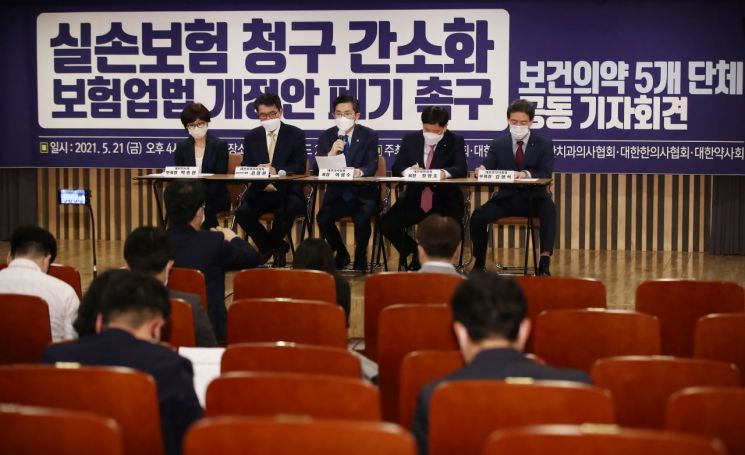
If the bill is promulgated, it will be implemented one year later (two years later for clinics with fewer than 30 beds). Until then, the industry and medical community must resolve the issue of the 'intermediary agency' in the indemnity insurance claim procedure. The Health Insurance Review & Assessment Service (HIRA) emerged as the intermediary agency, but the medical community strongly opposed it and even opposed the passage of the law itself, fearing that non-reimbursable medical details from hospitals and clinics would be transferred to HIRA. However, since the National Assembly classifies the bill as a livelihood bill, its approval is considered likely. The Korea Consumer Federation, an alliance of nine organizations, recently urged for the prompt passage of the bill.
Power Struggle Between Insurers and Card Companies Over Insurance Premium Card Payments
Meanwhile, the issue of insurance premium payments by card is expected to come under scrutiny again. The amendment to the Insurance Business Act proposed by Lee Jung-moon, a member of the Democratic Party of Korea on the National Assembly's Political Affairs Committee, includes a clause that punishes insurance companies (with imprisonment of up to one year or a fine of up to 10 million KRW) if they treat consumers who pay premiums by card unfavorably, such as by raising premiums. The intent is to prevent the burden of fees between insurance companies and card companies from being passed on to consumers.
According to the industry, in the first quarter, the proportion of insurance premium payments made by credit card was 5.1% for life insurance companies and 29.1% for non-life insurance companies. Non-life insurers had a relatively higher rate because they allow credit card payments for automobile insurance premiums. For long-term protection and savings products with monthly premiums, insurance companies have been reluctant to accept card payments due to card company fees.
The insurance industry states that they can allow card payments if card companies lower their fees, while card companies refuse to accept this. According to the '2023 National Audit Issues' report by the National Assembly Legislative Research Office, the fee rate applied by card companies to insurance companies is in the low 2% range of the payment amount. Insurance companies argue that if the fee burden increases, they have no choice but to raise overall premiums due to cost issues, while card companies claim they cannot accept fees at cost level.
© The Asia Business Daily(www.asiae.co.kr). All rights reserved.
![Clutching a Stolen Dior Bag, Saying "I Hate Being Poor but Real"... The Grotesque Con of a "Human Knockoff" [Slate]](https://cwcontent.asiae.co.kr/asiaresize/183/2026021902243444107_1771435474.jpg)
















