ROTC Half Under Quota... Some Units Have Only 5 Cadets
Result Reflects Perception of Poor Treatment of Junior Officers
This year’s first half saw the lowest-ever competition rate for candidates applying to the Army’s Reserve Officers' Training Corps (ROTC). Among these, half of the universities operating ROTC programs failed to fill their quotas. This appears to reflect the recent perception that junior officers have long service periods and poor treatment.
According to data submitted by the Ministry of National Defense to Song Ok-ju, a member of the National Assembly’s National Defense Committee from the Democratic Party of Korea, as of July this year, 54 out of 108 universities nationwide operating Army ROTC units had cadet quotas unfilled.
The ROTC unit at Gyeongin National University of Education had only 5 cadets out of a quota of 36, and the unit at Korea National University of Education had 23 cadets out of a quota of 69. Hanyang University filled 25 out of 54 slots, and Sogang University filled 20 out of 43.
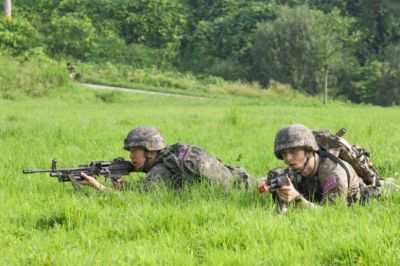 ROTC cadets training at the Army Cadet Military School in Goesan, Chungbuk [Image source=Provided by the Army]
The ROTC competition rate has decreased annually from 4.8 to 1 in 2015, to 2.6 to 1 in 2021, and 2.4 to 1 in 2022. This year’s first half competition rate for Army ROTC candidates remained at a record low of 1.6 to 1.
As a result, the Army conducted additional recruitment for the first time since its founding on the 1st of this month. Although there are currently more applicants than recruitment slots, many candidates drop out after enlistment. There is a risk that the number of commissioned officers graduating may fall below the target.
Currently, the service period for Army enlisted soldiers is 18 months, but for ROTC officers, it ranges from 24 to 36 months depending on the branch. Furthermore, the government plans to raise soldiers’ pay to 1.5 million KRW per month by 2025 based on the rank of sergeant, as outlined in its national agenda. Adding a 550,000 KRW support allowance, the total monthly pay will exceed 2 million KRW, which is higher than the average monthly pay of a second lieutenant (approximately 1.78 million KRW). This creates the perception that serving as an enlisted soldier is more advantageous than becoming an officer.
The National Assembly Budget Office pointed out in its 2023 budget overview report that “while the increase in soldiers’ pay has positive effects, the rise in rigid defense budgets may cause delays in acquiring advanced weapon systems and difficulties in securing junior officers.”
Assembly member Song stated, “It is the Ministry of National Defense’s obvious responsibility to secure excellent junior officers for the smooth execution of our military’s missions,” adding, “The Ministry must identify the causes and prepare innovative alternatives before the problem worsens.”
© The Asia Business Daily(www.asiae.co.kr). All rights reserved.
![Clutching a Stolen Dior Bag, Saying "I Hate Being Poor but Real"... The Grotesque Con of a "Human Knockoff" [Slate]](https://cwcontent.asiae.co.kr/asiaresize/183/2026021902243444107_1771435474.jpg)















