FDA Approval Followed by Announcement in Four Months
Plan to Confirm Safety of Brain-Implanted Chip
Elon Musk's neuroscience startup Neuralink has, for the first time, begun recruiting human subjects on the 19th (local time) to conduct experiments implanting devices into the brains of individuals with paralysis of all four limbs, enabling them to operate computers and other devices using only their thoughts.
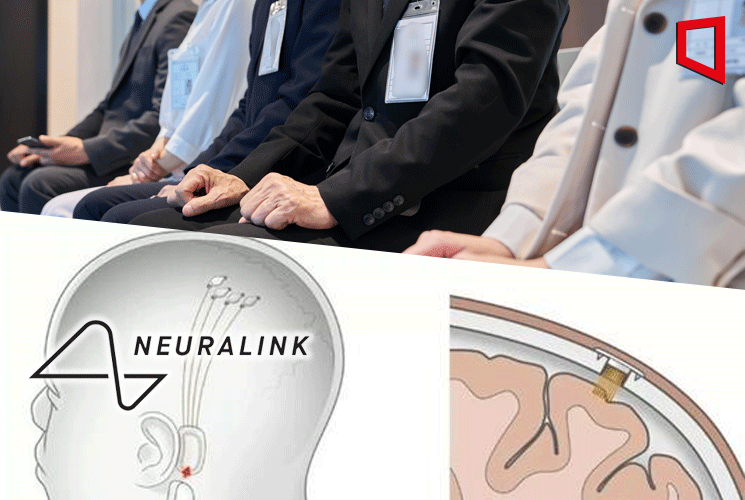
Neuralink announced this through the company's official blog on the same day. This comes four months after the U.S. Food and Drug Administration (FDA) approved research on humans in May. Neuralink explained that based on the FDA approval, it has been communicating with hospitals and has now entered the recruitment process for clinical trial participants to conduct experiments at one hospital. They also added that they have received approval from an independent institutional review board.
This is the first time Neuralink has started recruiting human subjects for such experiments. Until now, experiments were conducted first on animals such as monkeys.
This clinical trial will be conducted by surgically implanting a brain-computer interface (BCI) into the brain region that controls motor intention, using a robot.
Neuralink plans to deploy three devices developed so far simultaneously in this experiment. These include the Neuralink chip 'N1,' responsible for wireless brain signal input and output, which will be implanted in the brain area responsible for movement intention; the surgical robot 'R1,' used to install the N1; and the N1 user application (app), software that converts brain signals into computer commands connected to the N1. Neuralink stated that it will evaluate the safety and efficacy of these three components.
Through this, Neuralink aims initially to enable the trial participants to control a computer cursor or keyboard using only their thoughts.
The clinical trial subjects will be adults aged 22 or older who have paralysis of all four limbs due to cervical spinal cord injury or amyotrophic lateral sclerosis (ALS, also known as Lou Gehrig's disease), and must have a caregiver continuously present. The entire clinical trial is expected to take six years to complete.
However, Neuralink has not disclosed how many clinical subjects will be selected. The hospital where the implantation surgery will be performed is also undisclosed. According to current and former employees, Neuralink had previously planned to implant BCIs in a total of 10 people, but after the FDA raised safety concerns, discussions have been ongoing about reducing the number of clinical subjects.
Musk plans to facilitate computer chip implantation surgeries for treating diseases such as obesity, autism, depression, and schizophrenia through Neuralink.
However, experts say that even if BCI devices are proven safe for use in humans, it may take more than 10 years for Neuralink to obtain commercial approval, according to foreign media reports.
© The Asia Business Daily(www.asiae.co.kr). All rights reserved.
![Clutching a Stolen Dior Bag, Saying "I Hate Being Poor but Real"... The Grotesque Con of a "Human Knockoff" [Slate]](https://cwcontent.asiae.co.kr/asiaresize/183/2026021902243444107_1771435474.jpg)















