Tourism demand is increasing after the endemic phase. According to the World Travel & Tourism Council (WTTC), the tourism industry rapidly declined in 2020 due to the pandemic but grew by 25% and 22% in 2021 and 2022 respectively compared to the previous years. Consequently, investors are also showing increased interest in startups with business models related to tourism.
At the same time, negative concepts such as 'overtourism' have spread as the environmental damage and the lives of local residents suffering from tourism have come to the forefront in our society. In response, the Korea Tourism Organization set ‘realizing the value of sustainable tourism development’ as a future strategy for the tourism industry in its Basic Tourism Development Plan announced in 2021.
Against this backdrop, tourism startups are devising businesses that maximize positive social and environmental impacts while minimizing negative effects. This trend aligns with the growing interest in ESG (Environmental, Social, and Governance) within the startup ecosystem and the formation of ESG-focused funds.
In this context, MYSC (MY Social Company), a social innovation consulting and investment organization, operates a ‘Tourism Accelerating Program’ in partnership with the Korea Tourism Organization to discover and nurture startups in the tourism sector. A MYSC official said, “As the importance and influence of the tourism industry increase and ESG gains global attention, it is essential to consider sustainable tourism. We are discovering and nurturing startups that aim to create social value in the tourism industry.”
This year as well, MYSC planned and operated the tourism accelerating program ‘EMA Tourism’ together with the Korea Tourism Organization. Starting from the first cohort in 2021, the program is now in its third year, supporting tourism startups less than three years old to grow. At the ‘2023 Tourism Accelerating Demo Day’ held on the 15th at Heyground in Seongsu-dong, Seoul, 10 startups that have advanced sustainable tourism businesses and created social and financial value through the program were introduced.
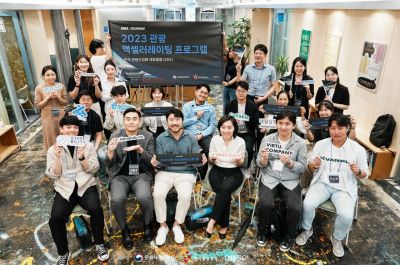 On the 15th, at Heyground in Seongsu-dong, Seoul, a group photo was taken of 10 companies participating in the accelerating program (Gwaenchana Maeul Mokpo, Naeil Sangjeom, Lunshot Company, Banple, Bucket Travel, Virtu Company, Stability, Simple Safari, Collab, Honolulu Company) along with representatives from the Korea Tourism Organization and MY Social Company during the '2023 Tourism Accelerating Demo Day.' / Photo by MY Social Company
Assigning New Meaning to Neglected ‘Spaces’... Revitalizing Local Economies
While some regions suffer from overtourism, others face difficulties in economic revitalization due to too few visitors. ‘Staybility,’ which operates a private pool villa reservation platform service, creates ‘accommodations where people want to stay’ focusing on such regions to attract visitors. For example, it transformed a hanok house in Daegu that had been neglected for three years into a serene caf? and remodeled a house abandoned for eight years in Jeju Island into a neat accommodation, thereby increasing the usability of neglected and abandoned spaces. Popular among the MZ generation (Millennials + Generation Z) who seek stylish accommodations and caf?s, Staybility currently has 170,000 followers on social media and receives about 100 SNS advertising inquiries per month.
There are also startups that discover idle spaces as travel destinations. ‘Vanple,’ a startup developing a road trip community map, created a platform where road trip travelers can share information. Road trips refer to long- or short-distance car trips such as car camping, auto camping, and campervan travel. Vanple also signs exclusive contracts with owners of idle land to convert these spaces into campgrounds. Soobin Jo, CEO of Vanple, said, “Idle spaces that were difficult to utilize in local areas are reborn as special travel destinations, gaining new meaning. We contribute to tourism revitalization by discovering new road trip locations, expanding the road trip population, and establishing a safe and enjoyable road trip culture.”
There are startups with business models addressing regional extinction. ‘Gwaenchanha Village Mokpo’ provides spaces to stay, work, and play so that travelers can feel like the destination is their hometown. For those who want to deeply experience the region but hesitate due to lack of information, it offers hyperlocal content, accommodations, participatory communities, and village currency services as an ‘all-in-one service.’ More than 1,400 travelers have experienced Mokpo through Gwaenchanha Village services, and over 170 people have decided on mid- to long-term stays. Dongwoo Hong, CEO of Gwaenchanha Village Mokpo, said, “We have been recognized as a global social innovation model addressing regional extinction and have been featured in various foreign media such as BBC and NHK.”
Respecting Customer Diversity with Customized Services Including for Vulnerable Tourists
Companies offering customized services that consider diverse characteristics of demanders, moving away from uniform tourism products, were also introduced. ‘Honolulu Company’ is an online travel agency aiming to create accommodation and travel culture that is easily accessible for vulnerable tourists. According to Honolulu Company’s own research, among 600 hotels with rooms for disabled guests as required by the Tourism Promotion Act, only 17 hotels were selling rooms in real time. However, even these rooms were underutilized due to insufficient promotion.
Beomsoo Kim, CEO of Honolulu Company, said, “We aim to solve the problem of underutilized disabled-only rooms and difficulties in accessing information about accommodations for disabled people. Through Honolulu Company’s ‘CheckinFree’ platform, users can easily check detailed conditions, photos, and make reservations for disabled rooms that were previously hard to access.”
There was also a startup working to improve accessibility to travel destinations where information is hard to find. ‘Simple Safari,’ operating ‘AmoTravel,’ provides personalized travel products through consultations with local experts for those who want to travel to remote overseas areas. Especially for destinations with low information accessibility such as Africa and South America, AmoTravel offers travel preparation, reservations, and local concierge services all at once, helping travelers explore remote areas easily and comfortably. It is expected to surpass 1 billion KRW in transaction volume this year. Yeo-jin Jung, CEO of Simple Safari, said, “We introduce local unique lifestyles and cultures, provide various products and services linked to sustainability, and contribute to creating local tourism ecosystems through tour personnel training.”
A Korea Tourism Organization official said, “To establish ESG practices in the tourism field, broad consensus among stakeholders, strategic public-private cooperation, and active participation of tourists are necessary.”
© The Asia Business Daily(www.asiae.co.kr). All rights reserved.
![Clutching a Stolen Dior Bag, Saying "I Hate Being Poor but Real"... The Grotesque Con of a "Human Knockoff" [Slate]](https://cwcontent.asiae.co.kr/asiaresize/183/2026021902243444107_1771435474.jpg)















