The nationwide housing business outlook for September has worsened compared to a month ago. However, in Seoul and Gyeonggi, housing prices continue to rise, and concerns about future supply shortages are growing, creating an atmosphere of sustained positive expectations.
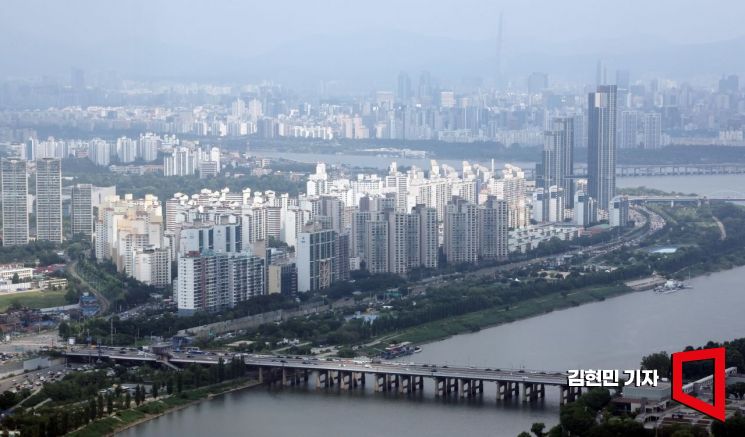 View of apartments in Ichon-dong, eastern Seoul, from the 63 Building observatory. Photo by Hyunmin Kim kimhyun81@
The Korea Housing Industry Research Institute (KHIRI) announced on the 14th that the nationwide housing business outlook index for this month recorded 86.6, down 10.1 points from last month’s 96.7, based on a survey of housing business operators.
The housing business outlook index is calculated from a survey on the perceived housing construction business climate conducted among about 500 member companies of the Korea Housing Association and the Korea Housing Builders Association. An index below 85 indicates a downturn phase, 85 to less than 115 indicates a stable phase, and 115 to less than 200 indicates an upturn phase.
While the index showed a downward trend nationwide, Seoul fell 14.5 points from 127.2 to 112.7, Incheon dropped 16.9 points (108.3→91.4), and Gyeonggi decreased 15.2 points (117.5→102.3), all falling more than 10 points. Accordingly, the metropolitan area declined 15.6 points month-on-month (117.7→102.1).
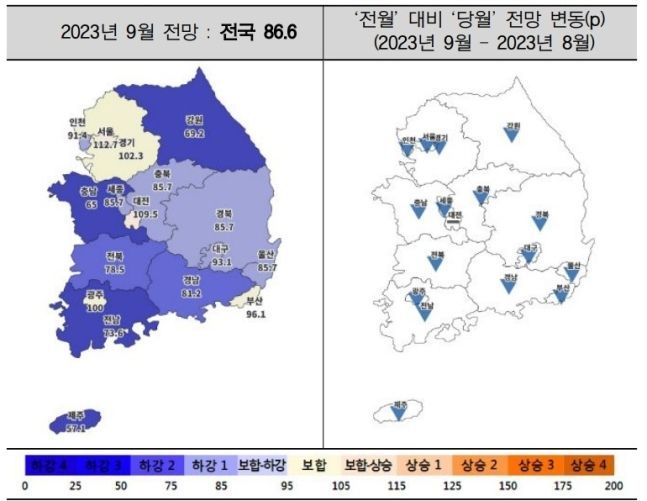
However, Seoul and Gyeonggi have maintained an index above the baseline of 100 for three consecutive months since July, so positive expectations still persist in the market. Non-metropolitan areas fell 5.4 points month-on-month (100.4→95.0).
Among metropolitan cities, all declined except Daejeon, which remained stable at 109.5. Ulsan showed the largest drop of 14.3 points (100.0→85.7), while Daegu (100.0→93.1), Gwangju (104.5→100.0), and Busan (100.0→96.1) also saw slight decreases.
In other regions, Gangwon experienced the largest decline nationwide, dropping 24.1 points (93.3→69.2). Jeju (73.6→57.1), Jeonbuk (93.7→78.5), Gyeongnam (94.7→81.2), Chungnam (77.7→65.0), and Jeonnam (82.3→73.6) also fell across the board.
KHIRI explained, "Due to the continued rise in sale and jeonse prices, a sharp decrease in permits and groundbreaking volumes, and concerns about future supply shortages caused by increased construction costs, the metropolitan market, where demand outweighs supply, is expected to maintain a positive outlook for the time being."
They added, "In contrast, small and medium-sized cities in provincial areas are expected to show a weak housing business outlook index for some time due to ongoing concerns such as demand contraction and an increase in unsold units."
The material supply index rose from 90.9 to 100.0, while the financing index slightly fell from 74.6 to 73.2.
The rise in the material supply index is interpreted as reflecting expectations of increases in cement prices and labor costs, as reflected in the standard construction cost regularly announced every September.
The housing construction order index (including redevelopment, reconstruction, public land, and private land) generally increased.
© The Asia Business Daily(www.asiae.co.kr). All rights reserved.
![Clutching a Stolen Dior Bag, Saying "I Hate Being Poor but Real"... The Grotesque Con of a "Human Knockoff" [Slate]](https://cwcontent.asiae.co.kr/asiaresize/183/2026021902243444107_1771435474.jpg)
















