Ban on Direct Landfilling at Sudogwon Landfill Site in 2026
Friction in Seoul Sangam-dong, Various Areas of Incheon and Gyeonggi
Model Solution Case 'Pyeongtaek Eco Center'
Starting in 2026, the import of unincinerated waste to the metropolitan landfill sites will be banned, intensifying conflicts over the installation of new large-scale resource recovery facilities (incinerators) across the metropolitan area. When Sangam-dong in Mapo-gu was finally selected as the site within Seoul, local residents immediately protested, and there have been disruptions such as suspension of public recruitment in Incheon and Gyeonggi areas. As the establishment of new incinerators becomes inevitable, calls are growing for solutions to resolve public conflicts.
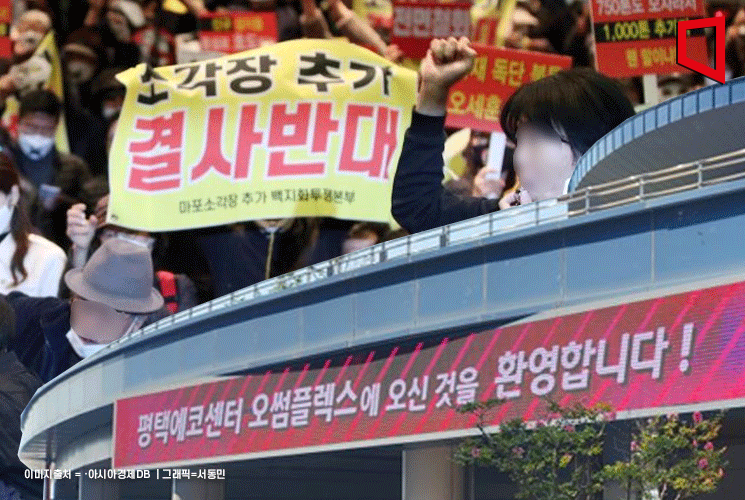
◆ Rising Resident Opposition to 'New Incinerator in Sangam-dong' = On the 31st of last month, Seoul City officially selected and announced two plots, including 481-6 Sangam-dong, as the site for a new incinerator with a capacity of 1,000 tons. The city has been working on selecting a site for the new incinerator since last year. Although two rounds of public recruitment were conducted, no autonomous districts volunteered. Consequently, the site selection committee established exclusion and evaluation criteria, initially shortlisting 36 locations in August last year, then narrowing down to five through meetings, and finally selecting Sangam-dong.
The local community immediately opposed the decision. Park Gang-su, Mayor of Mapo-gu, criticized it as "convenience-driven administration" for choosing Mapo-gu, which has suffered from existing incinerators, as the final site for the new facility. The 'Mapo-gu Incinerator Additional Installation Cancellation Struggle Headquarters,' composed of local residents, also raised their voices against it. Sung Eun-kyung, the head of the struggle committee, said, "On the 17th of last month, Seoul Mayor Oh Se-hoon promised to communicate with residents, but the decision was announced just two weeks later. There was no genuine intention to communicate from the start," adding, "The struggle committee is preparing to file an administrative lawsuit against Seoul City."
Seoul City maintains that it conducted environmental impact assessments and resident persuasion efforts over the past year. A strategic environmental impact assessment was conducted within a 5 km radius of the incinerator site to evaluate how pollutants affect air quality, concluding that the environmental impact is minimal. Since the Board of Audit and Inspection dismissed the public interest audit requested by Mapo-gu residents in March last year in July, the city believes it has secured legal and procedural legitimacy.
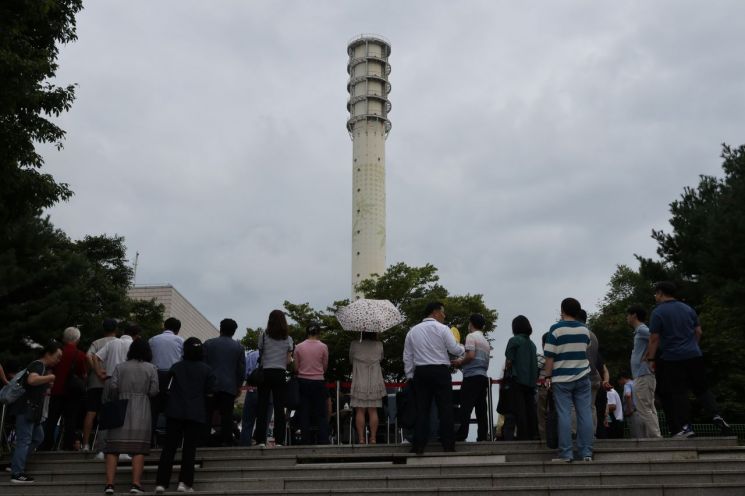 On the morning of the 4th, residents of Mapo-gu, Seoul, are watching a press conference held in front of the Sanggam-dong Resource Recovery Facility opposing the decision by District Mayor Park Gang-su to establish a new waste incineration plant. [Image source=Yonhap News]
◆ Cannot Delay New Incinerator Construction... Stalemate Across the Metropolitan Area = Resident opposition to the construction of new incinerators, a typical 'NIMBY' facility, was expected. Nevertheless, Seoul City has no choice but to proceed because, starting January 1, 2026, landfill disposal of unincinerated household waste at metropolitan landfills will be prohibited. Currently, Seoul operates four resource recovery facilities (Yangcheon, Nowon, Gangnam, Mapo) to incinerate waste, but as these facilities are 18 to 27 years old, their capacity has declined to 2,200 tons per day, which is insufficient for the daily waste generation of 3,200 tons. Without securing a new incinerator with a capacity of 1,000 tons, waste processing will become impossible from 2026.
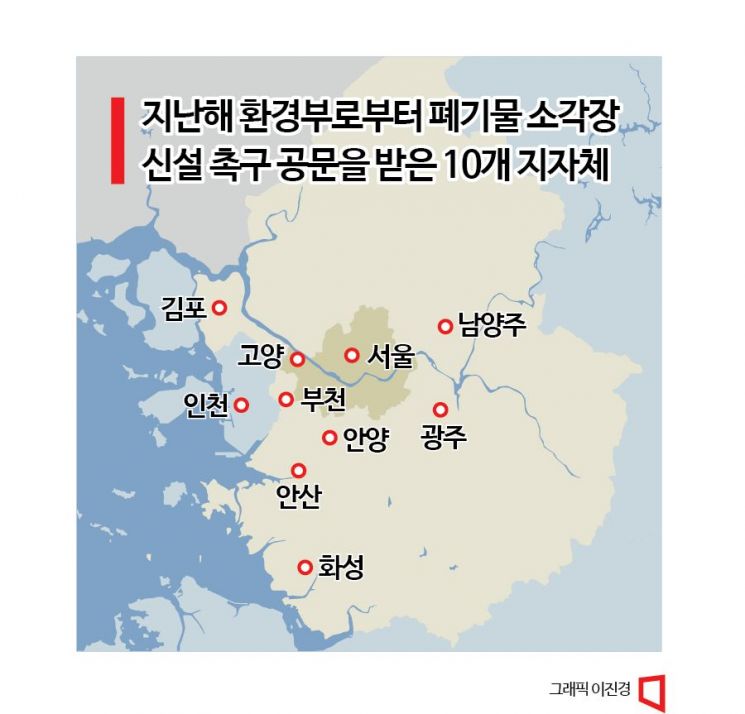
The situation is similar in Incheon and Gyeonggi Province, which share the metropolitan landfill. In July last year, the Ministry of Environment sent official letters to Seoul, Incheon, and eight cities in Gyeonggi Province (Goyang, Bucheon, Ansan, Namyangju, Anyang, Hwaseong, Gimpo, Gwangju) that generate more than 50 tons of combustible waste monthly, instructing them to complete new incinerator construction before the current local government heads' terms end. The Ministry of Environment is also considering penalties such as withholding national subsidies for other waste treatment facilities if these local governments fail to expand incinerators by 2026. A Ministry of Environment official emphasized, "To use landfill sites efficiently, banning direct landfill of household waste is essential."
However, in Incheon and Gyeonggi areas, progress is stalled due to resident opposition. Incheon formed a Western Region site selection committee last year and called for candidate sites but received no applications. Although five preliminary candidate sites were selected on Yeongjong Island, a scheduled briefing session on the 8th was canceled due to resident protests. Hwaseong conducted a site selection recruitment in March and received applications from three areas, but residents submitted withdrawal requests, temporarily halting the selection process. Gwangju is pushing for a new facility in Suyang-ri, Gonjiam-eup, but residents of nearby Sindun-myeon, Icheon City, are opposing it and have filed administrative lawsuits.
◆ Spotlight on the Resident-Welcomed 'Pyeongtaek Eco Center' = Amid these conflicts, a precedent of smoothly resolving disputes over new incinerator construction has attracted attention. The 'Pyeongtaek Eco Center' (Awesomeplex), located in Haechang-ri, Godeok-myeon, Pyeongtaek City, Gyeonggi Province, was established in 2019 with a capacity of 250 tons. After the approval of the 'Godeok Internationalization Plan District' in 2012, the project was actively pursued but initially faced opposition from local residents. Godeok-myeon residents visited the city hall to protest and held street demonstrations in front of Pyeongtaek Station.
To persuade residents, Pyeongtaek City held dozens of meetings with about 30 village chiefs from Godeok-myeon to understand their needs. Subsequently, the city actively incorporated their demands by placing the incinerator underground and installing a complex cultural and sports space on the surface, including a swimming pool, sauna, gateball court, and walking trails. The facility's operation was entrusted to the 'Godeok Haechang 2·5 Residents Cooperative,' a support council for residents in the surrounding impact area. Additionally, 130 households from Haechang 2-ri and 5-ri each hold a 0.77% stake, allowing them to receive an equitable share of the net profits from convenience facilities annually. As communication continued, residents shifted to support the project. Kwon Young-jin, head of the Godeok Haechang 2·5 Residents Cooperative, said, "Most of the residents' wishes were reflected," adding, "Especially, the clear explanation of the necessity of the incinerator and its low harmfulness was significant."
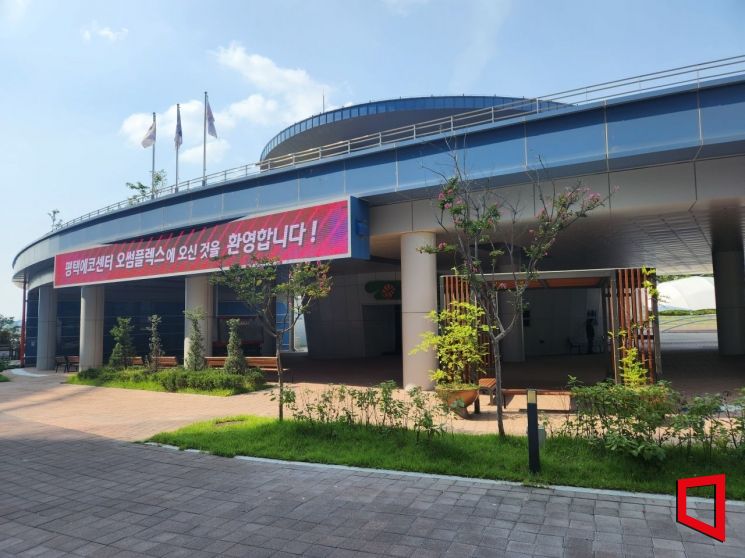 Pyeongtaek Eco Center in Pyeongtaek-si, Gyeonggi, recognized as an excellent case of installing undesirable facilities. Opened in 2019, Pyeongtaek Eco Center is an SRF combined heat and power facility that processes 250 tons of waste per day.
 Photo by Choi Taewon skking@
Since the establishment of the Pyeongtaek Eco Center, residents of Haechang 2·5-ri have expressed satisfaction. Lee So-heun (56, female), who runs a flower shop nearby, said, “There was strong opposition at first, but through dialogue, we reached an agreement. Now, the quality of life has improved greatly, and I even take my nieces and nephews to the swimming pool when they visit.” Kim (62, male), who operates a mart, also said, "There is no unpleasant odor as feared, and local residents can use the facilities at a discount, so many go there for bathing and other activities." Located not far from the metropolitan area and offering a 30% discount to Pyeongtaek citizens, the center's visitors increased from 2,946 in 2020 to 24,340 in 2021 and 73,598 in 2022.
◆ "Public Conflicts Require a 'Bottom-Up' Approach" = Experts say that, as in the case of the Pyeongtaek Eco Center, 'bottom-up' communication that listens to residents' desires is essential to minimize conflicts. Kim Jun-mo, a professor of public administration at Konkuk University, said, "The Sangam-dong case provoked strong opposition because it was driven by Seoul City's preferences rather than local needs," adding, "Through deliberative processes, clearly understanding and providing what residents want can reduce conflicts." Seo Min-hyung, a professor of real estate at Gyeongin Women's University, also emphasized, "It is important to persuade residents that incinerators are no longer harmful as before and to offer sufficient benefits that residents can accept," adding, "If residents can enjoy desired convenience facilities or benefits within reasonable limits, persuasion is possible."
If differences in positions are significant, forming a consultative body involving a third party to find a compromise is also considered. In 2013, residents of Sinhwa 1-ri, Uljin County, located within a 1 km radius of six nuclear reactors, 15 transmission towers, and four substations, opposed the Shin-Hanul nuclear power plant project and demanded collective relocation. Korea Electric Power Corporation, Korea Hydro & Nuclear Power, the Ministry of Trade, Industry and Energy, Uljin County, and residents engaged in negotiations but failed to reach an agreement for a year. Then, the National Unity Committee, a third party, recommended three private conflict mediation experts, who held 12 conflict mediation meetings. In December 2014, residents accepted that collective relocation was impossible and agreed to measures to improve quality of life, such as constructing detour roads for construction vehicles, expanding health checkups, and reducing noise. Kim Yoon-tae, a sociology professor at Korea University, said, "If conflict mediation is difficult, stakeholders should seek resolution through neutral mediators acceptable to all parties." Professor Kim Jun-mo also suggested, "If residents find it hard to express their wishes to higher authorities, forming a committee with third-party participation to coordinate positions is one option."
© The Asia Business Daily(www.asiae.co.kr). All rights reserved.
![Clutching a Stolen Dior Bag, Saying "I Hate Being Poor but Real"... The Grotesque Con of a "Human Knockoff" [Slate]](https://cwcontent.asiae.co.kr/asiaresize/183/2026021902243444107_1771435474.jpg)


















