The three major indices of the U.S. New York Stock Exchange are showing a downward trend from early trading within a narrow range on the 5th (local time), the day after the Labor Day holiday, due to weak economic indicators from China and a sharp rise in oil prices.
At around 10:13 a.m. at the New York Stock Exchange (NYSE), the Dow Jones Industrial Average, composed of blue-chip stocks, was trading at around 34,761, down 75.97 points (0.22%) from the previous close. The S&P 500, focused on large-cap stocks, was down 13.03 points (0.29%) to 4,502, and the tech-heavy Nasdaq was at 13,983, down 48.52 points (0.35%).
Currently, all 10 sectors of the S&P 500, except for energy-related stocks, are declining. Warner Bros. Discovery is down nearly 3% following its announcement that the Hollywood writers' strike could negatively impact its cash flow by approximately $300 million to $500 million. Bank of America (BoA) lowered target prices for airlines due to rising jet fuel prices, causing American Airlines, Delta Air Lines, and others to fall more than 2%. Carnival, a leading cruise company, is also down nearly 3%. In contrast, energy-related stocks such as Halliburton are showing strength. Airbnb and Blackstone jumped more than 7% and 3%, respectively, on news of their inclusion in the S&P 500 index. Oracle is trading slightly higher after Barclays upgraded its investment rating to overweight.
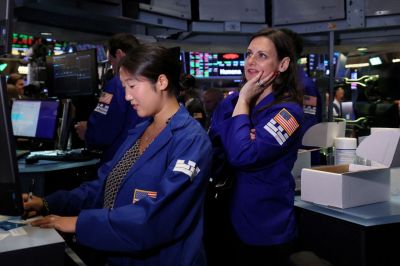
Investors are closely watching September trading, which began in earnest following the Labor Day holiday on the 4th. The sharp rise in international oil prices in the commodities market is exerting downward pressure on the stock market. Additionally, China's private sector economic indicator, the Caixin Services Purchasing Managers' Index (PMI), showed its weakest level in eight months, increasing concerns about global growth. The U.S. economic data released on the same day was also weak. The U.S. August Employment Trend Index (ETI) fell to 113.02 compared to the previous month. Factory orders for July also decreased by 2.1% from the previous month.
However, there is also optimism that these weak economic indicators, or bad news, could actually be positive for the New York Stock Exchange. Adam Turnquist, Chief Technical Strategist at LPL Financial, told CNBC that although September has traditionally been a weak month for the New York Stock Exchange, "history may not repeat itself, but this year's strong momentum suggests September may not be as bad as expected." Goldman Sachs lowered the probability of a U.S. recession from 20% to 15% and predicted that the Federal Reserve (Fed) may hold interest rates steady at this month's Federal Open Market Committee (FOMC) meeting.
Market expectations for the end of Fed tightening have increased following last week's employment report. The August employment report released on the 1st showed the U.S. unemployment rate rising to 3.8%, the highest level in about a year and a half, and wage growth slowing more than expected. This confirmed signals that the previously hot labor market is cooling down.
According to the FedWatch tool from the Chicago Mercantile Exchange (CME), federal funds futures are pricing in over a 95% chance that the Fed will hold rates steady in September. The probability of a hold in November is also around 57%. Although the Fed's June dot plot indicated the possibility of one more rate hike this year, investors are increasingly betting on no further increases. The remaining FOMC meetings this year are scheduled for September, November, and December.
This week, Fed officials will continue to speak. Fed Governor Christopher Waller, in an interview with CNBC's Squawk Box, positively assessed the recently released employment and inflation data, saying, "The key is that it allows us to proceed cautiously with rate hike decisions." He added, "We can just sit back and watch to see if the data continues to come in." He explained that since rates have already been raised sufficiently, it is time to monitor the cumulative effects of tightening. Market participants are paying close attention to Waller's dovish remarks, given his reputation as a hawk within the Fed. The Fed has previously raised the U.S. benchmark interest rate to a 22-year high of 5.25% to 5.50%.
On the 6th, Boston Fed President Susan Collins, who has indicated the need for further rate hikes, will speak. Remarks from Fed Governor Michelle Bowman and Dallas Fed President Lorie Logan are also scheduled. Notable doves such as Chicago Fed President Austan Goolsbee, Philadelphia Fed President Patrick Harker, and Atlanta Fed President Raphael Bostic will speak on the 7th. Additionally, key indicators including the Fed's Beige Book, S&P Global Services PMI, Institute for Supply Management (ISM) Non-Manufacturing PMI, and trade balance data will be released this week.
In the New York bond market today, Treasury yields are rising. The benchmark 10-year yield is around 4.24%, and the 2-year Treasury yield, sensitive to monetary policy, is around 4.92%. The dollar index, which measures the value of the U.S. dollar against six major currencies, is up more than 0.5% to 104.7.
International oil prices rose on expectations that OPEC+ producers will extend production cuts. October West Texas Intermediate (WTI) crude oil prices are trading above $86.8 per barrel, up more than 1.4% from the previous close.
European stock markets are mixed. Germany's DAX and France's CAC indices are down 0.19% and 0.25%, respectively. The UK's FTSE index is showing slight gains.
© The Asia Business Daily(www.asiae.co.kr). All rights reserved.
![Clutching a Stolen Dior Bag, Saying "I Hate Being Poor but Real"... The Grotesque Con of a "Human Knockoff" [Slate]](https://cwcontent.asiae.co.kr/asiaresize/183/2026021902243444107_1771435474.jpg)















