[Fuel Efficiency AtoZ]
If driving over 5.8 km per kWh is recognized,
Energy Consumption Efficiency Grade 1 is awarded
Hyundai Ioniq 6 and Tesla Model 3 qualify
Labeling differentiated reflecting electric vehicle characteristics
Darkest blue indicates Grade 1
Grades shown lighter as they decrease
Internal combustion engine vehicle labels changed for clarity
Starting in September, electric vehicles (EVs) will also be rated on a five-level scale based on their energy consumption efficiency, with detailed methods for displaying these ratings. Until now, only internal combustion engine vehicles have been graded and labeled in a way that consumers can easily identify at a glance. Considering the characteristics of EVs, the labeling method, including color schemes, has been newly designed.
According to the newly implemented "Regulations on Energy Consumption Efficiency Grades and Labeling of Automobiles" starting next month, EVs that achieve 5.8 km or more per kWh will receive a top efficiency rating of Grade 1. Among EVs currently sold domestically, models such as Hyundai Ioniq 6 (long-range type), Kona Electric (urban type), and Tesla Model 3 (rear-wheel drive base model) qualify for this rating.
Similarly, vehicles achieving 5.0 to 5.7 km/kWh are rated Grade 2, and those with 4.2 to 4.9 km/kWh receive Grade 3. Applying the new standards to currently available models, many popular vehicles such as Kia EV6, Tesla Model 3 (Long Range), Model Y, Hyundai’s new Kona Electric, and Ioniq 5 fall into Grades 2 and 3.
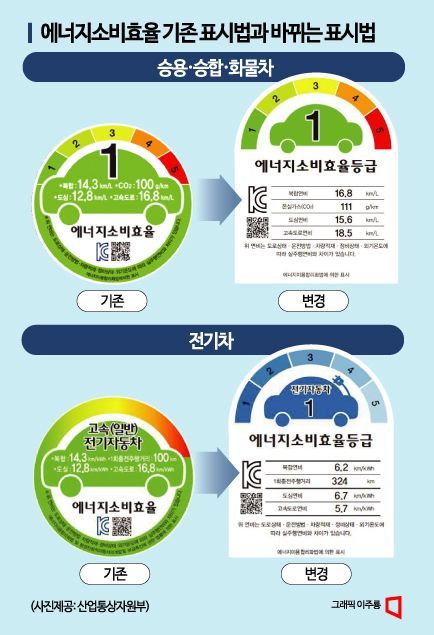
Vehicles with 3.4 to 4.1 km/kWh are rated Grade 4, while those at or below 3.3 km/kWh receive the lowest Grade 5. Tesla Model X and Mercedes-Benz EQS SUVs fall into Grade 4, whereas high-performance EVs like Porsche Taycan and Mercedes-Benz AMG are rated Grade 5. Various small commercial vehicles such as Hyundai Porter, Kia, and BYD (Biyadi) T4K mostly receive Grade 5.
The EV fuel efficiency grades use blue as the base color, with intensity varying by grade. Grade 1 is a deep blue, and the color becomes lighter as the grade decreases. Initially, the government planned to apply a system similar to that used for internal combustion engine vehicles when establishing the EV fuel efficiency grading system. Currently, internal combustion engine vehicles use green for high fuel efficiency (Grade 1), yellow for mid-level, and red for low efficiency.
However, following criticism from the automotive industry that this method does not adequately reflect the characteristics of both internal combustion and electric vehicles, EVs have been differentiated with a distinct grading system. For example, considering current charging fees and gasoline prices comprehensively, the charging cost for a Grade 5 EV traveling the same distance is about half or significantly less than the fuel cost of a Grade 1 gasoline vehicle. If the fuel efficiency labeling methods for EVs and internal combustion vehicles were similar, consumers might mistakenly assume that maintenance costs for vehicles with the same grade are comparable. To avoid this misunderstanding, a new labeling method has been adopted.
Under the new regulations, labels for internal combustion engine vehicles will also become more intuitive. Previously, the vehicle color on the label remained unchanged, and grades were indicated by numbers. Going forward, the vehicle color displayed on the label will vary according to the grade. Hybrid vehicles, which previously only displayed fuel efficiency grades in text, will now have vehicle colors adjusted according to each grade. Compact cars, plug-in hybrids, and hydrogen vehicles will not have separate grades, so their labels will remain largely unchanged.
© The Asia Business Daily(www.asiae.co.kr). All rights reserved.
![Clutching a Stolen Dior Bag, Saying "I Hate Being Poor but Real"... The Grotesque Con of a "Human Knockoff" [Slate]](https://cwcontent.asiae.co.kr/asiaresize/183/2026021902243444107_1771435474.jpg)















