Expansion Planned in the 66 Trillion Market
"Active Support for the 470 Billion Preliminary Feasibility Study Approval"
The People Power Party and the government have decided to support the budget to enable domestic companies to enter the global low Earth orbit satellite communication market, currently valued at $50 billion (66 trillion KRW).
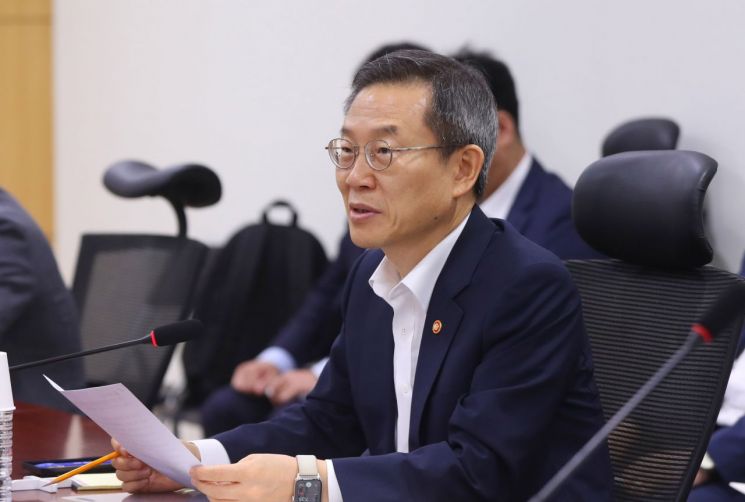 Minister Lee Jong-ho of the Ministry of Science and ICT is speaking at the working-level party-government meeting for CCU technology advancement and satellite communication activation held at the National Assembly Members' Office Building on the 25th.
 [Photo by Yonhap News]
On the 25th, members of the People Power Party belonging to the National Assembly's Science, Technology, Information and Broadcasting and Communications Committee held a working-level party-government consultation meeting at the National Assembly with Minister Lee Jong-ho of the Ministry of Science and ICT and other officials, agreeing to actively support securing the budget for the low Earth orbit satellite communication business, which is expected to grow to $210 billion (approximately 279 trillion KRW) in the future. The Ministry of Science and ICT plans to challenge a preliminary feasibility study project worth 470 billion KRW for this business.
Park Sung-joong, the ruling party's secretary of the Science, Technology, Information and Broadcasting and Communications Committee, said to reporters after the meeting, "We will conduct a preliminary feasibility study for the 470 billion KRW budget next year, and the committee will actively participate in the Ministry of Economy and Finance's feasibility study process."
Earlier, on the 30th of last month, the Ministry of Science and ICT announced that it would reapply for a preliminary feasibility study for research and development aimed at exporting low Earth orbit satellite communication technology. So far, the ministry has applied twice for preliminary feasibility studies from 2021 until last year but was rejected both times.
The ruling party explained that it would support the business in line with overseas companies actively promoting satellite communication projects. Park said, "The United States has SpaceX and Amazon, and the UK has OneWeb, but we do not have such companies, so we will actively promote the formation of domestic companies as well," adding, "Low Earth orbit satellite communication is a technology that will inevitably be used comprehensively for national security, disaster response, climate observation, and agriculture, so we must pay greater attention to it."
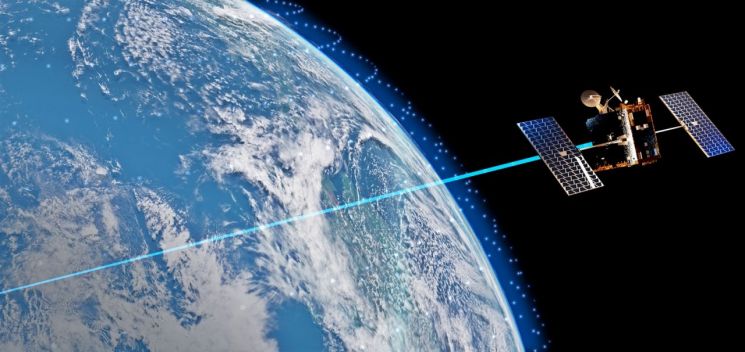
Low Earth orbit satellite communication utilizes communication sent from low Earth orbit satellites orbiting the Earth at altitudes between 300 and 1,500 km. Due to the low altitude, it can provide ultra-high-speed, low-latency services and is expected to be used for future 6G services. Currently, the low Earth orbit satellite communication market is about $50 billion (approximately 66 trillion KRW), but it is expected to grow to $210 billion in 30 years.
Additionally, the party and government announced plans to promote measures to advance carbon capture and utilization (CCU) technology to achieve carbon neutrality goals. CCU is a technology that captures carbon dioxide and recycles it into value-added compounds and other uses.
Park said, "Although there is corporate demand, the technology maturity is low, so we decided to invest a lot in research funding," adding, "There is legislation pending in the National Assembly regarding the capture, transport, storage, and utilization of carbon dioxide (CO2), and we agreed to actively expedite the passage of this legislation." The 'Act on Carbon Dioxide Capture, Transport, Storage, and Utilization,' proposed by People Power Party lawmaker Lee Cheol-gyu, is currently pending in the National Assembly's Industry, Trade, Resources, Venture, and SMEs Committee.
© The Asia Business Daily(www.asiae.co.kr). All rights reserved.
![Clutching a Stolen Dior Bag, Saying "I Hate Being Poor but Real"... The Grotesque Con of a "Human Knockoff" [Slate]](https://cwcontent.asiae.co.kr/asiaresize/183/2026021902243444107_1771435474.jpg)
















