China Bans Japanese Seafood Imports from 24th
Accounts for 20.8% of Japan's Seafood Exports
Setback Inevitable for 5 Trillion Yen Export Target
Seafood Prices Plummet on Site
As China imposed a complete ban on seafood imports in protest against Japan's discharge of contaminated water from its nuclear power plant into the ocean, the Japanese government is facing deep concerns. The Japanese government had set a goal to expand exports of agricultural and marine products to revitalize agriculture and fisheries, but analysts say the import ban by China, Japan's top export destination, will put a brake on these plans.
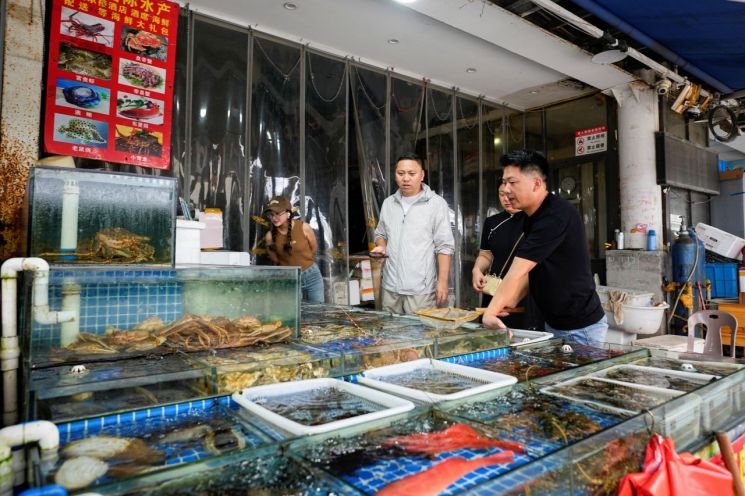
On the 24th, the General Administration of Customs of China issued a statement immediately after Japan began discharging contaminated water, announcing a total ban on imports of Japanese seafood. The reason cited was concerns over food safety due to the contaminated water discharge.
The Japanese fishing industry has been put on alert by this measure from the Chinese government. Mainland China accounts for 20.8% of imports in the Japanese seafood market, ranking first. Hong Kong and South Korea follow with 15.6% and 5%, respectively.
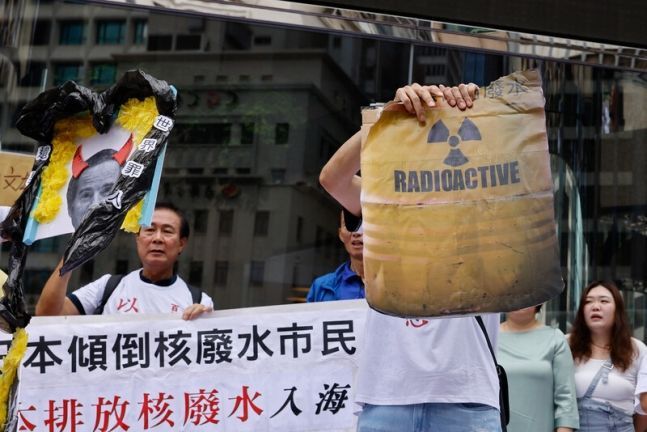 On the 24th, a protest criticizing the discharge of contaminated water from the Fukushima nuclear power plant in Japan is taking place in Hong Kong.
 [Image source=Reuters Yonhap News]
Looking at the overall scale of Japan's exports to China, agricultural and marine products account for only 1%, so the impact of China's measures on the entire export industry is expected to be limited. However, the repercussions on the fishing industry are not insignificant. Japan's Ministry of Agriculture, Forestry and Fisheries has set a goal to expand agricultural and marine product exports to 2 trillion yen (approximately 18.1754 trillion won) by 2025 and 5 trillion yen by 2030. This is close to the export amount of 1.2433 trillion yen recorded from January to November last year. The suspension of imports by China, a major export country, has caused setbacks in achieving the goal of expanding exports to 5 trillion yen.
Since last month, the Chinese government has been conducting comprehensive radiation inspections on Japanese seafood, and economic damage is becoming visible on the ground.
According to the General Administration of Customs of China, seafood imports from Japan to China amounted to 234.51 million yuan (approximately 42.7896 billion won), a 29% decrease compared to the same month last year. Specifically, imports of refrigerated fish decreased by 53% from the previous month to 22.63 million yuan (approximately 4.12047 billion won), and frozen fish imports fell by 13% to 36.77 million yuan.
Seafood prices have also dropped significantly. Since the Chinese customs began comprehensive radiation inspections on Japanese seafood last month, the price of Japanese abalone has fallen by about 30% compared to the previous year. Sea cucumbers dropped to 2,000 to 2,500 yen per kilogram in March, less than half the price compared to the previous year, as reports of Japan's contaminated water discharge circulated in the media.
Seafood processing factories, fearing damage to exports, have also reduced production. A Japanese seafood processing company supplying sea cucumbers and dried abalone to China said, "We have reduced production by 40% compared to last year," adding, "We are concerned about accumulating inventory and increasing losses."
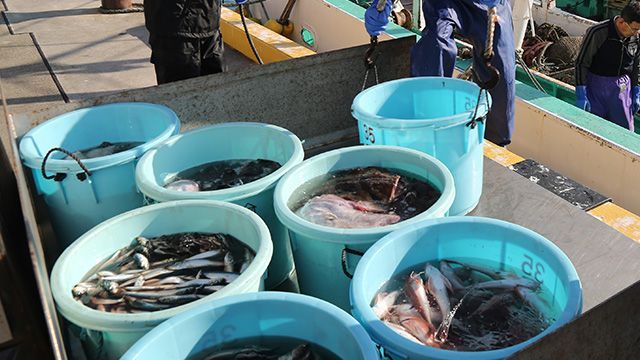 A local fisheries worker loads fish caught in the waters off Fukushima onto a forklift at Onahama Port in Iwaki City, Fukushima Prefecture, Japan.
In response, the Japanese government has taken emergency measures to minimize damage to the fishing industry, but these are criticized as mere stopgap measures. The Ministry of Agriculture, Forestry and Fisheries and the Ministry of Economy, Trade and Industry announced the day before that they would establish consultation desks at the Organization for Small & Medium Enterprises and Regional Innovation, Japan, and the Japan External Trade Organization to provide support for damage caused by rumors (defamation), exports, and management. However, some point out that the government should devise measures through cooperation among various ministries at the national level.
Mikiko Saito of PWC Consulting, a global management consulting firm, said, "Maintaining stable exports of agricultural and marine products is important from the perspective of food security," adding, "It is necessary to organize countermeasures not only by the Ministry of Agriculture, Forestry and Fisheries but also including other ministries."
© The Asia Business Daily(www.asiae.co.kr). All rights reserved.
![Clutching a Stolen Dior Bag, Saying "I Hate Being Poor but Real"... The Grotesque Con of a "Human Knockoff" [Slate]](https://cwcontent.asiae.co.kr/asiaresize/183/2026021902243444107_1771435474.jpg)

















