'Mongparnaseu Tower' Celebrates 50th Anniversary
"Stain on Paris Skyline," Harsh Local Criticism
Despite marking the 50th anniversary of the construction of Paris's skyscraper, the 'Montparnasse Tower,' criticism over the very existence of this building continues unabated among Parisians, rather than celebration.
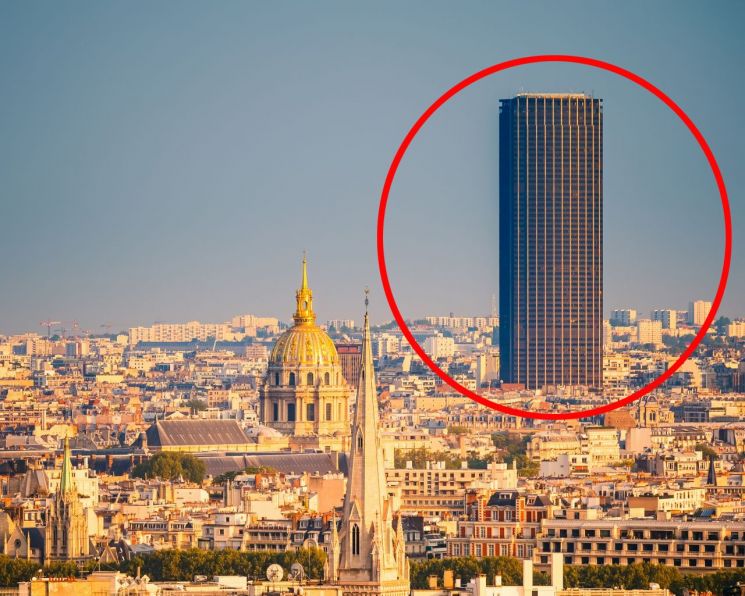 In the cityscape of Paris, the Montparnasse Tower stands alone prominently on the right side of the photo.
 [Photo by Getty Images Bank]
The reason is that the beautiful Paris cityscape, characterized by densely packed low-rise buildings averaging about six stories high and giving a harmonious and compact feel, was completely ruined by the presence of the black and unsightly 'Montparnasse Tower.'
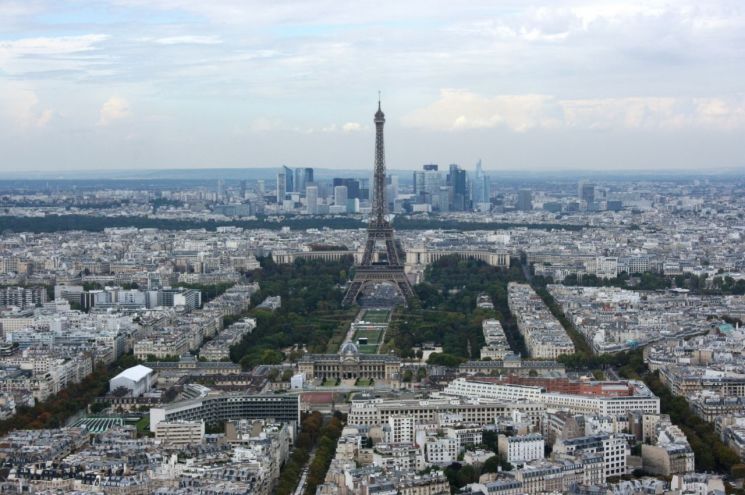
Recently, CNN focused on the Montparnasse Tower, which has been despised by residents for 50 years. Located in Paris, France, the Montparnasse Tower is famous for its observation deck with a front view of the Eiffel Tower, making it a beloved spot for tourists visiting Paris. However, locals harbor significant resentment, viewing the Montparnasse Tower as an eyesore.
Among Parisians, there is even a joke that the Montparnasse Tower observation deck is the most beautiful viewpoint because it is the only place where you cannot see the Montparnasse Tower itself.
At 209 meters, the tallest building in Paris
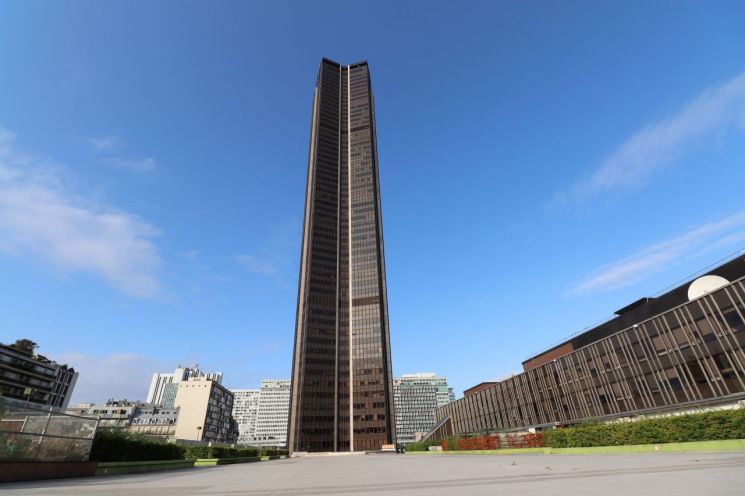 The Montparnasse Tower was built in accordance with Brutalism, an architectural style popular in the 1950s and 1960s.
 [Photo source=Pixabay]
The Montparnasse Tower was built in 1973. At the time of construction, it stood 209 meters tall, making it the tallest building in Paris. From the outset, most opinions were that it did not fit with Paris's character. Even 50 years after its completion, it is still regarded as a blemish on Paris's skyline.
The harsh criticism of the Montparnasse Tower stems from the fact that it contradicts the history and philosophy Paris pursues. Modern Paris was born through urban improvement projects carried out in the mid-19th century. At that time, Paris improved roads, sewage systems, and created large green spaces, greatly enhancing the city's hygiene and living environment. Above all, a defining feature of Paris was the uniformity of building shapes, which created overall city cohesion.
However, after experiencing the devastation of the world wars, Paris became desolate. To rebuild the city, a modernization project was launched, of which the Montparnasse Tower was a part.
But there was a problem. While most Parisian buildings did not exceed six stories, the Montparnasse Tower was designed with 59 floors. Parisians strongly opposed the tower's construction at the time. Despite the opposition, the Paris city authorities pushed forward with the construction. The completed Montparnasse Tower, with its simple architectural structure, massive scale, and uniform exterior, was completely out of sync with Paris's landscape, becoming a true eyesore for Parisians.
This is because the Montparnasse Tower was built in the Brutalism architectural style popular in the 1950s and 1960s. Brutalism emerged as a reaction against modern architecture's emphasis on ornate and decorative elements, advocating functionalism instead. It is characterized by the use of massive concrete or steel blocks, giving a rough and heavy impression. Since it does not pursue beauty, it is also often labeled as an 'ugly building.'
Height restriction regulations established to prevent a second 'Montparnasse Tower'
As public outcry and protests grew, four years after the building's completion in 1977, Paris city authorities established regulations limiting the height of new buildings to a maximum of 36 meters to prevent the construction of a second 'Montparnasse Tower.'
Not only the local community but also a conservative party candidate running for Paris mayor in 2014 called for the building's demolition. In 2005, news spread that asbestos, a carcinogen, was embedded in the building's ceilings and elevators, further intensifying public disdain.
While the Montparnasse Tower is the target of Parisians' dislike, it also has its advantages. As a commercial building with up to 59 floors, it houses various companies inside, and on the 56th floor, there is an observation deck and a restaurant where visitors can dine while enjoying views of Paris.
In particular, this location offers a panoramic view of Paris's symbol, the Eiffel Tower, and the night scenery, attracting about one million tourists annually. Another advantage of the Montparnasse Tower is its ultra-fast elevator, which can reach from the 1st to the 59th floor in just 38 seconds.
The building height restrictions that arose because of the Montparnasse Tower have since been lifted. In 2010, Paris relaxed height limits considering population growth. Residential buildings can now be built up to 50 meters, and commercial buildings up to 180 meters. Accordingly, in 2015, about 40 years after the Montparnasse Tower's completion, the city council approved the construction of the 180-meter-tall 'Triangle Tower.' The Triangle Tower is currently under construction and is scheduled for completion in 2026.
© The Asia Business Daily(www.asiae.co.kr). All rights reserved.
![Clutching a Stolen Dior Bag, Saying "I Hate Being Poor but Real"... The Grotesque Con of a "Human Knockoff" [Slate]](https://cwcontent.asiae.co.kr/asiaresize/183/2026021902243444107_1771435474.jpg)

















