Introduction of Tipping Culture in Domestic Restaurants and Taxi Services
"Owners Should Provide Incentives"… Initially Negative Public Opinion
However, Voluntary Tip Payments Are Hard to Consider Illegal
Recently, stories of being asked for tips at domestic restaurants and cafes have been circulating, sparking controversy among netizens.
Experts view the act of businesses requesting tips from consumers first as legally difficult to challenge, but consumers generally respond negatively.
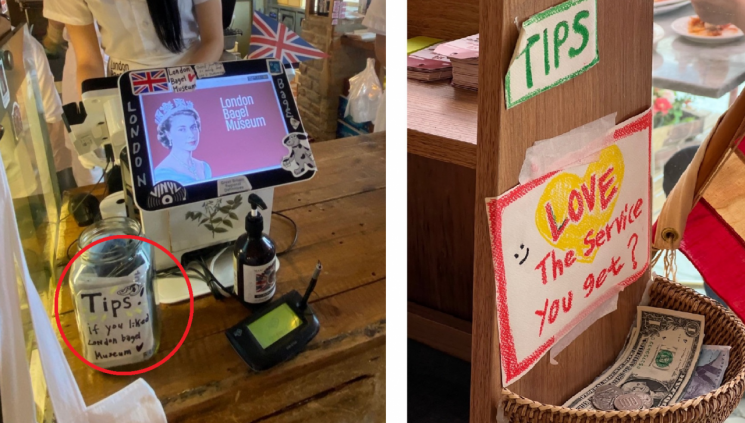
On the 18th, a story titled "A cafe in Yeonnam-dong started asking for tips" was posted on an online community. According to the story, a cafe employee showed the writer, Mr. A, a tablet and said, "How about a tip for the hardworking staff?" Mr. A added that the tablet had 5%, 7%, and 10% buttons and questioned, "Why bring something like this in?"
As the story gained attention, reports of tip boxes seen in domestic cafes and restaurants followed. A famous bagel shop, recently popular for its "early morning open run," also placed a tip box at the checkout counter, causing controversy among netizens. The argument is that if employees work hard, the owner should pay them more wages rather than relying on tips.
One netizen pointed out the problem, saying, "The restaurant I went to had a system where you order from your seat using a tablet, but they asked for tips," criticizing that the staff did not provide service worthy of tips.
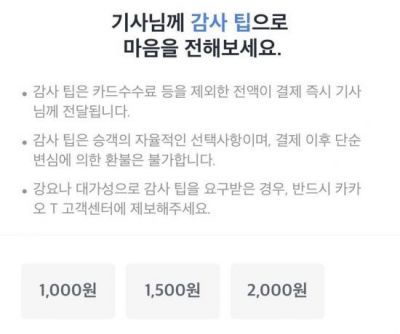
Earlier last month, Kakao Mobility's taxi-hailing service 'KakaoT' introduced a pilot gratitude tip feature, raising the possibility that tipping culture could take root in the taxi industry as well. Currently, KakaoT displays a tip payment window after customers give the highest rating (5 stars), allowing them to choose to pay 1,000, 1,500, or 2,000 won.
However, the response is not positive. According to a survey by consumer data platform Open Survey on the 20th, about 70% opposed the introduction of tipping. The main opinion is that since taxi fares have already increased, receiving tips would be an additional burden on consumers.
The 'Tipping Culture' Starting to Take Root in Korea... Is There a Legal Issue?
So, is this tipping culture legally problematic? Many netizens argue that under the 2013 revised Food Sanitation Act Enforcement Decree and Enforcement Rules, "It is illegal to receive tips at domestic restaurants or cafes and should be reported."
According to the enforcement decree, all food service establishments such as general restaurants and snack bars (excluding consigned catering businesses) cannot separately indicate value-added tax or service charges when displaying prices inside or outside the business premises. These must be included in the food price and shown as the 'final payment price' that customers actually pay.
However, experts interpret that tipping culture is not fundamentally illegal unless the business forcibly demands tips or deceives customers into giving them. If customers voluntarily provide tips, it is difficult to take issue with it.
In the case of KakaoT, the tip payment window clearly states, "Gratitude tips are voluntary choices by passengers, and if you are coerced or asked for tips in exchange for something, please report it," so it is also difficult to consider it illegal. However, if tips are demanded at excessively high amounts, it could be subject to regulation.
© The Asia Business Daily(www.asiae.co.kr). All rights reserved.
![Clutching a Stolen Dior Bag, Saying "I Hate Being Poor but Real"... The Grotesque Con of a "Human Knockoff" [Slate]](https://cwcontent.asiae.co.kr/asiaresize/183/2026021902243444107_1771435474.jpg)
















